Carbon Fiber Straps for Foundation Repair Cost & LEED Guide
Analyze carbon fiber straps for foundation repair cost, embodied carbon trade-offs, and how structural retrofits contribute to LEED certifications.

The Embodied Carbon Paradox in Foundation Retrofitting
Structural foundation failure presents a severe conflict for sustainable building projects. Traditional repair methods—such as excavating exterior soil, demolishing bowed concrete, and pouring new reinforced walls—generate massive amounts of embodied carbon. Portland cement production alone accounts for roughly 8% of global CO2 emissions. When a project is pursuing LEED v4.1 or Envision certification, replacing a structurally compromised but salvageable foundation wall can instantly destroy the project's Life Cycle Assessment (LCA) targets.
Carbon Fiber Reinforced Polymer (CFRP) straps offer a high-tensile, low-volume alternative. By bonding aerospace-grade carbon fiber to the interior of existing masonry or poured concrete walls, engineers can restore structural integrity without excavation or new concrete. However, the petroleum-based epoxy resins and energy-intensive carbon fiber manufacturing process carry their own environmental weight. Understanding this trade-off is essential for sustainability consultants and structural engineers aiming to optimize both the budget and the building's environmental product declarations (EPDs).
Analyzing the Carbon Fiber Straps for Foundation Repair Cost
When evaluating the carbon fiber straps for foundation repair cost, project managers must look beyond the initial material invoice and factor in labor, excavation avoidance, and certification-related soft costs. CFRP systems are generally more expensive per linear foot in raw materials than steel C-channels, but they drastically reduce labor hours and eliminate exterior landscaping destruction.
| Repair Method | Material Cost | Labor & Equipment | Total Estimated Cost | Relative Embodied Carbon |
|---|---|---|---|---|
| CFRP Straps (e.g., Fortress, Rhino) | $3,500 - $5,500 | $1,500 - $2,500 | $5,000 - $8,000 | Low (Saves existing wall) |
| Steel I-Beams / C-Channels | $2,000 - $3,500 | $3,000 - $4,500 | $5,000 - $8,000 | Medium (High steel emissions) |
| Exterior Excavation & Rebuild | $8,000 - $12,000 | $10,000 - $15,000 | $18,000 - $27,000 | Extremely High (New concrete) |
| Helical Tiebacks (Interior/Exterior) | $4,000 - $6,000 | $4,500 - $7,000 | $8,500 - $13,000 | Medium (Steel + soil disruption) |
The true financial advantage of CFRP emerges in the avoided costs. Exterior excavation requires heavy machinery, soil disposal, and subsequent landscaping restoration. Furthermore, steel beams require periodic anti-corrosion maintenance and occupy valuable interior square footage, whereas CFRP straps are less than 1/8-inch thick and can be painted over directly, preserving leasable or usable interior space.
Navigating LEED v4.1 Credits with CFRP Retrofits
Integrating carbon fiber foundation repair into a green building certification strategy requires precise documentation. Under LEED v4.1, the most relevant credit category is Materials and Resources (MR) Credit: Building Life-Cycle Impact Reduction.
Option 1: Historic and Blighted Building Reuse
If the structure is over 50 years old, utilizing CFRP to stabilize the foundation allows the project to retain the existing structural elements. LEED heavily rewards the retention of existing structural walls. By avoiding demolition, the project secures points that would be impossible if the foundation were rebuilt.
Option 4: Whole-Building Life-Cycle Assessment (LCA)
For new construction or major renovations that do not qualify for historic reuse, teams must run a cradle-to-grave LCA. According to data published by Architecture 2030, the structural frame and envelope typically account for the vast majority of a building's embodied carbon. While the carbon fiber and epoxy resin have a high global warming potential (GWP) per kilogram, the total mass used in a foundation repair is incredibly small (often under 50 lbs of composite for an entire basement). When modeled in LCA software like Tally or One Click LCA, the CFRP repair demonstrates a net-negative carbon impact compared to the baseline model of pouring a new reinforced concrete wall.
To satisfy LEED MR credits, do not rely on generic industry averages for carbon fiber. Request the specific Environmental Product Declaration (EPD) from the manufacturer (e.g., Sika, MAPEI, or Fortress Stabilization). Ensure the EPD covers the structural epoxy adhesive as well as the carbon fiber grid, as the epoxy often constitutes the majority of the volatile organic compound (VOC) and embodied carbon profile in the assembled system.
Technical Specifications and Approved Systems
Not all carbon fiber straps are engineered for subterranean hydrostatic pressure. For foundation repair, the system must comply with ACI 440.2R-17 (Guide for the Design and Construction of Externally Bonded FRP Systems for Strengthening Concrete Structures). When specifying materials, look for the following technical baselines:
- Tensile Strength: Minimum 140,000 psi (some aerospace-grade Toray T700 fibers exceed 300,000 psi).
- Modulus of Elasticity: Minimum 10,000,000 psi to resist lateral bowing without yielding.
- Epoxy Adhesive: 100% solids, high-modulus structural epoxy. Must meet ASTM C881 for bonding concrete to concrete, and possess a glass transition temperature (Tg) well above the maximum ambient basement temperature.
- Top and Bottom Anchorage: Carbon fiber is only as strong as its anchor points. Systems must include mechanical anchor bolts at the floor slab and top rim joist to prevent delamination under extreme hydrostatic loads.
Installation Edge Cases and Failure Modes
CFRP systems fail almost exclusively due to improper surface preparation and moisture mismanagement, not material weakness. Sustainability consultants overseeing green retrofits must ensure contractors adhere to strict environmental controls during installation.
Moisture Vapor Transmission (MVT) Limits
Concrete basement walls are inherently damp. Structural epoxies will not cure properly, and will eventually delaminate, if applied over actively weeping concrete. The substrate must be tested for MVT. Most manufacturers require an MVT rate of less than 4 lbs per 1,000 square feet per 24 hours (measured via ASTM F1869 calcium chloride test). If the wall exceeds this, exterior waterproofing membranes or interior French drains must be installed prior to CFRP application.
Surface Profile Requirements
Grinding the wall smooth is a critical error. The concrete must be shotblasted or scarified to achieve a Concrete Surface Profile (CSP) of 3 to 5. This creates the microscopic ridges necessary for the epoxy to mechanically lock into the substrate. A smooth troweled finish will result in catastrophic shear failure when the wall experiences lateral soil pressure.
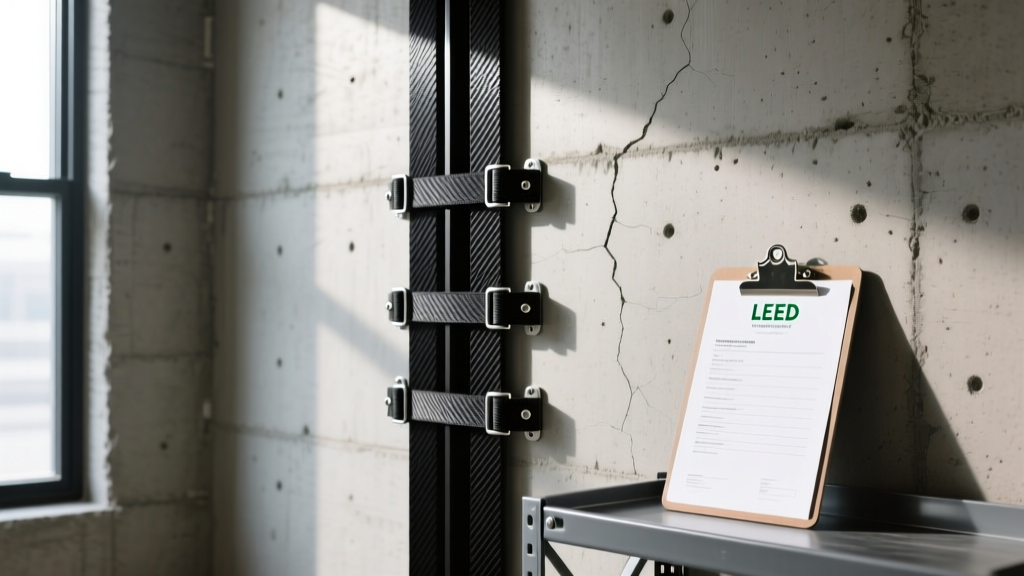
Certification Documentation Checklist
Before closing out the MR credits for your green building submission, compile the following dossier:
- Structural Engineer's Stamp: Calculations proving the CFRP system meets local lateral earth pressure codes, referencing ACI 440.2R.
- Product EPDs: Third-party verified declarations for both the carbon fiber fabric and the structural epoxy.
- VOC Test Results: Ensure the epoxy complies with SCAQMD Rule 1168 or LEED's specific VOC limits for adhesives and sealants to protect indoor environmental quality (EQ credits).
- LCA Comparison Report: A side-by-side Tally or One Click LCA report comparing the CFRP retrofit against a baseline of full wall replacement, highlighting the GWP reduction.
By treating carbon fiber foundation repair not just as a structural necessity, but as a strategic material choice, project teams can preserve the embodied carbon of existing structures, maintain rigorous green building certifications, and deliver a highly durable, space-saving solution for the building's lifecycle.
Written by
Priya KapoorPriya Kapoor is a real estate market analyst and construction economics researcher with expertise in housing affordability, development feasibility, and infrastructure investment. She holds a Master of Regional Planning from Cornell University and previously worked as a senior analyst at CBRE's Investment Properties group, where she modeled returns for $4B in mixed-use development pipelines. Priya now runs an independent research practice advising developers, municipalities, and REITs on construction cost forecasting and market timing. She publishes the quarterly "BuildMat Market Pulse" report tracking material price indices across 12 commodity categories. Based in Austin, TX, Priya serves on the board of Habitat for Humanity Austin and is a marathon runner.
More from Priya Kapoor
View all
Construction Cost
Cost to Build a 1600 Sq Ft Home in 2026: Full Breakdown
Accurate 2026 cost to build a 1600 sq ft home—material, labor, and regional pricing breakdowns included. Plan your budget with real-time estimates.
Aug 11, 2026

Wood & Lumber
Name the Types of Wood for Pressure Treatment and Preservation
Learn how to name the types of wood best suited for pressure treatment. Compare species treatability, chemical retention levels, and 2026 preservation costs.
Aug 4, 2026

Stone & Masonry
Stone Veneer Suppliers Lindenhurst: 2026 Cost Analysis
Analyze 2026 stone veneer costs in Lindenhurst, NY. Compare local supplier pricing, delivery fees, and Suffolk County installation labor rates.
Aug 4, 2026