Sourcing Second Hand Building Materials in Boise: 3 Case Studies
Explore three real-world case studies on sourcing second hand building materials in Boise, detailing cost savings, code compliance, and local salvage.

The Urban Mining Boom in the Treasure Valley
Boise's explosive population growth over the last decade has triggered a massive construction boom, but it has also generated thousands of tons of preventable waste. As the Treasure Valley shifts toward circular economy principles in 2026, sourcing second hand building materials in Boise has evolved from a niche DIY hobby into a strategic procurement method for general contractors, custom home builders, and commercial developers. According to the EPA's Sustainable Management of Construction and Demolition Materials guidelines, over 600 million tons of C&D debris are generated annually in the United States. By diverting these materials through urban mining, local builders are drastically cutting embodied carbon, preserving historical aesthetics, and bypassing modern supply chain volatility.
However, integrating salvaged materials requires navigating strict building codes, fluctuating local availability, and specialized labor costs. To understand the practical realities of this approach, we analyzed three recent construction projects in the Boise metropolitan area that successfully integrated reclaimed and surplus materials. These case studies reveal the exact financial models, sourcing strategies, and code-compliance workarounds used by local professionals.
Case Study 1: North End 1920s Craftsman Retrofit
The Challenge: Preserving Heritage While Upgrading Performance
In Boise's historic North End, a 1924 Craftsman bungalow required a complete structural and aesthetic overhaul. The original plan called for standard demolition and disposal, which would have sent approximately 45 tons of old-growth timber, vintage brick, and cast-iron fixtures to the Ada County landfill. Instead, the project team opted for selective deconstruction, partnering with local salvage experts to harvest the structure's core materials.
Scope: Full structural deconstruction and interior salvage.
Key Salvaged Materials: Old-growth Douglas Fir joists, tongue-and-groove subflooring, built-in cabinetry, and clawfoot tubs.
Net Financial Impact: Deconstruction cost $14,500 (compared to an $8,200 demolition bid). However, salvaged materials were brokered and sold for $22,000, resulting in a net profit of $7,500 before the rebuild phase even began.
The Sourcing and Reintegration Strategy
The harvested Douglas Fir was sent to a local mill in Caldwell to be re-sawn and kiln-dried, eliminating decades of embedded moisture and potential insect infestations. The milled lumber was then reused as exposed ceiling beams and custom stair treads in the new addition. For the materials the homeowners did not keep, they were donated to the Habitat for Humanity ReStore on State Street, generating a substantial tax write-off that further offset the deconstruction premium. The Building Materials Reuse Association (BMRA) notes that deconstruction can yield up to 25% more salvaged material value than traditional demolition when managed by certified crews.
Case Study 2: Boise Bench Accessory Dwelling Unit (ADU)
Optimizing the Envelope with Surplus Stock
With Boise's updated ADU ordinances encouraging densification, a developer on the Boise Bench sought to build a 750-square-foot detached ADU with a strict focus on minimizing upfront material costs without sacrificing energy performance. The strategy relied heavily on acquiring 'surplus' second hand building materials—new, unused products left over from larger commercial jobs—rather than heavily weathered reclaimed goods.
Cost Matrix: Virgin vs. Second-Hand Envelope Materials
| Material Category | Virgin Cost (2026) | Second-Hand Cost | Sourcing Channel |
|---|---|---|---|
| R-38 Fiberglass Batts | $1.15 / sq ft | $0.25 / sq ft | ReStore (Meridian) |
| Solid Core Wood Doors | $350.00 / unit | $85.00 / unit | Local Liquidators |
| Vintage Brick (Cleaned) | $1.40 / unit | $0.65 / unit | Salvage Yards |
| James Hardie Siding Scraps | $3.20 / sq ft | $0.90 / sq ft | Job Site Recovery |
By sourcing surplus insulation and scrap fiber-cement siding from a nearby multi-family development that over-ordered, the builder reduced the ADU's envelope material costs by 62%. The primary challenge was inventory management; surplus materials are often sold in fragmented batches, requiring the framer to adapt the stud layout to accommodate varying batt widths and the siding crew to blend multiple dye-lots of fiber cement.
Case Study 3: Warehouse District Commercial Upcycle
Heavy Timber and Masonry Recovery
In Boise's Warehouse District, a boutique retail space was carved out of an abandoned 1950s masonry warehouse. The design intent was industrial-chic, demanding heavy visual textures that new materials simply could not replicate. The general contractor utilized a 'design-for-disassembly' mindset in reverse, sourcing massive structural elements from regional agricultural teardowns.
- Cor-Ten Steel Beams: Sourced from a decommissioned grain elevator in Nampa. The beams were sandblasted to remove lead-based paint residues and sealed with a low-VOC clear matte polyurethane to meet indoor air quality standards.
- Boise Sandstone Blocks: Recovered from a demolished retaining wall near the Boise River Greenbelt. These were repurposed as the primary retail counter and point-of-sale podium.
- Heavy Timber Trusses: Acquired via the Habitat for Humanity ReStore network from a barn deconstruction in Eagle. The trusses were bolted to the existing masonry walls using concealed steel flitch plates to satisfy the structural engineer's lateral load requirements.
Navigating Boise Building Codes with Reused Materials
The most significant barrier to using second hand building materials in Boise is navigating the 2021 International Residential Code (IRC), which Ada County strictly enforces. Reused materials cannot simply be pulled from a demolition site and dropped into a new load-bearing assembly without verification.
Lumber Grading and Structural Reuse
Under IRC Section R301, reused structural wood must be graded by an approved agency to verify its load-bearing capacity. Hiring a certified lumber grader to inspect and stamp individual reclaimed joists can cost upwards of $800 per site visit, eroding the financial benefits of the salvaged wood. The most common workaround utilized by Boise contractors is 'downcycling' structural timbers into non-load-bearing applications. By using reclaimed heavy timber strictly for interior accent walls, mantels, or decorative ceiling cladding, builders bypass the grading requirement entirely while retaining the aesthetic value.
Glazing and Egress Requirements
Vintage single-pane windows are highly sought after for their wavy glass and old-growth wood frames, but they fail modern energy codes and egress requirements. IRC Section R310 mandates specific minimum opening dimensions for emergency escape and rescue openings in bedrooms. Builders in the Boise Bench ADU case study bypassed this restriction by using salvaged windows exclusively for interior transoms, non-egress decorative partitions, and clerestory lighting, while purchasing new, NFRC-certified dual-pane units for the exterior envelope. This hybrid approach preserves the historic character without triggering code violations or failing the local blower-door energy tests.
The Boise Second-Hand Sourcing Directory
For contractors and homeowners looking to integrate reclaimed materials into their next project, establishing a reliable supply chain is critical. The following local channels consistently yield high-quality inventory:
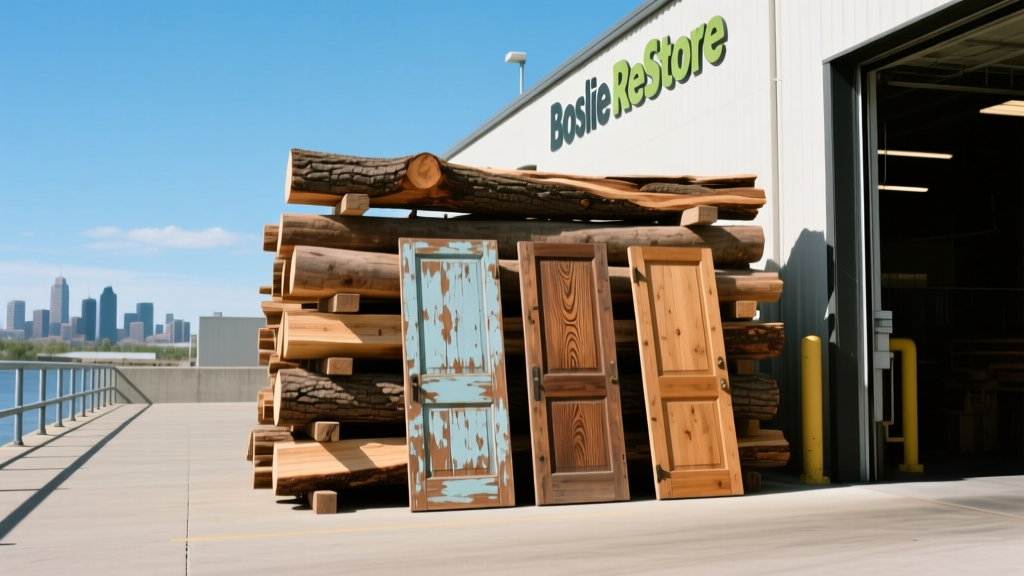
- Habitat for Humanity ReStore (State St & Meridian): The premier destination for surplus insulation, doors, cabinetry, and plumbing fixtures. Inventory turns over daily, requiring frequent visits and relationships with the loading dock managers.
- Local Deconstruction Crews: Companies specializing in soft-strips and full decon often sell old-growth framing lumber and vintage brick directly from the job site before it reaches a retail salvage yard, allowing buyers to purchase in bulk at wholesale rates.
- Online Marketplaces (Treasure Valley): Facebook Marketplace and Craigslist remain highly active for residential cleanouts. Setting up automated alerts for keywords like 'salvage', 'teardown', 'barn wood', and 'surplus' is essential for catching fleeting inventory.
- Architectural Salvage Brokers: For high-end historical elements like stained glass, cast-iron radiators, and period-specific hardware, specialized regional brokers maintain climate-controlled warehouses that protect delicate antiques from Idaho's harsh winter freezes.
Integrating second hand building materials in Boise requires a paradigm shift from just-in-time ordering to opportunistic procurement. By designing with flexibility, understanding local code workarounds, and building relationships with regional salvage networks, Treasure Valley builders can achieve superior aesthetic results, drastically reduce project waste, and protect their bottom lines against the unpredictability of modern lumber markets.
Written by
James ThorntonJames Thornton is a construction industry veteran with 25 years of hands-on experience in wood framing, lumber grading, and residential building codes. He started as a framing carpenter in rural Oregon, earned his ICC Residential Building Inspector certification, and eventually became a senior plan reviewer for the City of Portland Bureau of Development Services. James holds a B.S. in Wood Science & Technology from Oregon State University and is a certified lumber grader through the West Coast Lumber Inspection Bureau (WCLIB). He has inspected over 3,000 residential construction sites and authored the city's internal guide on advanced framing techniques (2x6 at 24" O.C.). James lives in Bend, OR, where he builds custom timber-frame cabins and competes in lumberjack sports.
More from James Thornton
View all
Insulation
Best Home Insulation Materials: Complete 2026 Guide
Compare top home insulation materials for 2026. Find R-values, installed costs per square foot, and best uses for fiberglass, spray foam, and mineral wool.
Aug 4, 2026

Sustainable Building
Certify Your Green Building Material for LEED and WELL
Step-by-step guide to certifying a green building material for LEED v5 and WELL v2. Master EPDs, HPDs, and VOC limits for 2026 project specifications.
Aug 4, 2026

Stone & Masonry
Veneer Stacked Stone Panels: Interior Design & Style Showcase
Discover how veneer stacked stone panels transform interiors. Explore modern design profiles, material pairings, and technical installation specs.
Aug 4, 2026