Best Siding Material for House Maintenance and Repair Costs
Find the best siding material for house maintenance. Compare fiber cement, vinyl, and wood lifecycle repair costs, failure modes, and expert fix guides.

The True Cost of Ownership: Rethinking the 'Best' Siding
When homeowners search for the best siding material for house exteriors, they typically prioritize upfront installation costs, curb appeal, or R-value insulation metrics. However, from a lifecycle perspective, the true cost of exterior cladding is dictated by its maintenance requirements, vulnerability to environmental degradation, and the complexity of localized repairs. A material that costs 20% more upfront but requires zero mid-cycle painting and allows for simple panel swaps will inevitably yield a lower total cost of ownership over a 30-year mortgage.
This guide evaluates the top residential cladding options strictly through the lens of long-term upkeep, structural failure modes, and actionable repair protocols. By understanding how each material behaves under thermal expansion, UV exposure, and impact stress, you can select a siding system that aligns with your maintenance tolerance.
- Zero-Maintenance Seekers: Insulated Vinyl Siding (CertainTeed CedarBoards) or Steel Siding.
- High-Durability / Periodic Upkeep: Fiber Cement (James Hardie ColorPlus).
- Aesthetic Purists / Active Maintainers: Engineered Wood (LP SmartSide) or Natural Cedar.
Material Breakdown: Repairability and Upkeep Protocols
Fiber Cement: The Heavyweight Champion of Durability
Fiber cement, governed by the ASTM C1186 standard, is a composite of Portland cement, cellulose fiber, and silica sand. Brands like James Hardie and Allura dominate this space. It is impervious to rot, termites, and fire, making it a top contender for the best siding material for house applications in wildfire-prone or humid zones.
Maintenance Reality: While the substrate itself is nearly indestructible, the finish is not. Pre-finished boards (e.g., James Hardie ColorPlus Technology) utilize a baked-on acrylic coating that typically lasts 15 years before chalking or fading requires a repaint. The critical maintenance vulnerability lies at the joints. Fiber cement does not expand and contract significantly, but the caulking at butt joints, corner boards, and window penetrations will degrade. Homeowners must inspect and replace 100% polyurethane sealant at these junctions every 5 to 7 years to prevent moisture intrusion behind the weather-resistant barrier (WRB).
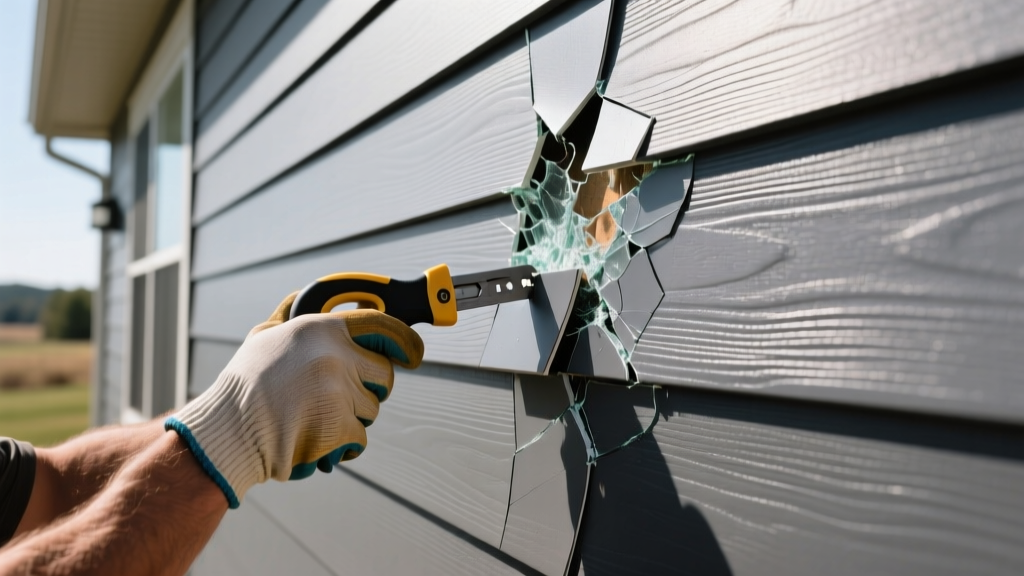
Repair Protocol: If a mid-wall board is shattered by a rogue baseball or heavy hail, repair is moderately invasive. Because standard installation relies on blind-nailing (where the overlapping board hides the nails), replacing a damaged center course requires face-nailing the bottom edge of the new board. You must then countersink the nails, fill them with color-matched exterior sealant, and spot-paint. UV fading on the surrounding 10-year-old boards often makes seamless color-matching impossible, forcing a full wall repaint.
Vinyl Siding: Cheap to Replace, Prone to Thermal and Impact Issues
Vinyl siding (ASTM D3679) remains the most installed cladding in North America due to its low initial cost and lack of required painting. However, its physical properties dictate a very specific maintenance profile. Vinyl exhibits massive thermal expansion and contraction—up to 5/8 of an inch per 12-foot panel across a 100-degree temperature swing.
Maintenance Reality: Vinyl requires almost no proactive maintenance beyond an annual power washing (using a low-pressure 40-degree nozzle to avoid forcing water behind the weep holes). However, it becomes highly brittle at temperatures below 40°F. A stray rock from a lawnmower in November can shatter a panel that would merely dent in July. Furthermore, dark-colored vinyl panels on south-facing walls are susceptible to thermal warping if they absorb excessive heat, a phenomenon exacerbated by reflective glass from nearby energy-efficient windows.
Repair Protocol: Vinyl is the undisputed king of easy localized repairs. Using a $5 siding zip tool (unlock tool), a homeowner can hook the bottom lip of the damaged course, unhook it from the panel below, pull the electro-galvanized roofing nails, and snap in a replacement piece in under three minutes. The catch? If the existing siding is more than 7 years old, UV degradation will have altered its color. A brand-new replacement panel on a faded south-facing wall will stick out conspicuously.
Engineered Wood: The Middle-Ground Contender
Engineered wood, such as LP SmartSide, utilizes oriented strand board (OSB) treated with zinc borate (SmartGuard process) to resist fungal decay and termite infestation. It offers the deep, authentic shadow lines of real cedar without the immediate susceptibility to rot.
Maintenance Reality: Engineered wood requires strict adherence to clearance and sealing rules. The bottom edge of the siding must be kept at least 6 inches above soil grade and 1 inch above concrete decks to prevent capillary moisture wicking. Any field cuts made during installation or repair must be sealed immediately with a high-quality primer or polyurethane sealant. If left exposed, the OSB core will absorb ambient moisture, leading to edge swelling and the characteristic 'flaking' delamination seen on poorly maintained installations.
Repair Protocol: Minor gouges can be sanded and filled with exterior-grade wood filler, then primed and painted. However, if moisture has breached the substrate and caused edge swelling, the board must be replaced. Replacement involves cutting out the damaged section, applying zinc-borate end-cut treatment to the exposed core of the adjacent boards, and flashing the joint.
15-Year Maintenance & Repair Cost Projection
The following table models the anticipated out-of-pocket maintenance and repair costs for a standard 2,500 sq. ft. two-story home over a 15-year period, assuming average environmental wear and two minor impact repairs per decade.
| Material Type | Proactive Upkeep (15 Yrs) | Average Repair Cost | 15-Yr Total Est. Cost |
|---|---|---|---|
| Insulated Vinyl | $0 (No painting/caulking) | $15 - $40 per panel (DIY) | $150 - $400 |
| Fiber Cement | $1,200 (Joint caulking at Yr 7 & 14) | $250 - $450 per board (Pro) | $2,200 - $3,500 |
| Engineered Wood | $3,500 (Full repaint at Yr 10) | $150 - $300 per board (Pro) | $4,500 - $6,000 |
Troubleshooting Decision Tree: Diagnosing Siding Failures
When siding fails, the visible symptom is rarely the root cause. Use this diagnostic framework to identify the underlying issue before attempting a repair. According to the Environmental Protection Agency, unresolved moisture intrusion behind cladding can lead to severe structural rot and indoor mold proliferation within 48 hours of saturation.
- Symptom: Wavy, buckling, or rippling vinyl panels.
- Cause A: Nails were driven flush or tight against the nail hem, preventing thermal expansion.
- Fix A: Unzip the affected courses, remove the nails, and re-install using aluminum roofing nails driven center-of-slot, leaving a 1/32-inch gap between the nail head and the vinyl.
- Cause B: Reflective solar heat from adjacent double-pane windows is melting/warping the PVC.
- Fix B: Install exterior window screens or replace the siding in that specific zone with high-heat resistant polypropylene or fiber cement.
- Symptom: Fiber cement boards cracking at the nail line or splitting horizontally.
- Cause: Improper fastening. The installer either over-drove the nails (crushing the board) or used smooth-shank nails that backed out due to wind uplift, causing the board to flex and snap. FEMA Building Science guidelines mandate specific wind-load fastening patterns for cladding in high-velocity hurricane zones.
- Fix: Replace the board using 1.5-inch stainless steel ring-shank siding nails. Ensure the nail head sits flush, not countersunk into the brittle cement matrix.
- Symptom: Engineered wood edges swelling, delaminating, or 'mushrooming' near the ground.
- Cause: Capillary action from soil contact or splash-back from roofs lacking gutters. The zinc-borate treatment protects against biological decay, but it cannot stop physical water absorption into the OSB core.
- Fix: Cut out the bottom 12 inches of the affected boards. Install Z-flashing and a PVC or fiber-cement water-resistive trim board to maintain a permanent 6-inch clearance from the soil grade.
Environmental Factors: How Climate Dictates Maintenance
The 'best' material is heavily dependent on your localized micro-climate. What works flawlessly in the arid Southwest will fail prematurely in the coastal Northeast.
Coastal and Salt-Spray Zones: Salt accelerates the corrosion of metal fasteners and degrades the plasticizers in cheap vinyl. In these regions, fiber cement with stainless steel fasteners is the optimal choice. Avoid steel siding unless it features a premium Kynar 500 fluoropolymer coating to prevent oxidation.
High-UV and Desert Climates: Intense UV radiation destroys the lignin in natural wood and fades the pigments in engineered wood and standard vinyl. Pre-finished fiber cement with UV-resistant acrylic coatings (like ColorPlus) or light-colored vinyl with titanium dioxide UV inhibitors are required to prevent chalking and thermal warping.
Freeze-Thaw Cycles: In northern climates, water that penetrates unsealed siding joints will freeze, expand by 9%, and cause spalling (chipping) in masonry-based products. Fiber cement is highly resistant to this, provided the joint caulking is maintained. The U.S. Department of Energy emphasizes that proper weather-resistant barriers and flashing are just as critical as the siding material itself in preventing freeze-thaw damage to the underlying sheathing.
Expert Verdict: Matching Material to Your Lifestyle
If your definition of the best siding material for house exteriors hinges on never climbing a ladder with a caulking gun or paintbrush, insulated vinyl siding is your only logical choice. Accept that it may look slightly less authentic and that a severe hailstorm might require a zip-tool repair session.
If you prioritize architectural authenticity, impact resistance, and are willing to hire a professional to re-caulk joints every seven years and repaint every fifteen, fiber cement offers the highest long-term return on investment and structural resilience. It bridges the gap between the indestructibility of masonry and the workability of wood, securing its place as the premium standard for modern residential cladding.
Written by
James ThorntonJames Thornton is a construction industry veteran with 25 years of hands-on experience in wood framing, lumber grading, and residential building codes. He started as a framing carpenter in rural Oregon, earned his ICC Residential Building Inspector certification, and eventually became a senior plan reviewer for the City of Portland Bureau of Development Services. James holds a B.S. in Wood Science & Technology from Oregon State University and is a certified lumber grader through the West Coast Lumber Inspection Bureau (WCLIB). He has inspected over 3,000 residential construction sites and authored the city's internal guide on advanced framing techniques (2x6 at 24" O.C.). James lives in Bend, OR, where he builds custom timber-frame cabins and competes in lumberjack sports.
More from James Thornton
View all
Insulation
Best Home Insulation Materials: Complete 2026 Guide
Compare top home insulation materials for 2026. Find R-values, installed costs per square foot, and best uses for fiberglass, spray foam, and mineral wool.
Aug 4, 2026

Sustainable Building
Certify Your Green Building Material for LEED and WELL
Step-by-step guide to certifying a green building material for LEED v5 and WELL v2. Master EPDs, HPDs, and VOC limits for 2026 project specifications.
Aug 4, 2026

Stone & Masonry
Veneer Stacked Stone Panels: Interior Design & Style Showcase
Discover how veneer stacked stone panels transform interiors. Explore modern design profiles, material pairings, and technical installation specs.
Aug 4, 2026