Smart Siding Performance Ratings and Technical Specs
Explore comprehensive smart siding performance ratings, dimensional specs, wind load limits, and installation tolerances for engineered wood cladding.
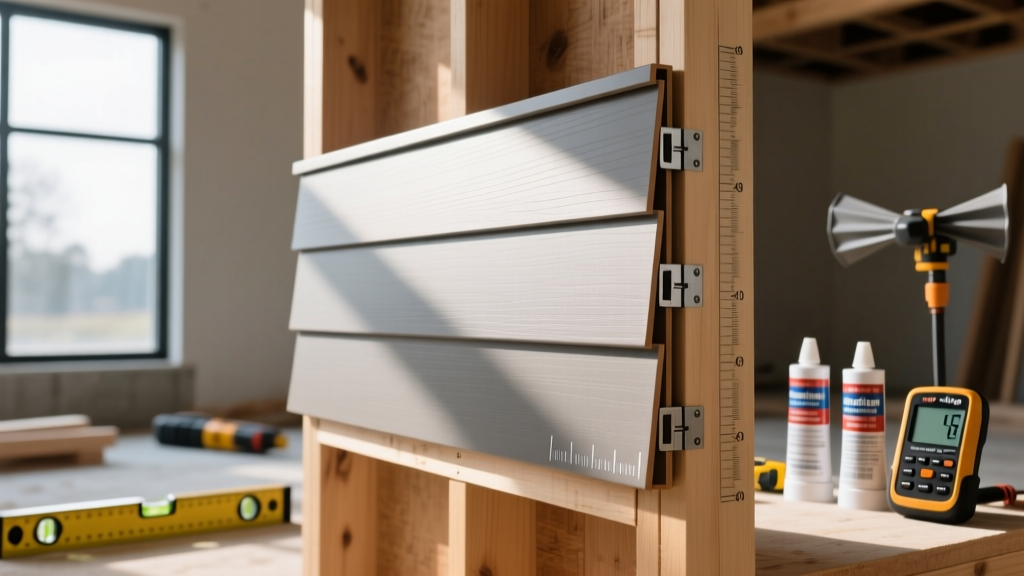
The Engineering Anatomy of Smart Siding
Smart siding, predominantly recognized in the industry by the LP SmartSide brand, is an engineered wood product designed to bridge the gap between the aesthetic warmth of natural wood and the durability of synthetic cladding. Unlike traditional hardboard or plywood sidings that suffered from delamination and moisture rot in the 1990s, modern smart siding utilizes a highly controlled manufacturing process. The core consists of oriented strand board (OSB) made from fast-growing, sustainably harvested wood strands. These strands are coated with water-resistant waxes and advanced phenolic or MDI (methylene diphenyl diisocyanate) resins, then subjected to intense heat and pressure to form a dense, structurally unified panel.
The defining performance characteristic of this material is its proprietary treatment process. The wood strands are infused with zinc borate, an EPA-registered fungicide and termiticide. According to data published by APA - The Engineered Wood Association, zinc borate provides long-term resistance against fungal decay and subterranean termites without leaching out over time. The exterior surface is then overlaid with a resin-saturated paper and embossed with a cedar woodgrain texture, followed by a factory-applied acrylic latex primer that blocks moisture intrusion and provides a uniform base for topcoats.
Core Performance Ratings and Code Compliance
When specifying cladding for regions prone to severe weather, architects and builders rely on standardized testing metrics. Smart siding consistently outperforms traditional wood and rivals fiber cement in several structural categories. Below are the baseline performance ratings for standard 7/16-inch thick engineered wood lap and panel siding under current 2026 building code frameworks.
| Performance Metric | Rating / Specification | Testing Standard / Certification |
|---|---|---|
| Wind Load Resistance | 130 mph (Standard); up to 150 mph (HVHZ) | ICC-ES ESR-1301 / ASTM D3167 |
| Hail & Impact Resistance | Withstands 2-inch hail at 70 mph | UL 2218 Class 4 / Internal Mfg. Testing |
| Fungal & Termite Resistance | Zinc Borate (0.3 lbs/ft³ retention) | ASTM D3273 / AWPA U1 |
| Surface Burning Characteristics | Class C (Flame Spread Index < 75) | ASTM E84 / UL 723 |
| Structural Shear Wall Rating | Approved for use as structural shear panel | ICC-ES ESR-1301 |
Note: Achieving the 150 mph High-Velocity Hurricane Zone (HVHZ) wind rating requires a specific fastening schedule, typically 12 inches on center (o.c.) at all studs and edges, combined with structural sheathing underneath. Always consult the manufacturer's latest ICC-ES evaluation report for exact fastener matrices.
Dimensional Specifications and Product Tolerances
Precision in manufacturing allows smart siding to offer longer lengths and more consistent profiles than natural wood, reducing waste and lap joints on wide elevations. LP Building Solutions manufactures these products in strict dimensional categories tailored to different architectural styles.
Lap Siding Profiles
- Lengths: 16 feet (standard), allowing for fewer seams on long wall planes compared to 12-foot fiber cement boards.
- Exposures: 4-inch, 6-inch, and 8-inch nominal exposures.
- Thickness: 7/16-inch (nominal) for standard lap; 1/2-inch available for premium deep-profile lines.
- Weight: Approximately 1.6 lbs per linear foot (for 6-inch exposure), significantly lighter than competing cementitious products.
Panel Siding and Trim
- Panel Dimensions: 4x8 ft, 4x9 ft, and 4x10 ft sheets.
- Groove Spacing: 4-inch or 8-inch on-center vertical grooves (Reverse Board and Batten styles).
- Trim Boards: Available in 4/4 (1-inch nominal) and 5/4 (1.25-inch nominal) thicknesses, widths up to 12 inches, used for fascia, corner boxes, and window surrounds.
Critical Installation Specs: The 1/8-Inch Rule and Fastening
The most common cause of smart siding failure is not material degradation, but improper installation that restricts natural thermal and hygroscopic expansion. Engineered wood expands and contracts primarily across its width and thickness, but linear expansion still occurs. Ignoring manufacturer-mandated expansion gaps will result in buckling, ridge-warping, and voided warranties.
You must leave a strict 1/8-inch gap at all end joints, corner joints, and where siding meets trim or openings. For panel siding, a 3/16-inch gap is required at all horizontal and vertical joints. Do not caulk these structural gaps; instead, use Z-flashing at horizontal panel joints and color-matched joint covers or flexible elastomeric sealants only where explicitly permitted by the manufacturer's technical bulletins.
Fastener Specifications
Corrosion resistance is non-negotiable. The zinc borate and resins in the siding will accelerate the corrosion of standard electroplated nails.
- Nail Type: Hot-dipped galvanized (HDG) or stainless steel only.
- Shank Diameter: Minimum 0.113 inches (8d common nail equivalent).
- Head Diameter: Minimum 0.262 inches to prevent pull-through.
- Penetration: Nails must penetrate a minimum of 1.5 inches into solid wood studs or structural framing.
- Placement: Face nailing requires nails to be placed 3/8-inch from the bottom edge and at least 3/8-inch from the side edges to prevent blowouts.
Material Comparison Matrix: Smart Siding vs. Fiber Cement
When evaluating cladding options, builders frequently cross-shop smart siding against fiber cement (e.g., James Hardie). While both are premium products, their physical specifications dictate different handling, structural, and installation requirements.
| Specification Category | Engineered Wood (Smart Siding) | Fiber Cement Siding |
|---|---|---|
| Material Weight (per 100 sq ft) | ~160 - 190 lbs | ~300 - 330 lbs |
| Standard Board Length | 16 feet | 12 feet (16 ft available but rare/heavy) |
| Cutting & Silica Hazard | Standard wood blades; no silica dust | Requires polycrystalline diamond blades; OSHA silica mandates apply |
| Cold Weather Impact | High flexibility; dents but rarely shatters | Becomes brittle; prone to snapping/shattering upon impact |
| Ground Clearance Requirement | 6 inches minimum above grade | 8 inches minimum above grade |
| Structural Shear Value | Can act as structural shear bracing | Non-structural; requires separate sheathing |
Frequently Asked Technical Questions
Can smart siding be installed directly over rigid foam insulation?
No. Engineered wood siding does not possess the inherent rigidity of fiber cement or natural wood bevel siding. It requires a solid, continuous nailing base. If you are using continuous exterior rigid foam insulation, you must install vertical wood furring strips (strapping) aligned with the studs, spaced a maximum of 16 inches on center, and fasten the siding directly into the furring strips and underlying studs. Failure to do so will result in a wavy elevation and compromised wind-load resistance.
What is the required moisture clearance above roofs and decks?
While the ground clearance requirement is 6 inches, the clearance above adjacent roofs, decks, or steps is strictly 1 inch. This 1-inch gap prevents capillary action and splash-back from wicking moisture into the end-grain of the boards. All end cuts made on-site must be immediately sealed with a high-quality, non-water-based exterior sealant or the manufacturer's approved edge sealer to maintain the moisture envelope.
Does the factory primer count as the first coat of paint?
The factory-applied acrylic latex primer on smart siding is designed for adhesion and moisture blocking, not for UV degradation resistance or final color retention. It is not a topcoat. You must apply a minimum of one coat of high-quality 100% acrylic latex exterior paint within 180 days of installation. For optimal longevity in high-UV environments, two topcoats are highly recommended to achieve the full 5-year or 15-year paint adhesion warranty, depending on the specific product line purchased.