Cost to Paint an Exterior Commercial Building: 2026 Pricing Guide
Discover the true cost to paint an exterior commercial building. Learn 2026 pricing per square foot, surface prep requirements, and coating systems.

Calculating the cost to paint an exterior commercial building requires moving beyond residential square-footage estimates. Commercial facades involve complex substrates like EIFS (Exterior Insulation and Finish Systems), CMU (Concrete Masonry Units), and corrugated metal panels, each demanding specialized coating chemistries and rigorous surface preparation. In 2026, facility managers and property owners must account for heightened OSHA access regulations, advanced elastomeric material costs, and strict environmental compliance when budgeting for exterior maintenance.
The Baseline: Average Cost to Paint an Exterior Commercial Building
Commercial painting bids are typically calculated by the square foot of wall area (not footprint). The total cost hinges on the substrate's porosity, the building's height, and the required coating system. Below is the current pricing matrix for standard commercial exterior repainting.
| Substrate Type | Required Coating System | Prep Intensity | Cost per Sq. Ft. (Wall Area) |
|---|---|---|---|
| Corrugated Metal Siding | DTM (Direct-to-Metal) Acrylic | Low (Power wash & spot prime) | $1.65 - $2.80 |
| Stucco / Traditional Plaster | 100% Acrylic or Elastomeric | Medium (Crack fill & prime) | $2.10 - $3.90 |
| EIFS (Synthetic Stucco) | Elastomeric (High-build) | High (Mesh repair & seal) | $3.25 - $5.50 |
| CMU (Concrete Block) | Block Filler + Acrylic Topcoat | High (Efflorescence removal) | $2.40 - $4.15 |
| Tilt-Up Concrete Panels | Masonry Primer + Acrylic | Medium (Acid etch/wash) | $1.90 - $3.20 |
Surface Preparation: Where 50% of Your Budget Actually Goes
The most common point of failure in commercial exterior painting is inadequate surface preparation. A premium polyurethane or elastomeric coating will peel within 18 months if applied over chalky, oxidized, or moisture-trapped substrates. Professional commercial contractors allocate 40% to 60% of the total project budget to preparation.
Pressure Washing and Chemical Cleaning
Standard residential pressure washing is insufficient for commercial facades. Contractors must use commercial-grade rigs delivering a minimum of 3,000 PSI at 4 to 8 GPM (Gallons Per Minute) to effectively remove atmospheric pollutants, biological growth, and oxidized coating chalk. For heavily chalked metal panels or stucco, a Trisodium Phosphate (TSP) or specialized commercial detergent wash is mandatory to ensure proper coating adhesion.
Joint Sealant and Crack Remediation
Before any paint is applied, all dynamic joints (where dissimilar materials meet, such as metal window frames against EIFS) must be re-caulked. Cheap silicone or acrylic latex caulks will fail under commercial thermal expansion. Specifications should mandate a high-performance polyurethane sealant, such as BASF MasterSeal NP 1 or Tremco TREMproof 200, which offers 25% to 50% joint movement capability.
If your building utilizes an EIFS cladding system, painting over trapped moisture will cause catastrophic delamination. Contractors must perform non-destructive moisture meter testing (using a Tramex or Delmhorst meter) before sealing the facade with an elastomeric coating. Any wet insulation board must be cut out and replaced prior to painting.
Commercial Coating Systems: Material Breakdown
Commercial buildings require industrial-grade coatings formulated for high UV resistance, bridging hairline cracks, and resisting wind-driven rain. The choice of coating drastically alters both the initial cost and the lifecycle maintenance schedule.
- Elastomeric Coatings (e.g., Sherwin-Williams SherLastic, Tnemec Series 151): Applied at a high Dry Film Thickness (DFT) of 10 to 15 mils (compared to 3 mils for standard paint). Elastomerics stretch to bridge hairline stucco and CMU cracks up to 1/16th of an inch. Best for: Stucco, EIFS, and CMU.
- DTM (Direct-to-Metal) Acrylics: Formulated with rust-inhibitive pigments that can be applied directly to lightly oxidized galvanized or corrugated steel without a separate primer. They resist flash-rusting and retain color retention under heavy UV exposure. Best for: Metal siding, warehouses, and agricultural facilities.
- Aliphatic Polyurethanes: The highest tier of commercial topcoats. They offer exceptional gloss retention, chemical resistance, and chalk resistance. Often used as a topcoat over an epoxy primer on structural steel or high-end metal panel systems. Best for: High-visibility corporate facades and coastal environments.
Access, Equipment, and Safety Surcharges
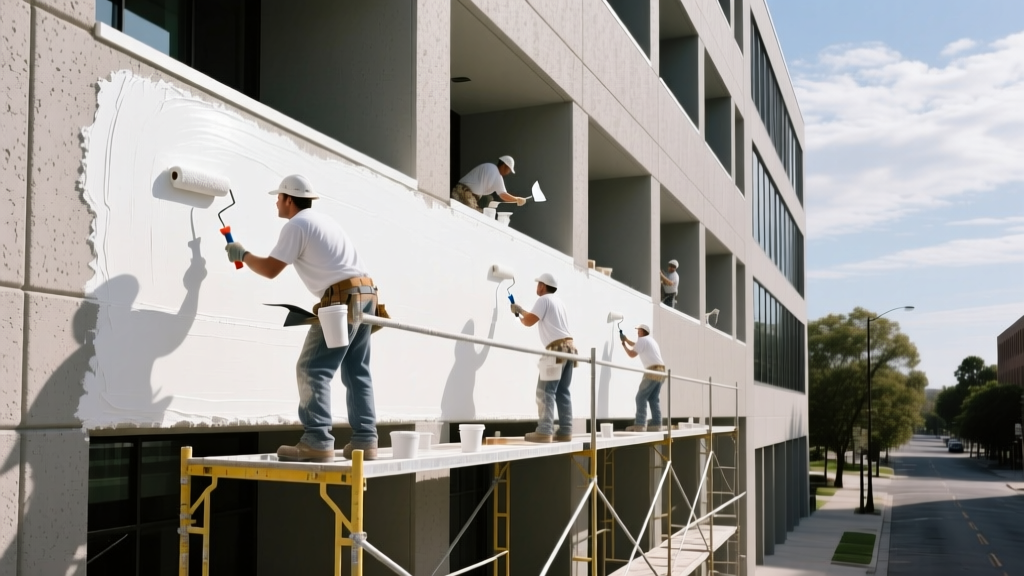
Unlike residential homes that can be painted with extension poles and basic ladders, commercial buildings trigger strict OSHA scaffolding and fall protection regulations. The method of access will add significant line items to your bid.
| Access Method | Typical Application | Estimated Weekly Cost |
|---|---|---|
| Articulating Boom Lift (e.g., Genie Z-45) | Warehouses, 2-3 story retail, uneven terrain | $900 - $1,400 / week |
| Telescopic Boom Lift (e.g., JLG 860SJ) | Mid-rise offices, 4-8 story facades | $2,200 - $3,500 / week |
| Suspended Swing Stage | High-rise, dense urban environments | $4,000+ setup + $500/day |
| Tube & Clamp Scaffolding | Complex architectural details, historic masonry | $15 - $25 per sq. ft. of scaffold face |
The Pre-1978 Factor: EPA RRP Compliance
If your commercial building was constructed before 1978, the EPA Lead Renovation, Repair and Painting (RRP) Rule applies. While commercial buildings are often exempt from the strict residential lead-safe work practices, the rule still applies if the building houses child-occupied facilities (like a ground-floor daycare or pediatric clinic). Furthermore, if pressure washing or scraping generates lead-contaminated debris, the contractor must comply with local environmental runoff regulations, requiring expensive water reclamation systems and hazardous waste disposal protocols. Expect a 15% to 25% premium on prep costs for pre-1978 structures requiring lead abatement containment.
Decision Framework: Paint, Coat, or Re-Clad?
Painting is a maintenance strategy, not a structural fix. Facility managers must evaluate the substrate's condition before authorizing a painting contract. Use this framework to determine the correct intervention:
- Scenario A: Fading and Chalking Only. The substrate is sound, joints are tight, and there is no moisture intrusion. Action: Standard power wash and apply a high-quality acrylic or DTM topcoat.
- Scenario B: Hairline Cracking and Minor Water Staining. Stucco or CMU shows micro-cracking but no structural shifting. Action: Apply an elastomeric coating system to bridge cracks and waterproof the facade.
- Scenario C: Spalling CMU, Rusted Metal Panels, or Wet EIFS. The substrate itself is failing. Paint will not adhere to spalling concrete, and sealing wet EIFS will cause mold and structural rot. Action: Do not paint. Budget for substrate repair, panel replacement, or full re-cladding.
'When evaluating bids for commercial exterior painting, never accept a proposal that simply lists "one coat of paint." A professional commercial specification will explicitly detail the DFT (Dry Film Thickness) required, the exact mils of the primer, the specific product data sheet (PDS) numbers, and the required surface preparation standard (such as SSPC-SP 1 for solvent cleaning).' — Facility Maintenance Executive Guidelines
By demanding rigorous surface preparation, specifying industrial-grade coatings like elastomerics or polyurethanes, and properly budgeting for OSHA-compliant access equipment, property managers can extend the life of their commercial cladding by 10 to 15 years, deferring massive capital expenditures on full facade replacements.
Written by
Elena RodriguezElena Rodriguez is a civil engineer and technical writer specializing in concrete technology, masonry systems, and ASTM/ACI compliance. She earned her B.S. in Civil Engineering from Texas A&M University and spent a decade at a materials testing laboratory, performing over 2,000 concrete compressive strength tests and masonry prism evaluations. Elena is an ACI-certified Field Testing Technician (Grade I) and a member of ASTM Committee C12 on Natural Building Stone. She currently consults on forensic engineering cases involving concrete failures and moisture intrusion. Based in San Antonio, TX, Elena is a proud member of the Society of Women Engineers (SWE) and coaches her daughter's FIRST Robotics team.
More from Elena Rodriguez
View all
Walls & Panels
Cost Analysis: Light Gauge Steel Framing Advantages and Disadvantages
Evaluate light gauge steel framing advantages and disadvantages through a strict cost analysis lens, comparing material, labor, and lifecycle expenses.
Aug 4, 2026

Walls & Panels
Gypsum Board Types: Exact Specifications, Thickness & Dimensions
Compare standard, Type X, and moisture-resistant gypsum board types. Get exact specifications, thicknesses, dimensions, and ASTM standards for your project.
Aug 4, 2026

Fire Resistance
Best Fire-Resistant Outdoor Decking Materials: 2026 Buyer Guide
Discover the best fire-resistant outdoor decking materials for 2026. Compare Class A PVC, aluminum, and hardwood options for WUI compliance and safety.
Aug 4, 2026