Complete Guide to Sustainable Siding Materials in 2026
Compare top sustainable siding materials for 2026. Analyze embodied carbon, lifespan, and costs of thermally modified wood, fiber cement, and metal.
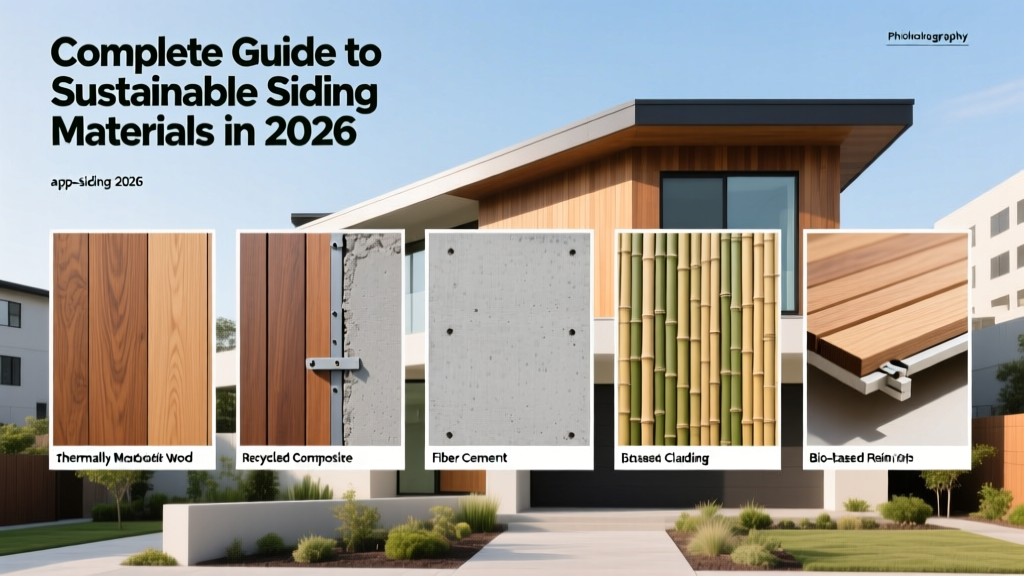
The Sustainability Matrix: Evaluating Eco-Friendly Cladding
Selecting sustainable siding materials requires moving beyond simplistic 'green' marketing. True environmental performance in 2026 is evaluated across three distinct lifecycle phases: Embodied Carbon (A1-A3 stages, covering raw material extraction and manufacturing), Operational Longevity (how long the material resists degradation without chemical maintenance), and End-of-Life Value (C4/D stages, focusing on recyclability or safe biodegradation). According to the Whole Building Design Guide, the building envelope dictates a structure's long-term energy resilience, meaning the siding must integrate flawlessly with continuous exterior insulation and weather-resistive barriers (WRB) to prevent thermal bridging and moisture intrusion.
This guide dissects the four most viable sustainable cladding systems available today, providing exact material specifications, real-world failure modes, and 2026 pricing data to help you make an empirically sound decision.
Thermally Modified Wood: The Premium Chemical-Free Choice
Thermally modified wood (TMW) represents the pinnacle of bio-based cladding. Unlike pressure-treated lumber that relies on copper-based chemical preservatives, TMW uses superheated steam (typically reaching 419°F / 215°C) to alter the wood's cellular structure. This process caramelizes the hemicellulose, effectively removing the sugars that attract fungi and wood-boring insects.
Product Spotlight & Specifications
- Top Brands: Thermory (Ash and Spruce), Kebony (Radiata Pine modified via furfurylation).
- Dimensions: Typically available in 1x6 (actual 3/4" x 5 1/2") tongue-and-groove or shiplap profiles.
- Material Cost (2026): $9.50 to $14.00 per square foot.
- Sourcing: Always verify that the base timber is certified by the Forest Stewardship Council (FSC) to ensure the raw material comes from responsibly managed, regenerative forests rather than old-growth logging.
Installation Gotchas & Failure Modes
The primary failure mode for TMW is not rot, but UV degradation and differential moisture movement. If left unfinished, thermally modified ash will weather to a silvery-gray patina within 12 to 18 months. While structurally sound, this aesthetic shift is often unwanted. To maintain the rich, dark chocolate tones, the siding must be coated with a high-quality, UV-inhibiting penetrating oil (such as Osmo UV-Protection Oil) every 3 to 5 years. Furthermore, installers must use stainless steel ring-shank nails or hidden clip systems; standard galvanized fasteners will react with the modified tannins, causing severe black streaking down the facade.
Fiber Cement: Balancing Longevity with Embodied Carbon
Fiber cement remains the dominant force in durable, low-maintenance siding. Composed of Portland cement, silica sand, and cellulose fibers, it is entirely impervious to termites, rot, and fire (boasting a Class A fire rating). However, its sustainability profile is complex due to the high embodied carbon associated with Portland cement production.
Mitigating the Carbon Footprint
To specify fiber cement sustainably, architects and builders in 2026 must demand Environmental Product Declarations (EPDs). Leading manufacturers are increasingly substituting a portion of the Portland cement with fly ash or slag (industrial byproducts), which can reduce the A1-A3 embodied carbon footprint by up to 20%.
Specifications & Pricing
- Top Products: James Hardie Artisan Lap (15/16" thick for deep shadow lines), Allura Fiber Cement.
- Material Cost (2026): $3.50 to $6.00 per square foot (standard 5/16" lap); $8.00+ for thick architectural panels.
- Lifespan: 50+ years with proper factory-applied acrylic finishes.
Edge Case Failure: Fiber cement is highly alkaline. If installed in direct contact with unprotected aluminum flashing or unanodized aluminum trim, the alkalinity will cause rapid galvanic corrosion. Always separate fiber cement from aluminum using a rubberized asphalt membrane or specify PVC/stainless steel flashings at all roof-to-wall intersections.
Engineered Wood: The High-Performance Upcycled Option
Engineered wood siding utilizes wood chips, strands, and veneers that would otherwise be discarded as mill waste, binding them with exterior-grade resins and wax. According to data from the American Wood Council, wood products inherently store carbon, and utilizing mill residuals maximizes the carbon sequestration value of every harvested tree.
Product Deep Dive: LP SmartSide
LP SmartSide dominates this category through its proprietary SmartGuard process, which impregnates the wood strands with zinc borate. Zinc borate is a highly effective, low-toxicity fungicide and termiticide.
Cost: $2.50 to $4.50 per square foot.
Weight: Approximately 30% lighter than fiber cement, significantly reducing transportation emissions and structural load requirements.
Recycled Metal Siding: The Closed-Loop Option
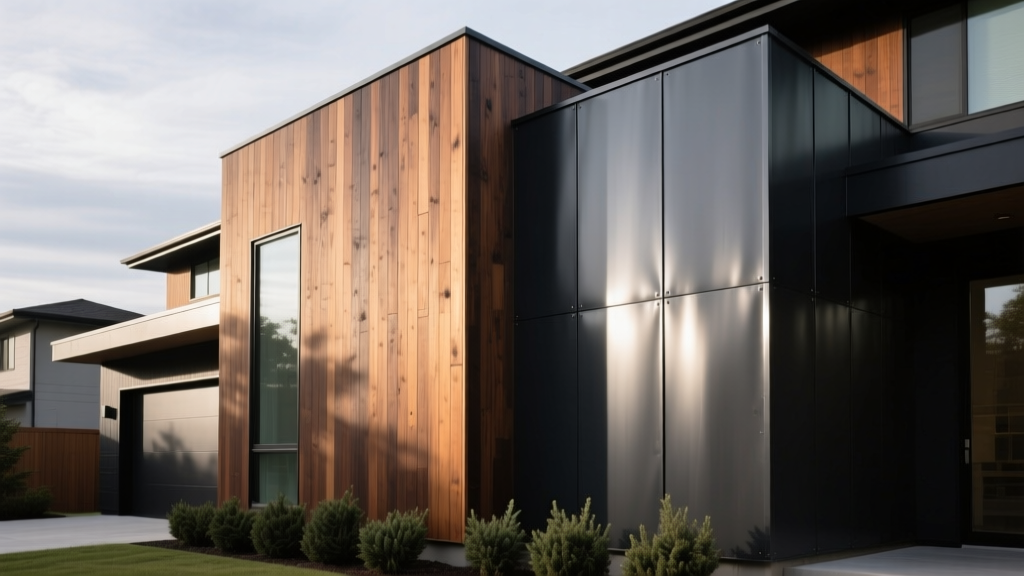
Metal siding—specifically aluminum and steel—offers the highest end-of-life recyclability of any cladding material. Aluminum siding produced today frequently contains 70% to 85% post-consumer recycled content. While the initial smelting of virgin aluminum is highly energy-intensive, recycling aluminum requires 95% less energy, making it a premier choice for circular economy building projects.
Architectural Profiles & Specs
- Profiles: Exposed fastener corrugated panels, hidden-clip standing seam, and flush architectural cassettes.
- Top Brands: ATAS International, Bridger Steel, Morin.
- Material Cost (2026): $8.00 to $15.00 per square foot, heavily dependent on gauge (24-gauge vs 22-gauge) and PVDF (Kynar 500) coating requirements.
Thermal Bridging Warning: Metal is a massive thermal conductor. Installing metal panels directly over rigid foam without a thermal break (such as fiberglass-reinforced plastic spacers or insulated furring channels) will result in severe condensation issues on the interior side of the wall assembly and drastically reduce the R-value of the continuous insulation.
2026 Material Comparison & Cost Matrix
The following matrix synthesizes the critical data points required for lifecycle cost analysis and environmental impact assessments.
| Material Type | Embodied Carbon (kgCO2e/m2) | Avg Material Cost (2026) | Expected Lifespan | End-of-Life Value |
|---|---|---|---|---|
| Thermally Modified Wood | Low (Biogenic Carbon Negative) | $9.50 - $14.00 / sq ft | 30 - 40 Years | Biodegradable / Compostable |
| Engineered Wood (Zinc Borate) | Low-Medium | $2.50 - $4.50 / sq ft | 30 - 50 Years | Biomass Energy Recovery |
| Fiber Cement (Fly Ash Blend) | Medium-High | $3.50 - $6.00 / sq ft | 50+ Years | Landfill (Inert / Non-toxic) |
| Recycled Aluminum | Medium (Offset by Recycled Content) | $10.00 - $15.00 / sq ft | 60+ Years | 100% Infinitely Recyclable |
Decision Framework: Matching Material to Microclimate
Sustainability is inherently tied to durability; replacing a 'green' material every 15 years due to climate mismatch destroys any initial carbon savings. Use this framework to finalize your specification:
- Coastal & Salt-Spray Environments: Specify Recycled Aluminum or Fiber Cement. Avoid metal fasteners in wood systems, as salt accelerates galvanic corrosion. If using fiber cement, ensure all cut edges are sealed to prevent salt crystallization within the porous matrix.
- High Humidity & Termite Zones (e.g., US Southeast): Specify Fiber Cement or Thermally Modified Wood. Engineered wood, despite zinc borate treatments, carries a higher risk of edge-wicking in environments with persistent 90%+ relative humidity and driving rain.
- Wildfire Interface Zones (WUI): Specify Fiber Cement or Metal. Thermally modified wood, while more dimensionally stable, is still combustible and will not meet the strict WUI codes in California (Chapter 7A) or Colorado without specialized, expensive fire-retardant backer boards.
- Budget-Conscious Eco-Builds: Specify Engineered Wood. It offers the lowest upfront cost, utilizes waste-stream timber, and provides excellent impact resistance compared to brittle fiber cement.
By aligning the physical properties of these sustainable siding materials with your specific hygrothermal climate zone and lifecycle carbon goals, you ensure the building envelope performs optimally for decades without requiring premature, carbon-intensive replacements.
Written by
James ThorntonJames Thornton is a construction industry veteran with 25 years of hands-on experience in wood framing, lumber grading, and residential building codes. He started as a framing carpenter in rural Oregon, earned his ICC Residential Building Inspector certification, and eventually became a senior plan reviewer for the City of Portland Bureau of Development Services. James holds a B.S. in Wood Science & Technology from Oregon State University and is a certified lumber grader through the West Coast Lumber Inspection Bureau (WCLIB). He has inspected over 3,000 residential construction sites and authored the city's internal guide on advanced framing techniques (2x6 at 24" O.C.). James lives in Bend, OR, where he builds custom timber-frame cabins and competes in lumberjack sports.
More from James Thornton
View all
Insulation
Best Home Insulation Materials: Complete 2026 Guide
Compare top home insulation materials for 2026. Find R-values, installed costs per square foot, and best uses for fiberglass, spray foam, and mineral wool.
Aug 4, 2026

Sustainable Building
Certify Your Green Building Material for LEED and WELL
Step-by-step guide to certifying a green building material for LEED v5 and WELL v2. Master EPDs, HPDs, and VOC limits for 2026 project specifications.
Aug 4, 2026

Stone & Masonry
Veneer Stacked Stone Panels: Interior Design & Style Showcase
Discover how veneer stacked stone panels transform interiors. Explore modern design profiles, material pairings, and technical installation specs.
Aug 4, 2026