Vinyl Siding Cost by Brand: 2026 Product Line Pricing Guide
Compare 2026 vinyl siding cost across top brands like CertainTeed, Alside, and Mastic. Get exact per-square-foot pricing for premium lines.
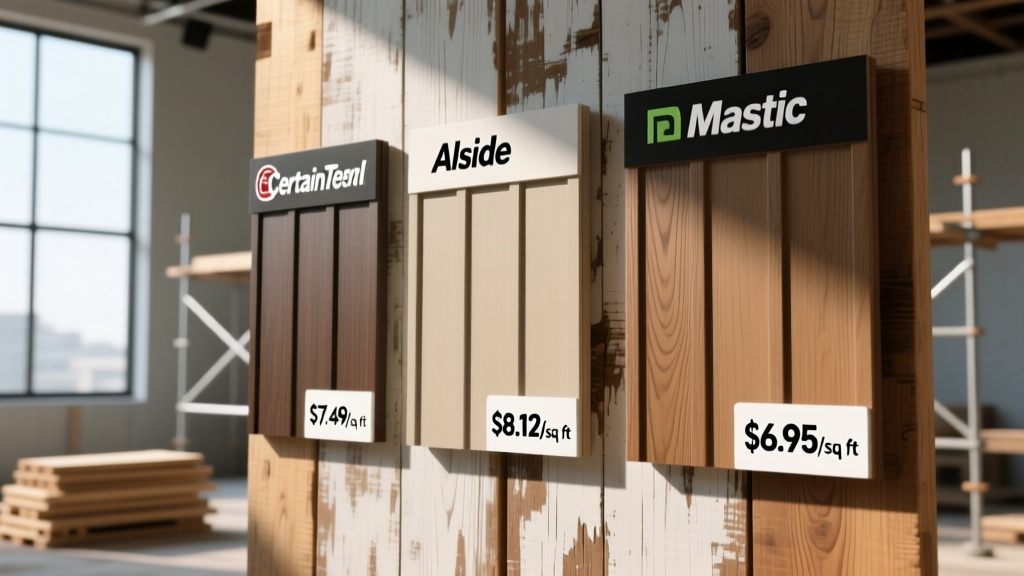
The True Vinyl Siding Cost: Beyond the Per-Square-Foot Average
When homeowners research the average vinyl siding cost, they are typically met with a broad national range of $3.00 to $8.00 per square foot installed. However, this aggregate data obscures the massive price variations driven by specific manufacturer product lines, panel thickness, and insulation integration. In 2026, the gap between budget hollow-back vinyl and premium insulated architectural lines has widened, making brand-level analysis essential for accurate budgeting.
According to the Vinyl Siding Institute, modern polyvinyl chloride (PVC) cladding is engineered to meet strict ASTM D3679 standards, but manufacturers differentiate their tiers through proprietary color technology, impact modifiers, and contoured foam backings. This deep-dive analyzes the exact material costs, technical specifications, and value propositions of the top North American vinyl siding brands to help you forecast your project accurately.
Tier 1 Premium Brands: CertainTeed and Mastic
Premium brands command a higher upfront vinyl siding cost but offset this through superior wind-load ratings, deeper shadow lines, and advanced UV-resistant color formulations that prevent the fading and warping common in budget lines.
CertainTeed: CedarBoards and Landmark Lines
CertainTeed dominates the premium residential market. Their CedarBoards insulated line features a 0.044-inch panel thickness backed by a custom-contoured expanded polystyrene (EPS) foam. This integration yields an R-value of up to R-3.3, which the U.S. Department of Energy notes is critical for reducing thermal bridging through wall studs. CedarBoards material costs range from $4.80 to $6.20 per square foot.
For architectural accents, the Landmark line offers premium shakes and shingles with a massive 0.050-inch thickness. Because these are injection-molded or heavily vacuum-formed for deep shadow lines, material costs jump to $6.50 to $8.50 per square foot. CertainTeed’s PermaColor technology allows for dark hues (like navy and charcoal) without the heat-distortion issues that plague standard vinyl, though these dark colors carry a 15% manufacturing surcharge.
Mastic (by Ply Gem): Quest and Structure
Mastic approaches the market with a focus on rigidity. The Structure line is their flagship insulated product, boasting a 0.046-inch face thickness and a 1.25-inch EPS foam backing. It is engineered to withstand 160 mph wind loads (ASTM D5206 tested). Expect material costs between $4.20 and $5.50 per square foot.
Their mid-tier Quest line is a traditional hollow-back panel at 0.042 inches. While it lacks insulation, it features a reinforced nailing hem that reduces wind-tear risk. Quest is priced aggressively at $2.60 to $3.40 per square foot for materials, making it a favorite for speculative builders and mid-range renovations.
Tier 2 Value & Mid-Range Lines: Alside and Royal
Value-tier brands optimize the vinyl siding cost by streamlining color options and focusing on high-volume extrusion processes, offering excellent durability for budget-conscious projects.
Alside: Prodigy and Charter Oak
Alside’s Prodigy line is a direct competitor to CedarBoards, featuring a 0.046-inch panel and a 1.5-inch EPS foam core (R-3.0). Alside utilizes a proprietary drop-lock nailing system that allows for precise thermal expansion and contraction. Material costs sit at $4.10 to $5.30 per square foot.
The Charter Oak line is Alside’s standard hollow-back workhorse. At 0.044 inches thick, it is slightly more rigid than standard builder-grade siding. It utilizes Alside’s Chromatix UV protection system. Material costs range from $2.80 to $3.90 per square foot.
Royal Building Products: Estate and Portsmouth
Royal’s Estate line pushes the boundaries of standard hollow-back siding with a 0.048-inch thickness, providing exceptional impact resistance without the cost of an insulated backing. Material costs are $3.50 to $4.50 per square foot. Their Portsmouth line offers budget-friendly 0.040-inch panels for sheds, garages, and low-budget flips, coming in at just $1.90 to $2.50 per square foot.
2026 Vinyl Siding Cost Matrix: Material vs. Installed
The table below breaks down the estimated 2026 pricing for these specific product lines. Note that 'Installed' costs include standard labor ($3.50 to $5.50 per sq. ft.), basic tear-off of one existing layer, and standard J-channel trim, as reported by Forbes Home Improvement industry aggregations.
| Brand & Product Line | Thickness | Type | Material Cost / Sq. Ft. | Installed Cost / Sq. Ft. |
|---|---|---|---|---|
| CertainTeed Landmark | 0.050" | Architectural | $6.50 - $8.50 | $11.00 - $14.50 |
| CertainTeed CedarBoards | 0.044" | Insulated | $4.80 - $6.20 | $9.00 - $11.50 |
| Mastic Structure | 0.046" | Insulated | $4.20 - $5.50 | $8.50 - $10.50 |
| Alside Prodigy | 0.046" | Insulated | $4.10 - $5.30 | $8.25 - $10.25 |
| Royal Estate | 0.048" | Hollow-Back | $3.50 - $4.50 | $7.50 - $9.50 |
| Alside Charter Oak | 0.044" | Hollow-Back | $2.80 - $3.90 | $6.50 - $8.50 |
| Mastic Quest | 0.042" | Hollow-Back | $2.60 - $3.40 | $6.25 - $8.00 |
| Royal Portsmouth | 0.040" | Budget | $1.90 - $2.50 | $5.50 - $7.00 |
Technical Specifications: How Thickness and Standards Alter the Invoice
The single greatest physical differentiator in vinyl siding cost is panel thickness, measured in mils or decimal inches. The industry standard for baseline residential siding is 0.035 inches. However, premium lines push this to 0.046 inches or higher.
- 0.035" to 0.038" (Builder Grade): Prone to oil-canning (visible wavering) on sun-exposed elevations. High risk of cracking during installation in cold weather.
- 0.040" to 0.044" (Mid-Range): The sweet spot for value. Provides adequate rigidity for standard 12-foot to 16-foot lengths without excessive material weight.
- 0.046" to 0.050" (Premium/Architectural): Necessary for deep wood-grain embossing. Thicker panels hold the physical texture better and resist hail impact (tested via ASTM D4226).
If you select dark architectural colors (e.g., slate gray, navy, or black) for a southern or western elevation, you must upgrade to a premium line with advanced UV inhibitors (like CertainTeed's PermaColor). Standard vinyl absorbs heat and expands; dark colors on thin (0.040") panels can reach surface temperatures exceeding 160°F, leading to permanent thermal distortion and voided warranties. Expect to pay a 15% to 20% premium on the material cost for dark, fade-resistant formulations.
Installation Variables That Skew Brand Pricing
Material costs only tell half the story. The final invoice is heavily influenced by site-specific labor and accessory requirements. When comparing quotes, ensure the contractor is pricing the following variables accurately:
- Substrate Preparation: If the existing wood sheathing has rot or requires a new layer of rigid foam board to meet 2026 IECC (International Energy Conservation Code) continuous insulation mandates, add $1.50 to $2.50 per square foot.
- Trim and Accessories: Premium brands require matching proprietary trim. Standard J-channel costs $0.50 per linear foot, but wide architectural fluted trim or custom-bent aluminum fascia can push trim costs to $4.00+ per linear foot.
- Tear-Off and Disposal: Removing existing wood or cementitious siding costs significantly more than stripping old vinyl. Budget an extra $1.00 to $1.75 per square foot for heavy tear-off and dumpster fees.
When reviewing contractor proposals, check the specified product's nailing hem. Premium lines like Alside Prodigy and Mastic Structure feature reinforced, double-thick nailing hems. This allows the installer to drive nails securely without tearing through the PVC, which is the leading cause of wind-tear failures in hollow-back budget siding.
Decision Framework: Which Brand Line Fits Your Project?
Choosing the right product line requires aligning your budget with your long-term homeownership goals.
Choose Budget Lines (Royal Portsmouth, Mastic Quest) If:
- You are flipping a property or preparing a home for immediate sale.
- The home is located in a mild climate with low temperature swings and minimal hail risk.
- You are siding a detached garage, shed, or non-conditioned outbuilding.
Choose Mid-Range Lines (Alside Charter Oak, Royal Estate) If:
- You plan to stay in the home for 5 to 10 years and want a balance of durability and cost.
- You are upgrading from damaged wood siding but do not need the thermal break of insulated panels.
- You prefer standard, lighter color palettes that do not require premium heat-reflective pigments.
Choose Premium Insulated Lines (CertainTeed CedarBoards, Alside Prodigy) If:
- You are executing a 'forever home' renovation and plan to stay for 15+ years.
- The home features 2x4 framing with inadequate cavity insulation, and you need the continuous R-3.0 exterior thermal break to lower HVAC loads.
- You desire deep, authentic wood-grain shadow lines and dark, modern color palettes that require thicker, heat-resistant PVC extrusions.
By moving past generic national averages and evaluating the specific thickness, insulation values, and warranty terms of individual product lines, you can accurately forecast your vinyl siding cost and select a cladding system that delivers lasting performance and aesthetic value.