Vinyl Siding Material Prices: 2026 Selection Framework & Cost Guide
Analyze 2026 vinyl siding material prices with our selection framework. Compare tiers, hidden costs, and brand benchmarks to optimize your budget.

The 2026 Vinyl Siding Pricing Matrix
Navigating vinyl siding material prices requires moving beyond the base "per square" (100 square feet) metric. Material costs in 2026 are heavily stratified by thickness, profile complexity, and backing technology. The following matrix establishes the baseline material-only costs before labor, trim, and regional shipping surcharges.
| Tier Classification | Panel Thickness | Material Price (Per Sq. Ft.) | Price Per Square (100 Sq. Ft.) | Primary Application |
|---|---|---|---|---|
| Builder Grade (Economy) | .038" - .040" | $1.80 - $2.60 | $180 - $260 | Flips, short-term rentals, budget rehabs |
| Mid-Grade (Standard) | .042" - .044" | $3.20 - $4.80 | $320 - $480 | Mid-term homeowners, standard residential |
| Premium / Insulated | .046" - .050"+ | $5.50 - $8.50 | $550 - $850 | Forever homes, high-wind zones, historic profiles |
| Architectural Shakes | .050" - .060" | $7.00 - $11.00 | $700 - $1,100 | Accent walls, gables, premium full-wrap |
Decoding Material Costs: What Drives the Price?
When evaluating quotes, contractors often obscure the specific material grade. Understanding the engineering differences between a $2.00 panel and a $7.00 panel is critical for making an informed procurement decision.
Thickness and Impact Resistance (ASTM D3679)
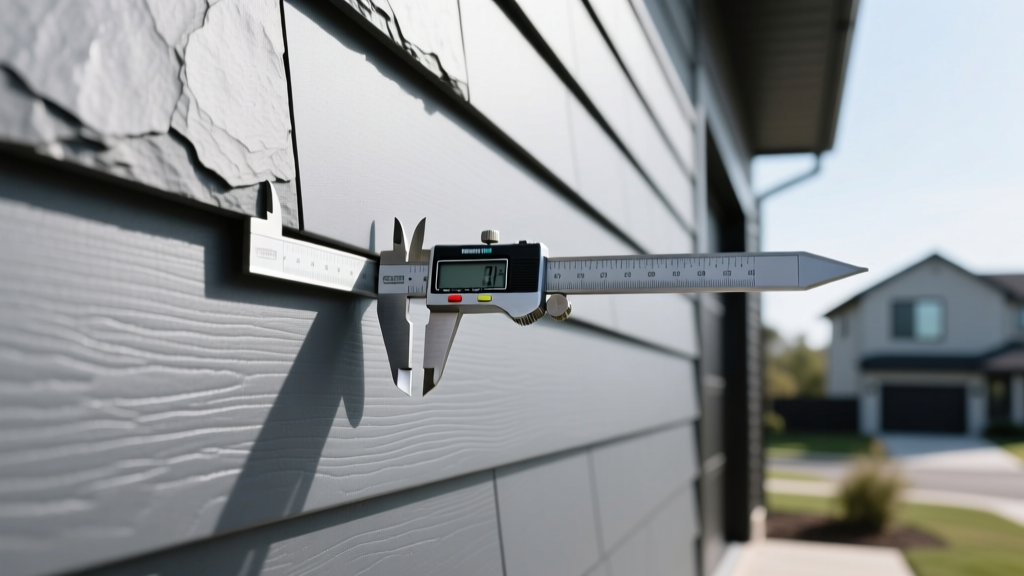
The Vinyl Siding Institute enforces ASTM D3679 standards, which mandate a minimum thickness of .035 inches. However, minimum compliance does not equal structural resilience. Builder-grade panels (.038") are prone to "oil-canning" (visible waviness under thermal expansion) and can shatter under hail impact. Premium panels (.046" and above) feature a stiffer profile, often incorporating a rolled or double-hem nail flange. This double hem locks panels together more securely, increasing wind-load resistance from a standard 110 mph to over 160 mph, which is a strict requirement in 2026 building codes for coastal and hurricane-prone zones.
The Insulated Vinyl Premium
Insulated vinyl siding integrates a contoured expanded polystyrene (EPS) foam backing directly to the panel. This adds an R-value of R-2.0 to R-5.0 to the exterior envelope. According to the U.S. Department of Energy, continuous exterior insulation is vital for minimizing thermal bridging through wall studs. Insulated vinyl commands a 40% to 60% material premium over hollow-back panels, but it also provides a rigid nailing surface that completely eliminates oil-canning and dampens exterior noise transmission.
Never budget based solely on the panel price per square. A complete siding envelope requires starter strips, J-channels, utility trims, soffit panels, fascia coils, and specialized mounting blocks. These accessory materials routinely add 18% to 24% to your total material invoice. Always request an itemized bill of materials (BOM) to verify accessory quality matches the panel grade.
The Selection Framework: Matching Budget to Project Lifespan
Use this decision framework to align your material selection with your real estate strategy. Buying premium materials for a 3-year hold is a poor allocation of capital, just as installing builder-grade siding on a forever home guarantees premature replacement costs.
- Scenario A: The 1-to-5 Year Hold (Flip or Rental)
- Selection: Builder Grade (.040"), hollow back, standard clapboard profile.
- Strategy: Focus on neutral, high-velocity colors (white, linen, light gray). Avoid dark colors, as thin panels warp easily when absorbing solar heat. Prioritize low material cost and fast installation over longevity.
- Scenario B: The 7-to-15 Year Hold (Move-Up Home)
- Selection: Mid-Grade (.044"), optional foam back, Dutchlap or board-and-batten profiles.
- Strategy: Invest in mid-tier acrylic UV coatings to prevent color fading. Look for panels with integrated weather-resistive barriers (WRB) or plan to apply a liquid-applied membrane beneath the hollow-back panels to protect the sheathing.
- Scenario C: The 20+ Year Hold (Forever Home)
- Selection: Premium Insulated (.048"+), double-hem lock, architectural shakes or deep-profile Dutchlap.
- Strategy: Maximize thermal performance and impact resistance. Darker colors (charcoal, navy, forest green) are viable here because the thick gauge and EPS backing prevent thermal warping. Demand a manufacturer's fade and hail warranty that is transferable to the next owner.
Top Tier Brands & 2026 Price Benchmarks
Market pricing varies by distributor and region, but the following brand benchmarks represent the national average for material procurement in 2026.
CertainTeed
CertainTeed dominates the premium segment. Their MainStreet line sits firmly in the mid-grade category, averaging $3.80 per square foot. For architectural accents, their Cedar Impressions polymer shakes cost upwards of $9.50 per square foot. Their proprietary PERMAcolor™ process embeds pigment throughout the panel thickness, justifying the higher price point with superior fade resistance.
Alside
Alside offers aggressive pricing in the mid-to-premium tiers. The Mezzo line features a low-gloss finish and a reinforced nail hem, typically pricing around $3.40 per square foot. Their flagship Charter Oak insulated line, featuring a neoprene foam backing and a 160-mph wind warranty, averages $6.20 per square foot, making it one of the most cost-effective insulated options on the market.
Mastic by Westlake Royal
Mastic's Quest line is a staple for standard residential applications ($3.10/sq. ft.), while their Structure insulated series ($6.80/sq. ft.) utilizes a contoured EPS foam that locks tightly to the wall sheathing, providing superior flatness and an R-value up to R-5.0.
Lifecycle Cost Analysis: Vinyl vs. Fiber Cement
When vinyl siding material prices push into the $7.00+ per square foot range for premium insulated products, homeowners often question if they should pivot to fiber cement (e.g., James Hardie).
The Break-Even Point: Premium insulated vinyl material costs roughly 30% more than mid-grade fiber cement panels. However, fiber cement requires repainting every 10 to 15 years (adding $4,000 - $7,000 per cycle) and demands specialized, slower installation due to its weight and silica dust hazards. Over a 30-year lifecycle, premium vinyl maintains a 15% to 20% lower total cost of ownership, provided the initial material thickness exceeds .046 inches to prevent physical degradation.
Procurement Strategy: Avoiding Distributor Markup
To optimize your budget, bypass big-box home improvement centers for large-scale projects. Big-box retailers typically apply a 25% to 35% markup on vinyl siding to cover retail overhead and inventory shrinkage. Instead, open a cash account with a dedicated exterior building materials distributor (e.g., ABC Supply, Beacon, or SRS Distribution). These pro-yards sell directly to the public at contractor-tier pricing, provided you meet their minimum order quantities (usually 5 to 10 squares). Furthermore, pro-yards can custom-bend aluminum trim coils on-site to match your vinyl color exactly, eliminating the need to paint wood fascia and further reducing long-term maintenance costs.
Written by
Marcus ChenMarcus Chen is a licensed structural engineer (PE) and building materials analyst with over 12 years of experience across residential, commercial, and industrial construction. He holds a Master of Science in Civil Engineering from UC Berkeley and spent six years at Thornton Tomasetti before transitioning to independent consulting and technical writing. Marcus specializes in material selection for seismic-prone regions, concrete reinforcement strategies, and lifecycle cost analysis. His work has been cited by the American Concrete Institute (ACI) and the Structural Engineers Association of California (SEAOC). When he is not on a job site or at his desk, you will find him hiking the Sierra Nevada or restoring a 1920s craftsman bungalow in Oakland, CA.
More from Marcus Chen
View all
Construction Cost
How Much Did the Eiffel Tower Cost to Build?
How much did the Eiffel Tower cost to build in 1889? We adjust for inflation and compare its budget to modern skyscraper construction.
Aug 4, 2026

Fire Resistance
What Is a Fire Resistant Material? Testing & Certification Guide
Discover what is a fire resistant material through ASTM and UL testing. Learn how fire ratings, certifications, and assemblies work in construction.
Aug 4, 2026

Construction Cost
How Much Did the Burj Khalifa Cost to Build?
How much did the Burj Khalifa cost to build? We break down the $1.5B project and extract 5 money-saving strategies for your next build.
Jul 30, 2026