5 8 Gypsum Board Price vs Fire-Rated Alternatives (2026)
Compare the 2026 5 8 gypsum board price against fire-rated alternatives. Expert cost breakdowns, assembly data, and material selection frameworks.

The Baseline: Evaluating the 5 8 Gypsum Board Price in 2026
Building codes governed by the International Building Code (IBC) and NFPA standards strictly mandate 1-hour or 2-hour fire-resistance ratings (FRR) for commercial corridors, multi-family residential separations, and stairwells. For decades, 5/8-inch Type X gypsum board has been the default material to achieve these ratings. However, as material science advances and labor costs shift, specifiers and general contractors must rigorously evaluate whether the standard 5 8 gypsum board price remains the most economical choice, or if specialized alternatives offer better lifecycle value.
2026 National Average Cost Snapshot (Per Sq. Ft.)
- 5/8" Type X Material: $0.58 – $0.74
- Installation Labor: $0.50 – $0.75
- Taping & Finishing (Level 4): $0.35 – $0.55
- Total Installed Baseline: $1.43 – $2.04 per sq. ft.
The core advantage of standard 5/8-inch Type X panels (such as USG Sheetrock Firecode X or Georgia-Pacific ToughRock Fireguard) lies in their predictable installation. Manufactured to ASTM C1396 standards, the glass-fiber-reinforced core prevents structural collapse during a fire. Yet, when evaluating the total assembly cost, the raw material price is only one variable. Framing spacing, moisture exposure, and impact resistance frequently dictate that an alternative material, despite a higher upfront per-sheet cost, yields a lower total project expenditure.
Head-to-Head Matrix: 5/8" Type X vs. Fire & Sound Alternatives
When a single layer of 5/8" Type X on each side of a wood or steel stud fails to meet the required Sound Transmission Class (STC) or impact durability, project teams pivot to alternatives. Below is a direct comparison of 2026 material costs and performance metrics for standard fire-rated assemblies.
| Material Type | Material Cost / Sq.Ft. | 1-Hr FRR Assembly | Moisture Tolerance | Impact Resistance |
|---|---|---|---|---|
| 5/8" Type X Gypsum | $0.58 - $0.74 | Single Layer (25ga steel) | Low (Paper facing molds) | Low |
| Double 1/2" Type X | $0.90 - $1.10 | Requires 2 layers | Low | Medium |
| Glass-Mat Gypsum (e.g., DensGlass) | $1.15 - $1.35 | Single Layer (Type X core) | High (Exterior/Wet) | Medium |
| Fiber-Reinforced (e.g., Fiberock) | $1.25 - $1.50 | Single Layer | Medium | Very High |
| Cement Board (e.g., Durock) | $1.10 - $1.40 | Requires specific UL designs | Very High | High |
Scenario-Based Decision Framework
Relying solely on the base 5 8 gypsum board price leads to costly change orders and premature failure in specialized environments. Use this framework to determine when the premium for alternative panels is mathematically justified.
Scenario A: High-Moisture Fire Zones (Commercial Kitchens & Pool Enclosures)
Standard Type X features a paper facing that acts as a food source for mold when exposed to high ambient humidity or direct water intrusion. In commercial kitchen shafts or indoor aquatic center walls, building codes still demand fire separation, but standard gypsum will degrade.
The Pivot: Specify glass-mat faced gypsum panels (like Georgia-Pacific DensGlass or USG Securock). While the material cost jumps by roughly 60%, you eliminate the need for separate vapor barriers and prevent catastrophic mold remediation costs post-construction. The Gypsum Association Fire Design Manual includes specific UL assemblies that substitute glass-mat panels directly into standard 1-hour and 2-hour wood and steel stud designs without altering the framing.
Scenario B: High-Impact Corridors (Hospitals, Schools, and Hotels)
Hospital gurneys, hotel luggage carts, and school foot traffic easily dent and puncture standard 5/8-inch gypsum. Repairing these walls requires facility management to repeatedly cut out damaged sections, re-tape, and repaint, disrupting operations.
The Pivot: Fiber-reinforced gypsum panels (such as USG Fiberock Abuse-Resistant). These panels integrate wood and glass fibers directly into the gypsum core, yielding an indentation resistance up to five times greater than standard Type X. Though the upfront material cost is nearly double, the 10-year lifecycle cost plummets because the walls do not require continuous patching or the installation of expensive PVC or rubber wall guards.
Scenario C: Standard Residential Party Walls & Plenum Ceilings
For multi-family residential demising walls or commercial ceiling plenums with no moisture or impact risks, alternatives are rarely justified.
The Verdict: Stick with standard 5/8" Type X. Attempting to substitute with double-layer 1/2" Type X to save on per-sheet material costs is a false economy. The labor required to hang, screw, and tape a first layer of 1/2" board before applying the fire-rated second layer will increase installation costs by 40-50%, vastly outweighing the pennies saved on the gypsum core.
One of the most overlooked financial benefits of 5/8-inch board is its rigidity. For ceiling applications, 1/2-inch gypsum requires framing spaced at 16 inches on-center (O.C.) to prevent sagging over time. 5/8-inch panels allow for 24-inch O.C. framing. Upgrading to 5/8" board on a ceiling actually reduces total project costs by eliminating 33% of the furring channels or joists, alongside the associated hangers and fasteners.
Hidden Cost Variables: Fasteners and Joint Treatment
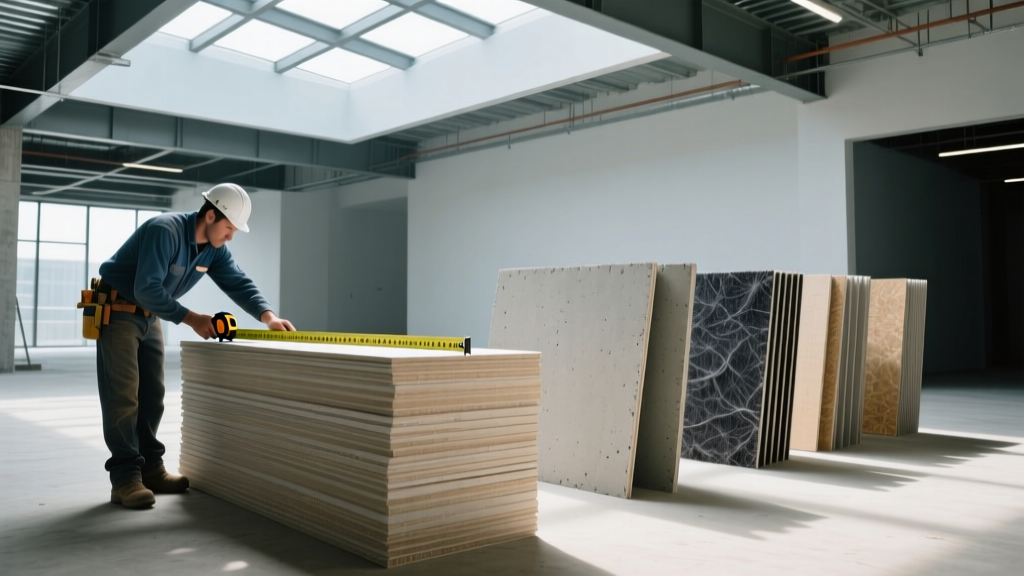
When comparing the 5 8 gypsum board price against specialized alternatives, contractors must account for consumable differences. Alternative boards drastically alter the fastening and finishing budget:
- Fastener Density: Cement boards and high-density fiber-reinforced panels require specialized corrosion-resistant screws (e.g., ceramic-coated or stainless steel) and often demand a higher density of fasteners per panel to prevent edge blowout. This adds $0.04 to $0.08 per square foot in fastener costs alone.
- Joint Compound Compatibility: Standard Type X uses conventional all-purpose or lightweight joint compound. Glass-mat and cement boards require specialized setting-type compounds (like USG Durabond) and alkali-resistant fiberglass mesh tape to prevent joint cracking, increasing finishing material costs by approximately 15%.
- Weight and Labor Fatigue: A standard 4x12 sheet of 5/8" Type X weighs roughly 90 lbs. A comparable sheet of cement board can exceed 115 lbs. The increased weight slows down hanging crews, reduces the number of sheets hung per day, and increases the risk of workplace injury, subtly driving up labor bids.
Sourcing and Supply Chain Realities
As of 2026, the North American gypsum manufacturing sector has stabilized following the capacity expansions of the early 2020s. However, regional pricing disparities remain acute. In the Pacific Northwest and Northeast corridors, freight surcharges for heavy building materials can inflate the delivered price of 5/8" Type X by up to 18% compared to Southern manufacturing hubs.
To mitigate this, large-scale commercial projects are increasingly utilizing regional manufacturing plants for standard Type X, while sourcing high-performance alternatives (like glass-mat or fiber-reinforced panels) from centralized national distributors, accepting the higher freight cost only on the specialized square footage required for shafts, stairwells, and wet zones. This hybrid procurement strategy optimizes the overall wall assembly budget without compromising code compliance or structural integrity.
Summary: The Final Verdict on Assembly Costs
The base 5 8 gypsum board price remains the undisputed benchmark for standard, dry, low-impact fire separations. However, modern construction demands a holistic view of the assembly. By substituting standard Type X with glass-mat panels in wet zones and fiber-reinforced panels in high-traffic corridors, project teams avoid the hidden costs of moisture remediation, continuous wall repairs, and excessive framing materials. Always cross-reference your material selections with tested UL assemblies to ensure the alternative panel maintains the required fire-resistance rating without requiring costly structural modifications.
Written by
James ThorntonJames Thornton is a construction industry veteran with 25 years of hands-on experience in wood framing, lumber grading, and residential building codes. He started as a framing carpenter in rural Oregon, earned his ICC Residential Building Inspector certification, and eventually became a senior plan reviewer for the City of Portland Bureau of Development Services. James holds a B.S. in Wood Science & Technology from Oregon State University and is a certified lumber grader through the West Coast Lumber Inspection Bureau (WCLIB). He has inspected over 3,000 residential construction sites and authored the city's internal guide on advanced framing techniques (2x6 at 24" O.C.). James lives in Bend, OR, where he builds custom timber-frame cabins and competes in lumberjack sports.
More from James Thornton
View all
Insulation
Best Home Insulation Materials: Complete 2026 Guide
Compare top home insulation materials for 2026. Find R-values, installed costs per square foot, and best uses for fiberglass, spray foam, and mineral wool.
Aug 4, 2026

Sustainable Building
Certify Your Green Building Material for LEED and WELL
Step-by-step guide to certifying a green building material for LEED v5 and WELL v2. Master EPDs, HPDs, and VOC limits for 2026 project specifications.
Aug 4, 2026

Stone & Masonry
Veneer Stacked Stone Panels: Interior Design & Style Showcase
Discover how veneer stacked stone panels transform interiors. Explore modern design profiles, material pairings, and technical installation specs.
Aug 4, 2026