Gypsum Board Mold Resistant Options: 2026 Product Guide
Compare top gypsum board mold resistant products for 2026. Learn ASTM standards, fiberglass vs. paper facings, installation tips, and exact pricing.

The Science Behind Mold Resistant Gypsum Board
Mold requires three elements to thrive: moisture, optimal temperatures, and an organic food source. Standard drywall inadvertently provides a massive food source through its cellulose paper facing and the starch used to bind the gypsum core. When exposed to high humidity or minor leaks, standard panels become a breeding ground for Aspergillus, Penicillium, and Stachybotrys (black mold).
Manufacturers engineer gypsum board mold resistant variants to eliminate or treat this food source. The market is currently divided into two primary technologies:
- Chemically Treated Paper-Faced Boards: These retain the traditional paper facing but treat both the paper and the core with antimicrobial biocides (often zinc sulfate or boric acid derivatives) that inhibit spore germination.
- Inorganic Fiberglass-Faced Boards: These completely eliminate the organic paper facing, replacing it with a woven fiberglass mat. Because fiberglass is inorganic, it offers zero nutritional value to mold, making it the superior choice for high-risk environments.
Top Mold Resistant Gypsum Board Products Compared
Selecting the right panel depends on the moisture exposure level of the specific room. Below is a comparison of the leading products available in 2026, categorized by their facing technology and ideal applications.
| Brand & Product Line | Facing Material | Core Treatment | ASTM D3273 Score | Avg. Cost / Sq Ft | Best Application |
|---|---|---|---|---|---|
| GP DensArmor Plus | Fiberglass Mat | Moisture/Mold Treated | 10 (Highest) | $0.95 - $1.25 | Bathrooms, basements, behind tile |
| USG Sheetrock Mold Tough | Treated Paper | Antimicrobial Core | 10 | $0.65 - $0.85 | Kitchens, laundry rooms, garages |
| CertainTeed M2Tech | Treated Paper | Moisture/Mold Treated | 10 | $0.70 - $0.90 | General residential high-humidity |
| National Gypsum Gold Bond XP | Treated Paper | Silicone & Biocide Core | 10 | $0.65 - $0.80 | Commercial restrooms, corridors |
When to Upgrade to Fiberglass Mat
While treated paper boards (like USG Sheetrock Mold Tough) perform exceptionally well in areas with high ambient humidity, they are not recommended for direct tile backer applications in wet zones. If you are installing drywall in a shower surround, steam room, or directly behind a kitchen sink where liquid water contact is frequent, specify a fiberglass-faced panel like Georgia-Pacific DensArmor Plus or transition to a dedicated cement board.
Decoding the Standards: ASTM D3273 Explained
When reviewing manufacturer spec sheets, you will frequently see references to ASTM D3273 (Standard Test Method for Resistance to Growth of Mold on the Surface of Interior Coatings in an Environmental Chamber). This is the definitive benchmark for drywall mold resistance.
The test places the material in a highly controlled chamber with elevated humidity and introduces four specific mold strains. The material is scored on a scale of 0 to 10:
- Score 0: Heavy mold growth covering the surface.
- Score 5: Moderate, localized growth.
- Score 10: No observable growth under 10x magnification.
All premium mold resistant gypsum boards must achieve a perfect 10 to be classified as such. Always verify the ASTM D3273 score on the product data sheet rather than relying solely on marketing terms like 'mold-inhibiting'.
Installation Best Practices to Prevent Mold Intrusion
Installing mold resistant drywall with standard techniques compromises the entire system. Follow these specific field protocols to maintain the integrity of the wall assembly.
- Maintain the Floor Gap: Never let the bottom edge of mold resistant gypsum board rest directly on a concrete slab or subfloor. Capillary action will wick moisture up into the panel edge. Maintain a strict 1/2-inch gap at the floor, which will later be covered by baseboard trim.
- Use Sill Sealer on Bottom Plates: Before framing, apply a closed-cell foam sill sealer or a liquid-applied capillary break between the concrete and the bottom wood plate to prevent moisture migration into the wood, which can transfer to the drywall edge.
- Seal Penetrations Immediately: Cutouts for electrical boxes and plumbing pipes expose the untreated gypsum core. Seal these perimeters with an acoustical sealant or mold-resistant caulk to prevent humid air from entering the wall cavity.
- Fastener Spacing: Follow standard framing protocols (screws every 8 inches on ceilings, 12 inches on walls). Over-driving screws breaks the facing mat, exposing the core to moisture and negating the surface protection.
The Joint Compound Trap: Why Your Mud Matters
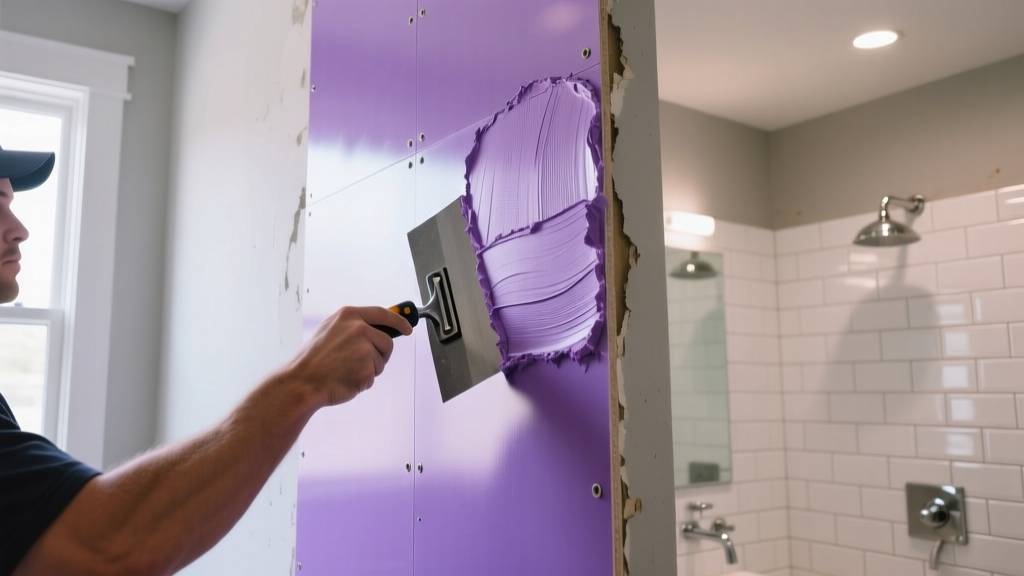
The most common failure mode in mold resistant wall systems occurs at the finishing stage. Contractors often spend a premium on mold resistant panels, only to finish the seams with standard pre-mixed all-purpose joint compound.
Standard pre-mixed mud contains organic starches and takes 24 hours or more to dry. During this prolonged drying window, the wet starch acts as a prime food source for mold spores, effectively creating a mold highway directly over your mold resistant panels.
The Solution: Setting-Type Compounds
For the taping and fill coats, exclusively use setting-type joint compounds (e.g., Durabond 45, Durabond 90, or Easy Sand 45). These are powder-based, chemically set compounds that cure via an exothermic reaction rather than evaporation. They contain significantly fewer organic binders, cure in 45 to 90 minutes, and are highly resistant to mold growth. Reserve pre-mixed mud strictly for the final skim coat, ensuring the room is well-ventilated and dehumidified to force rapid drying.
Cost Breakdown: Mold Resistant vs. Standard Drywall
Upgrading to mold resistant gypsum board represents a fractional increase in the overall construction budget but provides massive long-term risk mitigation, particularly in basements, bathrooms, and coastal climates.
| Material Category | Material Cost (per 4x8 Sheet) | Material Cost (per Sq Ft) | Installed Cost (per Sq Ft) |
|---|---|---|---|
| Standard 1/2" Drywall | $12.00 - $15.00 | $0.37 - $0.47 | $1.50 - $2.00 |
| Mold Resistant (Paper-Faced) | $21.00 - $27.00 | $0.65 - $0.85 | $1.85 - $2.40 |
| Mold Resistant (Fiberglass Mat) | $30.00 - $40.00 | $0.95 - $1.25 | $2.20 - $2.80 |
For an average 100-square-foot bathroom, upgrading from standard drywall to a fiberglass-faced mold resistant board adds approximately $70 to $100 in material costs. According to the EPA Mold Cleanup Guidelines, professional mold remediation in a compromised bathroom wall cavity typically costs between $1,500 and $4,000, making the upfront material upgrade a highly cost-effective insurance policy.
Common Failure Modes and Troubleshooting
Even with the correct materials, poor environmental management during construction can lead to mold issues before the building is even occupied.
Failure Mode 1: Rain Exposure During Framing
The Problem: Panels are hung before the building is fully dried-in (roof and windows installed). Rain wets the panels, and the drywall is closed up with insulation before drying.
The Fix: If mold resistant board gets rained on, it must be evaluated. Fiberglass-faced boards can often be dried out with industrial dehumidifiers if the core is not structurally compromised. Paper-faced boards that show edge swelling or core softening must be torn out and replaced.
Failure Mode 2: Missing Vapor Retarders in Cold Climates
The Problem: In Climate Zones 5 and above, interior winter moisture drives through the drywall and condenses on the cold exterior sheathing, wetting the back of the drywall.
The Fix: Install a Class I or II vapor retarder (like 4-mil polyethylene or a smart vapor retarder like CertainTeed MemBrain) on the warm-in-winter side of the wall, directly behind the mold resistant drywall, to prevent interstitial condensation.
Failure Mode 3: Improper Storage on Site
The Problem: Drywall bundles are stacked flat on a damp concrete subfloor, wicking moisture into the bottom sheets.
The Fix: Always store drywall flat on a raised platform or dunnage at least 4 inches off the subfloor. Keep the factory plastic wrapping intact until the exact day of installation to protect against ambient construction humidity.
Written by
Priya KapoorPriya Kapoor is a real estate market analyst and construction economics researcher with expertise in housing affordability, development feasibility, and infrastructure investment. She holds a Master of Regional Planning from Cornell University and previously worked as a senior analyst at CBRE's Investment Properties group, where she modeled returns for $4B in mixed-use development pipelines. Priya now runs an independent research practice advising developers, municipalities, and REITs on construction cost forecasting and market timing. She publishes the quarterly "BuildMat Market Pulse" report tracking material price indices across 12 commodity categories. Based in Austin, TX, Priya serves on the board of Habitat for Humanity Austin and is a marathon runner.
More from Priya Kapoor
View all
Construction Cost
Cost to Build a 1600 Sq Ft Home in 2026: Full Breakdown
Accurate 2026 cost to build a 1600 sq ft home—material, labor, and regional pricing breakdowns included. Plan your budget with real-time estimates.
Aug 11, 2026

Wood & Lumber
Name the Types of Wood for Pressure Treatment and Preservation
Learn how to name the types of wood best suited for pressure treatment. Compare species treatability, chemical retention levels, and 2026 preservation costs.
Aug 4, 2026

Stone & Masonry
Stone Veneer Suppliers Lindenhurst: 2026 Cost Analysis
Analyze 2026 stone veneer costs in Lindenhurst, NY. Compare local supplier pricing, delivery fees, and Suffolk County installation labor rates.
Aug 4, 2026