Selecting Abuse Resistant Gypsum Board for Commercial Interiors
Compare top abuse resistant gypsum board products, framing requirements, and 2026 costs to specify durable walls for hospitals, schools, and corridors.

The Anatomy of Abuse and Impact Resistance
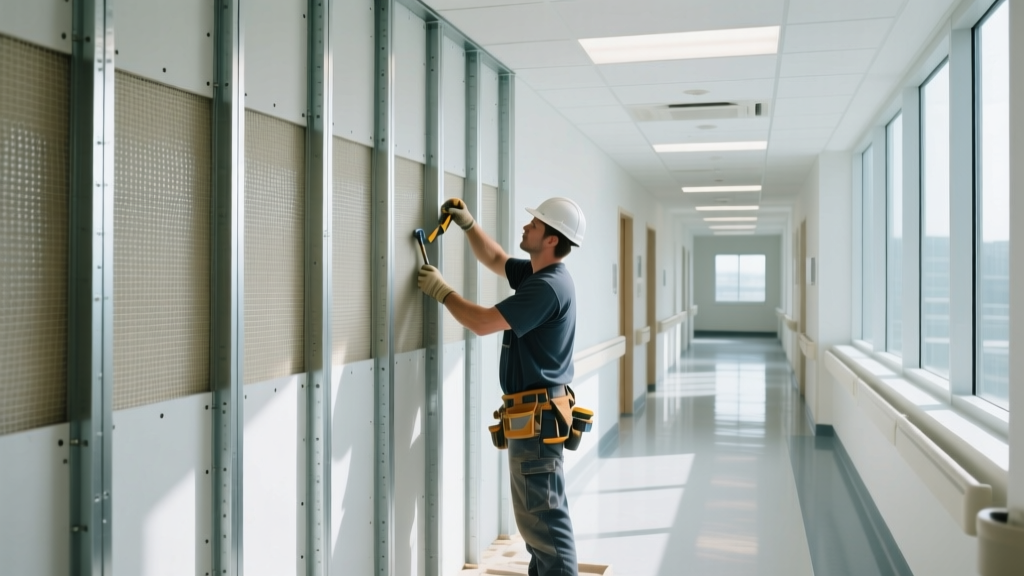
Specifying standard drywall for high-traffic commercial zones guarantees a cycle of costly maintenance. Gurneys in hospitals, carts in school hallways, and luggage in hotel corridors will quickly dent, puncture, and degrade standard 5/8-inch Type X panels. Abuse resistant gypsum board solves this through three distinct structural enhancements: a high-density calcium sulfate core, reinforced heavy-duty face paper, and a fiberglass mesh backing.
When evaluating panels, architects and contractors must distinguish between surface abuse and structural impact. Surface abuse refers to scuffs, scratches, and minor indentations from everyday friction. Impact resistance refers to the panel's ability to withstand concentrated, high-velocity strikes without puncturing or suffering core fracture.
Top Product Lines and Specifications (2026 Market)
The commercial gypsum market is dominated by three primary manufacturers offering specialized AR panels. All products listed below meet or exceed ASTM C1629 (Standard Classification for Abuse-Resistant Nondecorated Interior Gypsum Panel Products and Fiber-Reinforced Cement Panels).
| Product Line | Manufacturer | Core Thickness | ASTM C1629 Rating | 2026 Material Cost |
|---|---|---|---|---|
| Sheetrock Brand Abuse-Resistant Firecode C | USG | 5/8 in. | Level 2 (Moderate) | $0.95 - $1.15 / sq. ft. |
| ToughRock Abuse-Resistant | CertainTeed | 5/8 in. | Level 2 (Moderate) | $0.90 - $1.10 / sq. ft. |
| Gold Bond XP Abuse-Resistant | National Gypsum | 5/8 in. | Level 2 (Moderate) | $0.92 - $1.12 / sq. ft. |
| Sheetrock Brand Extreme Impact | USG | 5/8 in. + Backing | Level 4 (Severe) | $1.85 - $2.30 / sq. ft. |
Framing and Fastening: The Hidden Weak Point
The most common failure in abuse-resistant wall assemblies is not the drywall itself, but the framing behind it. If a heavy cart strikes an AR panel mounted on flimsy 25-gauge studs at 24 inches on-center, the drywall will survive, but the studs will deflect. This deflection transfers kinetic energy to the panel joints, causing the tape and compound to fracture.
According to the Whole Building Design Guide (WBDG), high-traffic interior partitions require rigid structural backing. For all abuse-resistant applications, you must specify a minimum of 20-gauge steel studs (16-gauge is highly recommended for hospital corridors) spaced at a maximum of 16 inches on-center. Additionally, install a double bottom track or structural blocking at 48 inches above the finished floor—the exact height where most cart and gurney impacts occur.
Fastener Specifications
- Screw Type: Use only coarse-thread, bugle-head drywall screws with a minimum corrosion-resistant coating. For steel framing, fine-thread high-low screws are mandatory.
- Spacing: Fasteners must be placed every 8 inches along the edges and every 12 inches in the field. This is 33% denser than standard drywall fastening patterns.
- Penetration Depth: Screws must dimple the face paper without breaking it. A broken paper face compromises the tensile strength of the panel at the exact point of impact.
Finishing Protocols for High-Impact Seams
A wall is only as strong as its joints. Standard pre-mixed all-purpose joint compound remains slightly flexible and soft after curing, making it the primary failure point during surface abrasion. To maintain the integrity of an abuse-resistant assembly, the finishing schedule must be upgraded.
- Tape: Use fiberglass mesh tape or heavy-duty cross-laminated paper tape. Avoid standard paper tape, which can delaminate under sheer stress.
- First and Second Coats: Apply a setting-type joint compound (such as USG Durabond 45 or 90). Setting compounds cure via a chemical reaction, creating a rock-hard, high-compressive-strength surface that resists indentation.
- Top Coat: A lightweight setting compound or high-impact topping compound can be used for the final skim coat to ensure a Level 4 or Level 5 finish.
- Corner Protection: Never use standard vinyl corner bead. Specify heavy-duty stainless steel or anodized aluminum corner guards, mechanically fastened with screws before applying the setting compound.
Cost Analysis: Material vs. Lifecycle Value
While the upfront material cost for abuse resistant gypsum board is roughly 80% to 120% higher than standard 5/8-inch Type X, the lifecycle cost analysis heavily favors AR systems in commercial environments. Facility managers in healthcare and education report that standard corridor walls require patching and repainting every 18 to 24 months.
"When you factor in the labor rates for commercial drywall repair, the cost to patch and repaint a 100-foot hospital corridor twice over a five-year period exceeds the initial premium of installing abuse-resistant panels by a factor of three. The ROI on AR board is typically realized within 36 months of project handover."
Expect total installed costs (including 16-gauge framing, dense fastening, and setting-type compounds) to range from $6.50 to $9.00 per square foot in 2026, compared to $3.50 to $4.50 for standard commercial partitions. For detailed standard classifications, refer to the Gypsum Association's technical resources.
Decision Framework: When to Specify AR Board
Use this practical framework to determine the appropriate panel specification for your project zones:
- Specify Standard 5/8" Type X: Private offices, low-traffic residential corridors, back-of-house storage, and ceilings.
- Specify Abuse-Resistant (Level 2): Public school hallways, hotel guest corridors, retail back-aisles, and standard hospital patient room interiors.
- Specify Extreme Impact-Resistant (Level 3/4): Psychiatric facilities, correctional institutions, main hospital gurney corridors, loading dock staging areas, and elevator lobbies.
Does abuse-resistant board improve acoustic performance?
Marginally. The increased core density of AR board (approx. 2.3 lbs per board foot vs. 1.8 lbs for standard) provides a slight bump in mass, improving Sound Transmission Class (STC) by 1 to 2 points. However, if acoustics are a primary concern, you should pair AR board with sound-damping insulation and resilient channels, rather than relying on the panel's mass alone.
Can I use standard joint compound on AR board?
Technically yes, but it violates the principle of the assembly. Standard pre-mixed compound will dent and scuff much faster than the AR panel itself, creating a visible weak point at every seam. Always use setting-type compounds for the base coats to ensure the joints match the durability of the field.
Is it fire-rated?
Yes. Most abuse-resistant boards are also classified as Type X or Type C, meaning they contain glass fibers and other additives to maintain structural integrity during a fire. They are fully compatible with 1-hour and 2-hour ASTM E119 fire-rated assemblies, provided the specific UL or ULC design number is followed for stud gauge and fastener spacing.
Written by
Priya KapoorPriya Kapoor is a real estate market analyst and construction economics researcher with expertise in housing affordability, development feasibility, and infrastructure investment. She holds a Master of Regional Planning from Cornell University and previously worked as a senior analyst at CBRE's Investment Properties group, where she modeled returns for $4B in mixed-use development pipelines. Priya now runs an independent research practice advising developers, municipalities, and REITs on construction cost forecasting and market timing. She publishes the quarterly "BuildMat Market Pulse" report tracking material price indices across 12 commodity categories. Based in Austin, TX, Priya serves on the board of Habitat for Humanity Austin and is a marathon runner.
More from Priya Kapoor
View all
Construction Cost
Cost to Build a 1600 Sq Ft Home in 2026: Full Breakdown
Accurate 2026 cost to build a 1600 sq ft home—material, labor, and regional pricing breakdowns included. Plan your budget with real-time estimates.
Aug 11, 2026

Wood & Lumber
Name the Types of Wood for Pressure Treatment and Preservation
Learn how to name the types of wood best suited for pressure treatment. Compare species treatability, chemical retention levels, and 2026 preservation costs.
Aug 4, 2026

Stone & Masonry
Stone Veneer Suppliers Lindenhurst: 2026 Cost Analysis
Analyze 2026 stone veneer costs in Lindenhurst, NY. Compare local supplier pricing, delivery fees, and Suffolk County installation labor rates.
Aug 4, 2026