Blue Gypsum Board Code Compliance: IBC Rules for Veneer Plaster Bases
Master IBC code compliance for blue gypsum board. Learn framing, fastening, and fire-rating rules for veneer plaster base installations in 2026.

The Critical Distinction: Blue Board vs. Moisture-Resistant Drywall
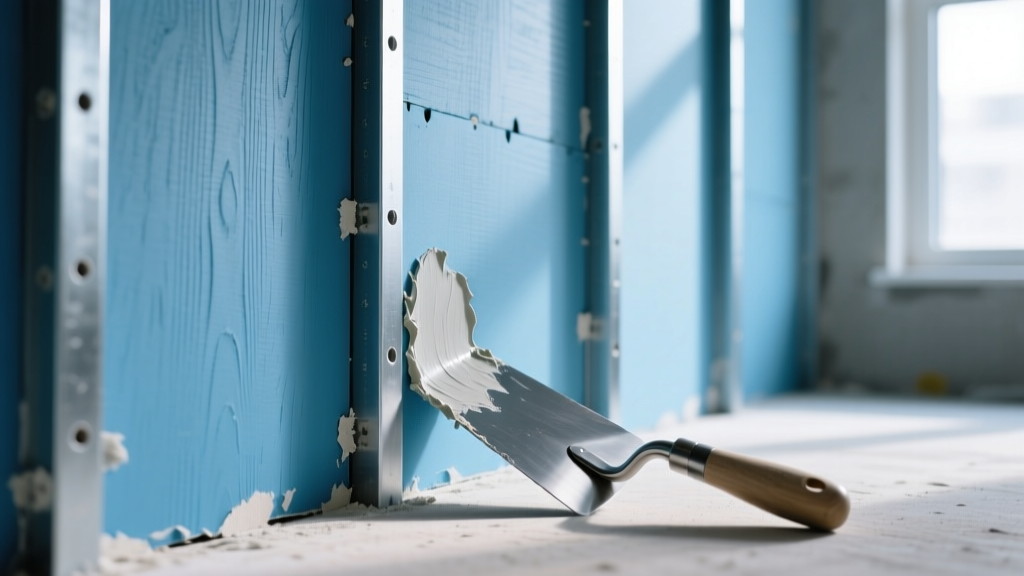
The most common code violation involving blue gypsum board stems from a fundamental material misunderstanding. In the construction industry, blue-faced gypsum board—such as USG Imperial® Veneer Finish Base or National Gypsum Kal-Kore®—is specifically engineered as a substrate for veneer plaster systems. It is not a moisture-resistant (green board) or mold-resistant (purple board) product. The blue face paper is highly absorbent, designed to draw moisture from wet plaster applications to ensure proper chemical curing and mechanical bonding.
Applying standard joint compound to blue board, or installing it in continuous high-humidity environments without a plaster finish, violates both manufacturer specifications and the International Building Code (IBC). Under IBC Chapter 25, gypsum base for veneer plaster must be treated as a distinct assembly category, separate from standard gypsum panel products used for taping and finishing.
Material Standards and ASTM C1396 Compliance
To pass municipal inspections, the blue gypsum board installed on-site must carry a certification mark indicating compliance with ASTM C1396 (Standard Specification for Gypsum Board). Specifically, inspectors will look for compliance with Section 6 of this standard, which governs 'Gypsum Base for Veneer Plaster'.
Key ASTM C1396 Section 6 Requirements
- Water Absorption: The core and face paper must meet specific absorption limits to prevent premature degradation during the wet plaster application phase.
- Surface Water Absorption: The face paper must exhibit a controlled absorption rate (typically measured via the Cobb test) to ensure the veneer plaster cures at the correct rate without blistering or delaminating.
- Thickness Tolerances: 1/2-inch boards must maintain a minimum thickness of 0.485 inches, while 5/8-inch boards must maintain a minimum of 0.610 inches to support the sheer weight of the plaster overlay.
Framing and Fastening Code Requirements
Because veneer plaster systems are heavier and more rigid than standard taped drywall, the structural framing and fastening schedules are strictly regulated. IBC Section 2508 and the Gypsum Association's GA-216 guidelines mandate maximum framing spacing and specific fastener types to prevent deflection, which can cause the brittle plaster finish to crack.
| Board Thickness | Wood Framing Max Spacing | Steel Framing Max Spacing | Required Fastener (Wood) | Required Fastener (Steel) |
|---|---|---|---|---|
| 1/2 inch | 16 inches o.c. | 16 inches o.c. (20 ga.) | 1-1/4 in. Type G or W | 1 in. Type S |
| 5/8 inch | 24 inches o.c. | 24 inches o.c. (20 ga.) | 1-5/8 in. Type G or W | 1-1/4 in. Type S |
Inspector Note: Using standard drywall screws (fine thread) on wood framing, or coarse-thread wood screws on light-gauge steel framing, is an automatic fail during rough-in inspections. Fasteners must penetrate steel studs by a minimum of 3/8 inch and wood framing by a minimum of 5/8 inch.
Fire-Resistance Ratings and Plaster Assemblies
Blue gypsum board alone does not possess a fire rating; the rating is assigned to the complete assembly (board + plaster + framing). When paired with approved veneer finishes, 5/8-inch blue board assemblies can achieve 1-hour and 2-hour fire-resistance ratings under UL and ULC classifications.
For a 1-hour rated partition, code typically requires 5/8-inch veneer plaster base on both sides of 2-1/2 inch steel studs, finished with a minimum 1/16-inch thickness of approved veneer plaster (such as Imperial® Finish or Diamond® Finish). Always verify the specific UL Design number (e.g., U336 or equivalent) on the submitted architectural plans.
Prohibited Applications: Where Code Forbids Blue Board
Despite its durability, blue gypsum board is strictly prohibited by IBC Section 2509 in areas subject to continuous high humidity or direct water exposure. Municipal inspectors will issue a stop-work order if blue board is found in the following applications:
- Shower and Tub Surrounds: Blue board cannot be used as a tile backing or substrate in wet areas. Cementitious backer units (CBU) or glass mat water-resistant gypsum (ASTM C1178) are required.
- Saunas and Steam Rooms: The absorbent nature of the blue face paper will wick ambient moisture, leading to core degradation and mold proliferation.
- Exterior Soffits: Even when protected from direct rain, the humidity fluctuations in exterior soffits exceed the environmental limits of veneer plaster bases.
Common Inspection Failures and Troubleshooting
To ensure a smooth final inspection, project managers and site superintendents must audit the installation against these frequent code violations:
⚠️ Top 3 Veneer Base Inspection Red Flags
- Improper Joint Treatment: Standard paper drywall tape and joint compound cannot be used on blue board. Code requires the joints to be treated with specific veneer plaster joint tape and a setting-type joint compound, or left open if the plaster specification dictates a two-coat system that bridges the joints.
- Missing Edge Support: All tapered and non-tapered edges must land on a framing member or blocking. Floating edges are strictly prohibited in plaster assemblies due to the impact vulnerability of thin veneer coats.
- Temperature Violations: IBC and manufacturer codes mandate that the building interior must be maintained at a minimum of 55°F (13°C) for 48 hours prior to, during, and after plaster application. Applying plaster over cold blue board prevents the chemical set of the gypsum plaster.
2026 Cost and Procurement Data
Budgeting for a veneer plaster system requires accounting for both the specialized substrate and the skilled labor required for the finish. As of early 2026, material costs for blue gypsum board reflect a premium over standard drywall, justified by the superior acoustic and impact-resistant properties of the final plaster assembly.
- Material Cost (5/8 in. Blue Board): $21.00 - $26.00 per 4x8 sheet (approx. $0.65 - $0.81 per sq. ft.).
- Material Cost (Standard 5/8 in. Drywall): $14.00 - $17.00 per 4x8 sheet (approx. $0.43 - $0.53 per sq. ft.).
- Veneer Plaster Labor & Material: $3.50 - $5.50 per sq. ft. (applied), heavily dependent on regional union labor rates and the specific finish (smooth trowel vs. sand float).
While the upfront cost of a blue board and veneer plaster system is 40% to 60% higher than a standard Level 4 drywall finish, the lifecycle cost is often lower in high-traffic commercial corridors, schools, and hospitals due to the plaster's extreme resistance to impact damage and scuffing.
Written by
James ThorntonJames Thornton is a construction industry veteran with 25 years of hands-on experience in wood framing, lumber grading, and residential building codes. He started as a framing carpenter in rural Oregon, earned his ICC Residential Building Inspector certification, and eventually became a senior plan reviewer for the City of Portland Bureau of Development Services. James holds a B.S. in Wood Science & Technology from Oregon State University and is a certified lumber grader through the West Coast Lumber Inspection Bureau (WCLIB). He has inspected over 3,000 residential construction sites and authored the city's internal guide on advanced framing techniques (2x6 at 24" O.C.). James lives in Bend, OR, where he builds custom timber-frame cabins and competes in lumberjack sports.
More from James Thornton
View all
Insulation
Best Home Insulation Materials: Complete 2026 Guide
Compare top home insulation materials for 2026. Find R-values, installed costs per square foot, and best uses for fiberglass, spray foam, and mineral wool.
Aug 4, 2026

Sustainable Building
Certify Your Green Building Material for LEED and WELL
Step-by-step guide to certifying a green building material for LEED v5 and WELL v2. Master EPDs, HPDs, and VOC limits for 2026 project specifications.
Aug 4, 2026

Stone & Masonry
Veneer Stacked Stone Panels: Interior Design & Style Showcase
Discover how veneer stacked stone panels transform interiors. Explore modern design profiles, material pairings, and technical installation specs.
Aug 4, 2026