Gypsum Board Alternatives: The Ultimate Selection Guide
Explore top gypsum board alternatives like cement board, MgO, and glass-mat panels. Compare costs, fire ratings, and moisture resistance for your next build.

The Case for Moving Beyond Standard Drywall
Standard paper-faced gypsum board remains the undisputed baseline for interior partitions, governed by ASTM C1396 specifications. At an average material cost of $0.55 to $0.75 per square foot, it offers unmatched speed of installation and predictable finishing. However, as building codes tighten around moisture management, impact resistance, and specialized fire containment, architects and contractors are increasingly specifying gypsum board alternatives to mitigate failure risks.
When standard drywall is exposed to bulk water, its paper facing becomes a primary food source for mold, and its core loses structural integrity. In high-impact zones like hospital corridors or school hallways, standard 1/2-inch panels dent and puncture easily. Selecting the right alternative requires balancing material cost, weight, framing requirements, and long-term durability.
Decision Framework: When to Switch from Standard Gypsum
- Stick with Standard/Type X Gypsum: Standard residential interiors, upper-floor bedroom partitions, and ceilings where moisture exposure is strictly controlled and impact risk is low.
- Specify Alternatives: Below-grade foundations, commercial wet areas, elevator shafts, exterior shear walls, high-traffic institutional corridors, and unconditioned spaces during the construction drying-in phase.
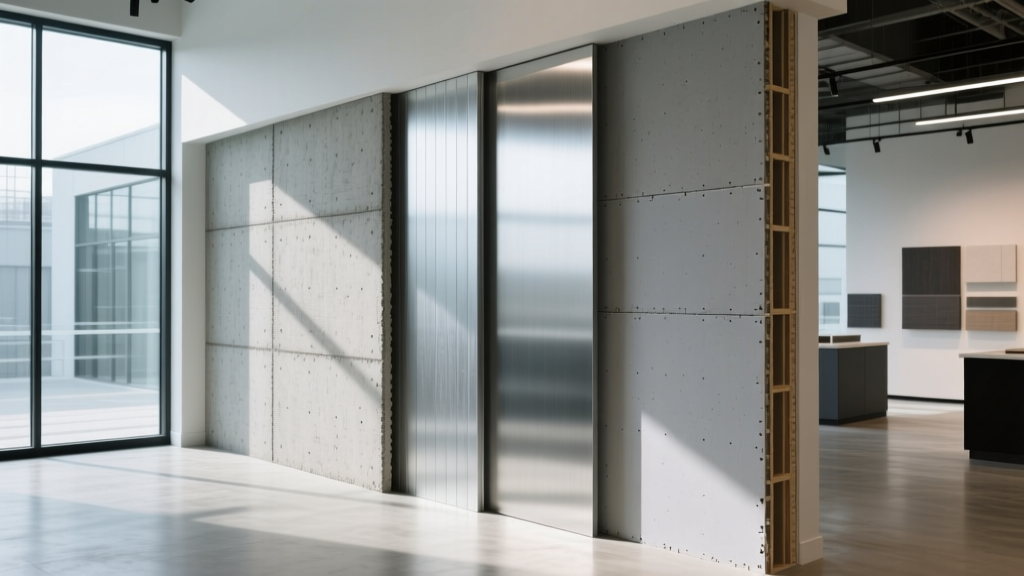
Top 4 Gypsum Board Alternatives Evaluated
1. Portland Cement Board (Fiber-Cement)
Cement board, such as USG Durock or James Hardie backer boards, replaces the gypsum core with a Portland cement matrix reinforced with fiberglass mesh. It is completely impervious to water degradation and offers exceptional impact resistance.
- Best Applications: Commercial shower surrounds, exterior tile substrates, floor underlayments, and exterior sheathing in high-wind zones.
- Material Cost: $1.15 to $1.45 per sq. ft. (for 1/2-inch panels).
- Weight: ~2.4 to 3.0 lbs per sq. ft. (nearly 50% heavier than standard drywall).
- Installation Gotcha: Standard utility knives are useless here. Cutting requires a carbide-tipped scoring tool or a diamond-blade angle grinder, which generates significant silica dust. Always specify hot-dipped galvanized or stainless steel screws (ASTM C1002 Type S) to prevent rust bleeding through finishes.
For a comprehensive look at cementitious panel specifications, manufacturers like USG provide detailed technical data sheets outlining load-bearing capacities and fastening schedules.
2. Magnesium Oxide (MgO) Board
MgO board has gained massive traction as a direct, lightweight alternative to cement board. Made from magnesium oxide and magnesium chloride (or sulfate) cements reinforced with wood fibers and glass mesh, it is naturally mold-resistant, non-combustible, and highly impact-resistant.
Early generations of imported MgO board utilized magnesium chloride, which is hygroscopic (attracts water). In humid climates, this caused boards to 'weep' corrosive salt brine, rusting fasteners and destroying adjacent metal framing. When specifying MgO board today, you must explicitly require sulfate-based (MgSO4) formulations, which are chemically stable and do not weep.
- Best Applications: Fire-rated shaft walls, exterior sheathing behind cladding, and moisture-prone commercial basements.
- Material Cost: $1.60 to $2.30 per sq. ft. (Premium pricing reflects the sulfate purification process).
- Weight: ~1.6 lbs per sq. ft. (Much lighter than cement board, easing labor costs).
- Water Absorption: Less than 5% by volume (tested via ASTM C473), compared to standard drywall which can absorb up to 10 times that amount.
- Best Applications: Exterior sheathing behind weather-resistive barriers, soffits, and interior walls in unconditioned spaces where the building envelope is not yet sealed.
- Material Cost: $1.20 to $1.55 per sq. ft.
- Best Applications: Commercial kitchens, food processing facilities, agricultural buildings, and car washes.
- Material Cost: $2.50 to $4.00+ per sq. ft.
- Advantage: Requires no taping, mudding, or painting. A simple wipe-down is the only maintenance required.
- Verify the Core Chemistry: If using MgO, demand the manufacturer's third-party lab report confirming it is a sulfate-based (MgSO4) formulation, not chloride-based.
- Match the Fastener to the Alkalinity: Ensure the bill of materials includes galvanized or stainless fasteners for any cementitious or MgO panel.
- Check Acoustic Requirements: If the alternative panel is being used in a party wall, verify the STC (Sound Transmission Class) rating. FRP and thin cement boards transmit sound poorly compared to multi-layer Type X gypsum assemblies.
- Account for Dust Mitigation: If cutting cement or MgO boards indoors, include HEPA-filtered dust extraction systems in the contractor's scope of work to comply with OSHA silica dust regulations.
3. Fiberglass-Mat Gypsum Panels (The Hybrid Alternative)
Products like Georgia-Pacific DensGlass or USG Fiberock are technically gypsum-core panels, but they replace the vulnerable paper facing with embedded fiberglass mats. This hybrid approach bridges the gap between traditional drywall workability and extreme environmental resistance. Under Gypsum Association guidelines, these panels are classified separately due to their facing materials and superior water resistance.
4. Fiber-Reinforced Polymer (FRP) & Interlocking PVC Panels
For environments where hygiene, chemical resistance, and zero moisture absorption are paramount, FRP and extruded PVC panels (like Trusscore) bypass traditional framing finishing entirely. These panels feature interlocking tongue-and-groove edges and install directly over existing substrates or bare studs.
Cost and Performance Comparison Matrix
| Material Type | Avg. Cost / Sq. Ft. | Weight (lbs/sq ft) | Water Absorption | Primary Limitation |
|---|---|---|---|---|
| Standard Paper Gypsum | $0.55 - $0.75 | 1.6 | High | Mold risk, low impact strength |
| Portland Cement Board | $1.15 - $1.45 | 2.8 | Negligible | Heavy, requires specialized cutting |
| Sulfate-Based MgO Board | $1.60 - $2.30 | 1.6 | Very Low | High material cost, supply variance |
| Fiberglass-Mat Gypsum | $1.20 - $1.55 | 1.8 | Low (<5%) | Core can still degrade if submerged |
| Interlocking PVC / FRP | $2.50 - $4.00 | 0.8 | Zero | Aesthetics, poor acoustic isolation |
Critical Installation Adjustments for Alternative Panels
Switching from standard drywall to an alternative material fundamentally alters the framing, fastening, and finishing phases of construction. Contractors must adjust their bids and schedules to account for the following variables:
Framing Spacing and Load Limits
Because cement and MgO boards are either significantly heavier or more rigid/brittle than standard gypsum, framing spacing often must be reduced. While 1/2-inch standard drywall easily spans 24 inches on center (OC) for ceilings, heavy cement board typically requires 16-inch OC framing to prevent sagging and fastener pull-through. Always verify the manufacturer's maximum deflection limits (typically L/360 for tile substrates).
Fastener Protocols and Corrosion
The alkaline nature of Portland cement and MgO will rapidly corrode standard phosphate-coated drywall screws. You must specify corrosion-resistant fasteners. For interior wet areas, ceramic-coated or hot-dipped galvanized screws are mandatory. For exterior applications or coastal environments, 304 or 316 stainless steel fasteners are required to prevent structural failure and surface staining.
Joint Treatment and Finishing
Standard paper tape and all-purpose joint compound will fail on alternative boards due to differing expansion/contraction rates and moisture exposure. Cement board joints must be taped with alkali-resistant fiberglass mesh tape and filled with a polymer-modified thin-set mortar or specialized cementitious joint compound. MgO boards often require specific polyurethane or elastomeric sealants at the joints if left exposed to weather during construction.
Proper moisture management extends beyond the panel itself. As noted by building science experts at the EPA's guidelines on mold and moisture control, the entire wall assembly—including vapor retarders and drainage planes—must be designed to dry in at least one direction, regardless of whether the interior sheathing is paper-faced drywall or cement board.
Final Specification Checklist
Before finalizing your material schedule for a commercial or high-performance residential build, run through this specification checklist:
By strategically deploying gypsum board alternatives in high-stress environments, builders eliminate the most common callbacks related to water damage, mold remediation, and impact repair, ultimately protecting the long-term integrity of the structure.
Written by
David NakamuraDavid Nakamura is a licensed architect (AIA) and construction technology writer focused on sustainable building methods, mass timber engineering, and high-performance building envelopes. He holds a Master of Architecture from the University of Washington and is a certified Passive House Consultant (CPHC). David spent eight years at the Seattle firm Mithun, where he led the design of three LEED Platinum projects, before founding his own practice specializing in net-zero residential design. He serves on the editorial advisory board of GreenBuilder Magazine and has authored peer-reviewed papers on cross-laminated timber (CLT) connections for the Journal of Structural Engineering. In his spare time, David teaches woodworking at Pratt Fine Arts Center and kayaks the Puget Sound.
More from David Nakamura
View all
Construction Cost
Labor Cost to Build a Deck Per Sq Ft: 2026 Installation Guide
Discover the exact labor cost to build a deck per sq ft in 2026. This installation guide breaks down contractor rates, complexity factors, and hidden fees.
Aug 4, 2026

Construction Cost
How Much Does It Cost to Build a 3 Bedroom House? Financing Guide
Learn exactly how much it costs to build a 3 bedroom house and explore 2026 financing options, construction loan types, and budget frameworks for your build.
Aug 4, 2026

Construction Cost
Cost to Build a Tennis Court: 2026 Guide
How much does it cost to build a tennis court in 2026? Breakdowns for asphalt, concrete, and synthetic surfaces plus fencing and lighting.
Jul 30, 2026