Preventing Drywall Cracks: Gypsum Board Specs and Performance Ratings
Understand why drywall cracks form by analyzing gypsum board specifications, framing tolerances, and performance ratings to prevent structural failures.
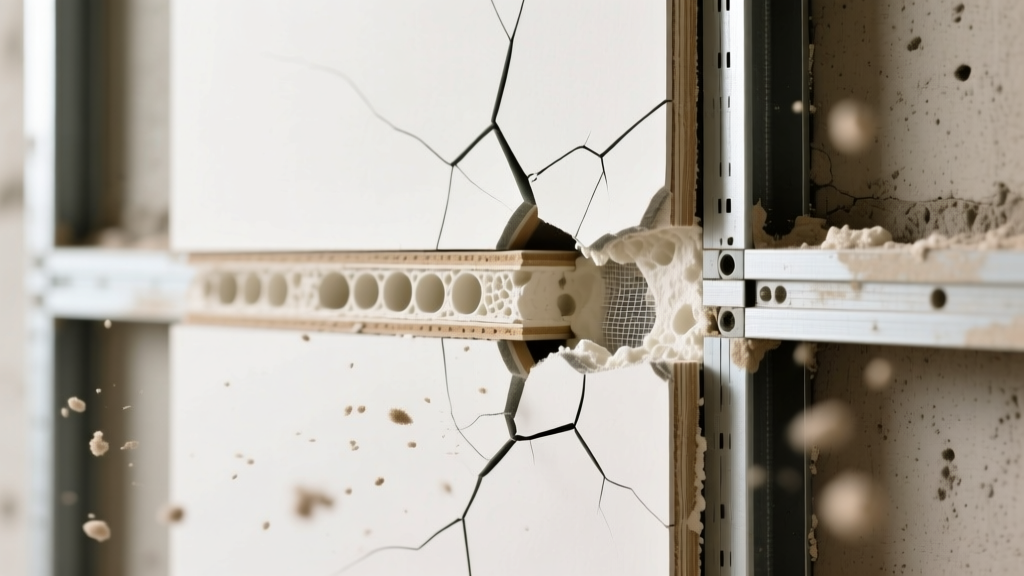
The Physics of Gypsum Board Failure
Drywall cracks are rarely just cosmetic blemishes; they are physical manifestations of specification failures, structural deflection, or environmental shear. Gypsum board (ASTM C1396) is a composite material consisting of a non-combustible calcium sulfate dihydrate core encased in a paper or glass-mat facing. While the paper facing provides high tensile strength, the gypsum core is inherently brittle and possesses low shear resistance. When framing members deflect, twist, or expand, the rigid gypsum panel cannot absorb the kinetic energy, resulting in stress concentrations that fracture the panel or tear the joint treatment.
Specification Matrix: Thickness, Spacing, and Crack Risk
The most frequent cause of field cracking and joint separation is the misapplication of panel thickness relative to framing spacing. According to guidelines published by the Gypsum Association, exceeding the maximum span rating of a gypsum panel causes gravity-induced sagging. This sagging places continuous tensile stress on the longitudinal joints, eventually tearing the paper tape and cracking the finishing compound.
| Board Thickness & Type | Max Wood Framing | Max Steel Framing | Primary Crack Risk if Exceeded |
|---|---|---|---|
| 1/4" Standard | N/A (Curved only) | 16" O.C. | Severe flex cracking, core pulverization |
| 3/8" Standard | 16" O.C. | 16" O.C. | Fastener pop, joint shear at edges |
| 1/2" Standard | 16" O.C. | 24" O.C. | Ceiling sag, longitudinal seam splits |
| 1/2" Ceiling (Lightweight) | 24" O.C. | 24" O.C. | Minimal (if properly fastened) |
| 5/8" Type X (Fire-Rated) | 24" O.C. | 24" O.C. | Minimal (High rigidity, reinforced core) |
Environmental Performance and Moisture-Induced Shear
Gypsum is hygroscopic. Standard panels will absorb ambient moisture, causing the core to expand and the paper facing to stretch. When the environment dries, the panel contracts. This continuous hygroscopic cycling creates shear forces at the rigid joints. To mitigate this, specifications must match the board's environmental performance rating to the room's humidity profile.
Moisture-Resistant (MR) and Glass Mat Specifications
For environments with sustained humidity levels above 60% (e.g., commercial kitchens, indoor pool enclosures, or unconditioned spaces during construction), standard paper-faced boards will inevitably develop joint cracks due to core degradation. Specifications must call for moisture-resistant gypsum board (ASTM C1396, Section 7) or, preferably, glass mat gypsum panels (ASTM C1278). Glass mat panels, such as those specified in USG's specialized commercial lines, utilize a fiberglass mat facing that is entirely impervious to moisture absorption, eliminating the hygroscopic expansion that tears paper tape.
Fastener Specifications and the Truss Uplift Phenomenon
Improper fastener depth is a leading cause of localized 'nail pop' cracks. Per ASTM C840 standards, drywall screws must penetrate the wood framing by a minimum of 5/8 inch. However, the critical specification is the dimple depth. The screw head must be driven exactly 1/32 inch below the paper surface. If driven flush, the head provides no holding depression for the joint compound. If driven deeper than 1/32 inch, the screw tears the paper facing, destroying the panel's tensile anchorage and guaranteeing a radial crack around the fastener within months of seasonal humidity changes.
Solving Truss Uplift Cracks
In residential construction with engineered wood roof trusses, the bottom chord of the truss is buried in insulation and remains cold and dry in winter, while the top chord is exposed to snow and moisture. This differential causes the truss to arch upward (truss uplift), pulling the ceiling drywall away from the interior partition walls and creating a massive horizontal drywall crack at the ceiling-wall intersection.
Specification Fix: Do not fasten the ceiling drywall to the bottom chord of the truss within 16 inches of the intersecting wall. Instead, specify a specialized truss clip (e.g., Simpson Strong-Tie DTC). The clip fastens to the wall top plate and slots over the truss chord, allowing the truss to move vertically up to 1/2 inch without transferring the kinetic load to the drywall panel.
Joint Compound Chemistry: Shrinkage and Tensile Strength
The final variable in crack prevention is the specification of the joint treatment system. Joint compounds are not interchangeable; they possess vastly different chemical shrinkage rates and compressive strengths. According to National Gypsum and other major manufacturers, relying solely on pre-mixed drying-type compounds for all three coats is a primary cause of seam cracking.
- First Coat (Tape Bed): Must be a setting-type compound (e.g., USG Durabond 45 or equivalent). Setting compounds undergo a chemical crystallization process rather than water evaporation. This results in near-zero volumetric shrinkage (less than 0.1%) and a compressive strength exceeding 2,500 psi. This rigidly locks the paper tape in place.
- Second Coat (Fill): Can be a high-strength drying-type compound. Drying compounds shrink up to 30% by volume as water evaporates. If used on the first coat, this shrinkage pulls the tape inward, creating a hairline crack directly over the seam.
- Third Coat (Topping): Must be a lightweight topping compound. Topping compounds are formulated with perlite or limestone aggregates to minimize shrinkage and provide a fine, easily sanded finish. They have low tensile strength and should never be used to embed tape.
By strictly aligning gypsum board thickness with framing tolerances, specifying moisture-appropriate facings, controlling fastener depth to exactly 1/32 inch, and sequencing joint compounds by their chemical shrinkage profiles, builders can effectively eliminate the structural and environmental variables that cause drywall cracks.