Drywall Finishing Tools Cost Calculator & 2026 Pricing
Calculate your 2026 drywall finishing tools costs. Compare pricing for taping knives, mud pans, and automatic tapers to budget your next gypsum board project.
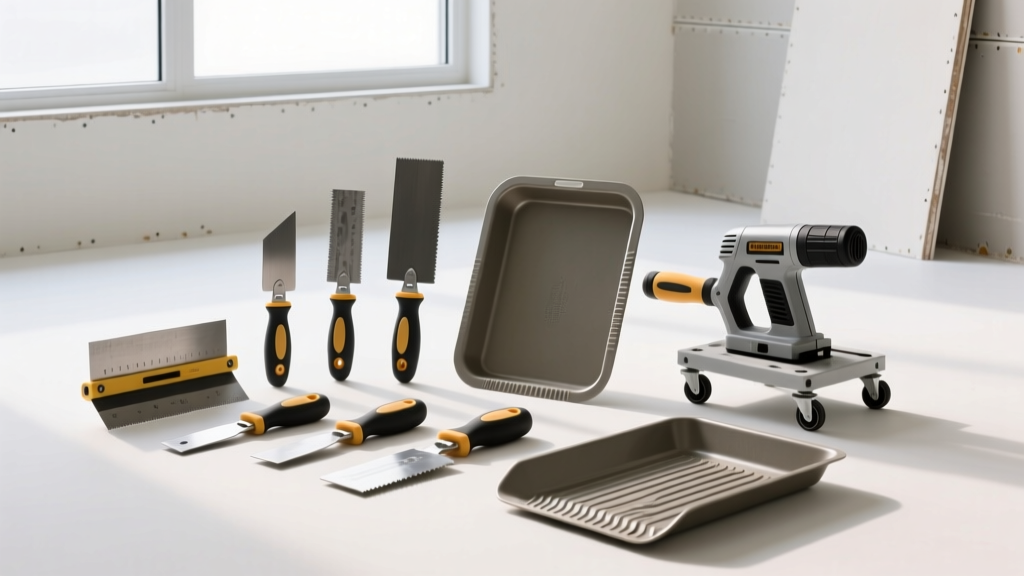
The Economics of Drywall Finishing: Fixed vs. Variable Tool Costs
Drywall finishing represents the most labor-intensive and skill-dependent phase of gypsum board installation. While material costs—such as the boards, joint compound, and paper or fiberglass tape—scale linearly with the square footage of the project, the cost of drywall finishing tools operates on a step-function model. A contractor finishing a 500-square-foot patch requires nearly the exact same baseline hand tool investment as one finishing a 2,500-square-foot basement. Understanding the distinction between fixed capital expenditures (hand tools, mechanical tapers) and variable consumables (sanding screens, mixing paddles) is critical for accurate 2026 project budgeting.
Essential Hand Tools: Unit Pricing & Metallurgy
The foundation of any finishing kit is the taping knife and mud pan. However, not all blades are created equal. The metallurgy of the blade dictates both the upfront cost and the long-term replacement frequency. According to finishing standards outlined by the Gypsum Association, the tool must maintain a perfectly straight edge to achieve a Level 4 or Level 5 finish without leaving ridges.
Blade Metallurgy and Cost Implications
- Blue Steel: The industry standard for professional finishers. It holds a sharp edge longer than stainless steel, reducing the frequency of replacement. However, it is highly susceptible to rust and requires immediate drying and oiling after use. Average 2026 cost: $30–$45 per blade.
- Stainless Steel: Rust-proof and low maintenance, making it ideal for DIYers or crews working in high-humidity environments. The trade-off is a softer edge that dulls faster, requiring replacement 30% more often in high-volume commercial applications. Average cost: $35–$55 per blade.
- Carbon Steel: The cheapest option, but highly prone to corrosion and edge degradation. Not recommended for professional use where a Level 5 skim coat is required. Average cost: $12–$18 per blade.
2026 Hand Tool Pricing Matrix
| Tool Category | Recommended Model / Spec | 2026 Unit Cost | Expected Lifespan |
|---|---|---|---|
| 6' Taping Knife | Level 5 Blue Steel (4-750) | $34.00 | 2–3 years |
| 10' Finishing Knife | Marshalltown Stainless (D810S) | $48.50 | 1.5–2 years |
| 12' Skim Coat Blade | Goldblatt Blue Steel (14-12) | $62.00 | 1–2 years |
| Mud Pan | Level 5 Aluminum 13' (4-813) | $28.00 | 5+ years |
| Corner Trowel | Goldblatt Stainless Inside/Outside | $55.00 | 3–4 years |
| Pole Sander Head | Marshalltown Swivel Head (DS891) | $32.00 | 2 years |
Mechanical & Automatic Taping Tools: Rent vs. Buy Analysis
For projects exceeding 3,000 square feet of drywall, manual taping and mudding become economically unviable due to labor costs. Automatic taping tools (auto-tapers, flat boxes, and compound pumps) drastically reduce labor time but require a massive upfront capital outlay. Leading manufacturers like TapeTech and Level 5 Tools dominate this space.
The Break-Even Calculation Framework
To determine whether to rent or purchase an automatic finishing kit in 2026, use the following break-even formula. A standard professional auto-taper kit (pump, taper, flat box, corner roller) costs approximately $4,200 to buy new. Renting the same kit from a national equipment rental chain averages $185 per day.
Break-Even Formula:
Capital Cost / Daily Rental Rate = Break-Even Days
$4,200 / $185 = 22.7 Days
If your crew finishes drywall for more than 23 days per year (roughly 45,000 square feet of board at standard commercial speeds), purchasing the equipment yields a positive ROI. If you only finish 4 to 5 residential basements a year (approx. 12 days of finishing), renting remains the mathematically superior choice.
Dust Extraction and Sanding Equipment Costs
The shift toward Level 5 finishes and stricter OSHA regulations regarding respirable crystalline silica dust has made mechanical dust extraction a mandatory cost center for professional gypsum board contractors. Manual pole sanding with standard screens is no longer viable for commercial bids.
Sanding Equipment Tiers
- Manual Pole Sanding (Tier 1): Costs $45–$65 for the pole and head. Consumable 120-grit sanding screens cost $1.20 each. Use case: Small patches, DIY, unoccupied residential renovations.
- Handheld Drywall Sanders with Vacuum (Tier 2): Tools like the Porter-Cable 7800 or Wen 4370 range from $140 to $220. They require pairing with a shop vac equipped with a HEPA filter (adding $150). Use case: Independent contractors doing 1-2 homes a month.
- Professional Giraffe Sanders & Dust Extractors (Tier 3): The industry gold standard is the Festool Planex Drywall Sander (~$1,250) paired with a Festool CT 36 HEPA Dust Extractor (~$750). Total investment: ~$2,000. Use case: High-end residential and commercial contractors where dust containment is contractually mandated.
Consumables & Mixing Equipment Estimator
Beyond the primary application and sanding tools, finishing requires a steady stream of consumables and mixing hardware. Joint compound must be mixed to a specific viscosity—often compared to 'smooth peanut butter'—which requires high-torque mixing equipment to prevent burning out standard drill motors.
- Low-RPM High-Torque Drill: Standard drills spin too fast, whipping air into the compound and creating micro-bubbles that ruin the finish. A dedicated mud mixer like the Milwaukee Super Hawg (1/2 inch, 0-1000 RPM) costs $249.
- Mixing Paddles: A 24-inch stainless steel mixing paddle with a 5-inch blade costs $38. Expect to replace the paddle every 6 months due to abrasive wear from the gypsum and limestone aggregates in the compound.
- Sanding Consumables: For a standard 2,000 sq. ft. home (approx. 8,000 sq. ft. of drywall surface), budget for 40-50 sanding screens or sponges. At $1.50 per screen, allocate $75 per project for sanding consumables.
- Cleaning Solvents: While water cleans wet joint compound, dried compound requires mechanical scraping. Budget $15 per month for brush cleaners and rust-inhibitor sprays for blue steel tools.
Expert Insight: Never use a standard drill to mix setting-type compounds (like Durabond 90 or Easy Sand 45). These setting compounds cure via a chemical reaction and are significantly denser and more abrasive than pre-mixed air-drying compounds. Mixing them with a standard 20V cordless drill will strip the planetary gears within three to five batches. Always use a dedicated 120V corded low-RPM mixer.
Total Project Tool Budget Formula
To accurately estimate the tool and consumable overhead for your next gypsum board project, input your project variables into this standardized 2026 formula:
Total Finishing Overhead = (Baseline Hand Tools * Depreciation Rate) + (Auto Tool Rental Days * Daily Rate) + (Square Footage / 100 * $3.50 Consumable Factor)
Example Calculation for a 3,000 sq. ft. commercial tenant improvement (12,000 sq. ft. of board):
- Hand Tool Depreciation (15% of $500 kit): $75
- Auto Tool Rental (4 days @ $185): $740
- Consumables (12,000 / 100 * $3.50): $420
- Total Tool & Consumable Budget: $1,235
Frequently Asked Questions
Do I need to buy specialized tools for moisture-resistant (green) or fire-rated (Type X) drywall?
No. The core gypsum and facing paper change, but the finishing tools remain identical. You will use the same 6', 10', and 12' taping knives and flat boxes. However, Type X drywall is 5/8-inch thick and heavier, which may require a heavier-duty drywall lift (rental cost ~$110/day), but the finishing hand tools do not need to be upgraded.
How often should I replace my sanding screens when doing a Level 5 skim coat?
A Level 5 finish requires a full skim coat of joint compound over the entire board surface. This creates significantly more dust and friction than standard Level 4 taping. Expect to replace a 120-grit sanding screen every 150 to 200 square feet of wall space during the final sanding phase. Always follow up with a 150-grit or 180-grit screen or sponge for the final polish before priming.
Is it worth buying titanium-coated taping knives?
For 95% of contractors, no. Titanium-coated knives cost 2 to 3 times more than standard blue steel ($85–$120 per blade). While they offer superior rust resistance and slightly better edge retention, the high upfront cost rarely yields a positive ROI compared to simply replacing a $35 blue steel blade when it dulls or pits. Stick to high-carbon or blue steel and maintain them properly with WD-40 or camellia oil after every wash.