Troubleshooting a Compromised Type X Gypsum Board Fire Rating
Learn how to troubleshoot and repair a compromised Type X gypsum board fire rating. Expert fixes for penetrations, joints, and water damage.

The Mechanics of Type X Fire Resistance and Failure Points
Type X gypsum board is the backbone of passive fire protection in commercial and multi-family residential construction. Standard 5/8-inch Type X panels achieve a 1-hour fire rating on a single layer (wood or steel studs) and a 2-hour rating when applied in two layers. The fire resistance is not merely a product of thickness; it relies on a precise core formulation. The calcined gypsum core contains chemically bound water (calcium sulfate dihydrate) and is reinforced with continuous glass fibers.
When exposed to fire, the gypsum undergoes calcination, releasing water vapor to delay heat transmission. The glass fibers hold the calcined core together, preventing the board from cracking and falling off the framing. However, the type x gypsum board fire rating is an assembly rating, not just a material rating. If the continuous membrane is broken by unsealed penetrations, improper patching, or moisture degradation, the entire assembly fails to meet NFPA 101 Life Safety Code requirements.
Symptom-to-Fix Decision Matrix
Identifying the root cause of a compromised fire rating is the first step in remediation. Use this diagnostic matrix to determine the required repair protocol.
| Observed Symptom | Root Cause | Code Violation | Required Repair Action |
|---|---|---|---|
| Visible gaps around pipes/wires | HVAC or plumbing retrofits without firestopping | Allows smoke and flame spread through annular gaps | Apply intumescent sealant and mineral wool backing |
| Cracks at butt joints or corners | Structural shifting or use of drying-type compound | Breaks the continuous fire-resistive membrane | Re-tape and apply setting-type compound (base coat) |
| Soft, swollen, or discolored drywall | Water leak or prolonged high humidity exposure | Core delamination destroys structural fire integrity | Cut out damaged section; patch with new 5/8" Type X |
| Oversized electrical box cutouts | Router slip or incorrect box sizing during rough-in | Gap exceeds the 1/8-inch maximum allowance | Install firestop putty pads or non-combustible mortar |
Troubleshooting Specific Failure Scenarios
Scenario 1: Unsealed Electrical and Plumbing Penetrations
The most common violation in Type X assemblies occurs during secondary trades. When electricians or plumbers drill through a rated partition, the resulting annular gap must be sealed to match the wall's rating. According to the UL Fire Resistance Directory, metallic pipes and conduit require specific sealant depths based on the diameter of the penetration.
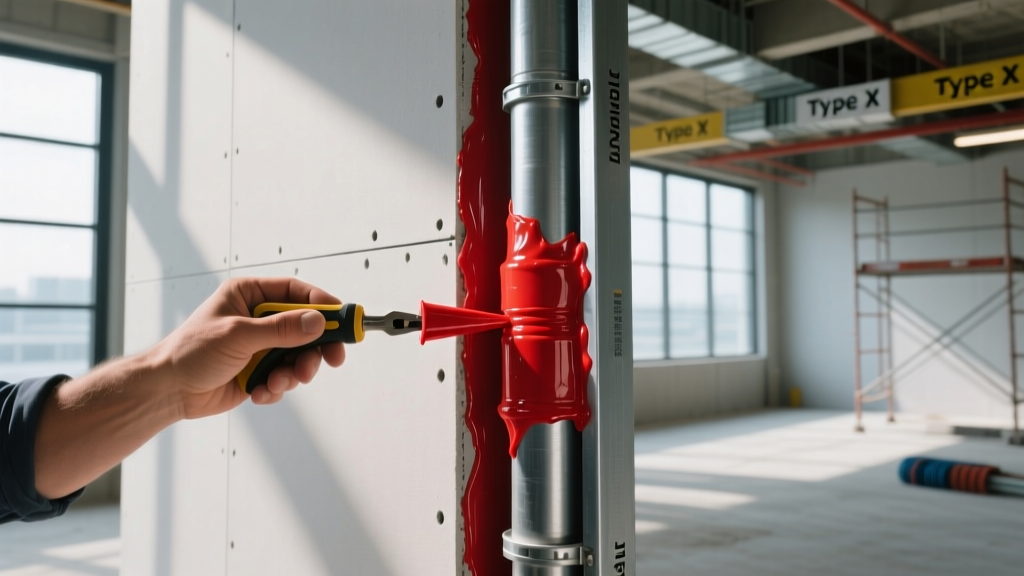
- Small Penetrations (Under 2 inches): Clean the gap, apply a minimum 1/2-inch depth of a tested intumescent sealant (e.g., 3M Fire Barrier Sealant FD 150+ or Hilti CP 606). The sealant must bond directly to the gypsum core, not just the paper facing.
- Large Penetrations (2 to 6 inches): Intumescent sealant alone will sag and fail. You must pack the annular gap with high-density mineral wool (minimum 4 pcf density) to within 1 inch of the wall surface, then cap it with 1 inch of intumescent sealant.
- Plastic Pipes (PVC/CPVC): Plastic melts during a fire, leaving a massive hole. You must use a firestop device (like a SpecSeal intumescent collar) or a heavy-bodied ablative sealant specifically tested for plastic pipe consumption.
Scenario 2: Improper Patching with Standard Drywall
Contractors frequently make the mistake of using leftover 1/2-inch standard drywall to patch holes in a 5/8-inch Type X wall. This creates a thermal weak point. Furthermore, using standard all-purpose joint compound (drying-type) for the base coat compromises the joint. Drying-type compounds shrink and contain high levels of organic binders that burn out rapidly under heat.
Scenario 3: Water Damage and Core Delamination
Type X gypsum board is highly susceptible to moisture. If a roof leak or plumbing burst saturates the board, the paper facers delaminate from the core. Even if the board dries out, the structural bond is permanently destroyed. In a fire event, the calcined core will crumble and fall away from the fasteners because the glass fiber matrix can no longer anchor to the degraded paper and crumbly core. Any Type X board that has been saturated must be cut out and replaced. Do not attempt to encapsulate water-damaged fire-rated drywall with sealers or skim coats.
Step-by-Step Repair Protocol for Fire-Rated Assemblies
When executing repairs on a compromised Type X assembly, follow this strict sequence to ensure code compliance and passing inspections.
- Identify the Original UL Design: Consult the building's architectural plans or the Gypsum Association Fire Resistance Design Manual to determine if the wall is a 1-hour (e.g., UL U305 for wood studs) or 2-hour (e.g., UL U419 for steel studs) assembly. This dictates the number of layers and fastener spacing.
- Cut and Prep the Substrate: Use a drywall router or jab saw to create clean, square edges around the damaged area. Cut back to the center of the nearest studs to ensure the new patch has a solid nailing surface. Vacuum all gypsum dust from the cavity; dust prevents firestop sealants from adhering properly.
- Install the Patch: Cut a new piece of 5/8-inch Type X gypsum board. Secure it using Type S (steel studs) or Type W (wood studs) drywall screws. Fasteners must be spaced no more than 12 inches on center along the perimeter and field, driven just below the paper surface without breaking the paper.
- Tape and Finish: Apply fiberglass mesh tape or paper tape over the joints. Embed the tape in a setting-type compound. Apply a minimum of two additional coats, feathering the edges to a minimum 12-inch width to ensure a smooth, continuous surface.
- Firestop Penetrations: If the repair involves a penetration, apply the approved firestop system. Ensure the sealant is tooled smooth and fully contacts both the penetrating item and the gypsum core.
Approved Firestop Materials & 2026 Cost Estimates
Budgeting for fire-rated repairs requires an understanding of specialized material costs. Standard drywall supplies will not suffice. Below are current market averages for professional-grade firestop materials.
| Material Category | Specific Product Example | Approx. Unit Cost (2026) | Primary Application |
|---|---|---|---|
| 5/8" Type X Panel (4x8) | USG Sheetrock Firecode X | $22.00 - $28.00 / sheet | Base membrane patching |
| Intumescent Sealant (10.1 oz) | 3M Fire Barrier Sealant FD 150+ | $9.50 - $14.00 / tube | Metallic pipe and conduit gaps |
| Firestop Putty Pad | Hilti CFS-P PA | $6.00 - $10.00 / pad | Behind electrical outlet boxes |
| Mineral Wool Batt (High Density) | Roxul Safe 'n' Sound | $1.60 - $2.50 / sq ft | Backing for large annular gaps |
| Setting-Type Compound (25 lb) | USG Durabond 90 | $18.00 - $24.00 / bag | Fire-resistant joint base coats |
Inspection and Code Compliance Checklist
Before closing out a repair ticket or calling for a municipal fire inspection, verify the assembly against this checklist. Fire marshals and third-party inspectors (like IFC or FM Global representatives) will reject assemblies for minor deviations.
- Fastener Verification: Are screws spaced correctly (max 12" O.C.) and are there any missed studs or popped screws?
- Joint Treatment: Are all joints, including the perimeter where the wall meets the ceiling or floor, taped and finished with setting-type compound?
- Annular Gap Limits: Do all pipe penetrations fall within the maximum annular gap allowed by the specific UL design (typically 1 inch max, but varies by manufacturer)?
- Sealant Depth: Is the intumescent sealant applied to the correct depth (usually 1/2" to 1" depending on pipe diameter) and fully tooled?
- Electrical Box Protection: If boxes are installed back-to-back on opposite sides of the wall, are they separated by a minimum of 24 inches horizontally, or protected by firestop putty pads?
- Documentation: Is the specific UL design number and the manufacturer's firestop system number labeled on the wall near the penetration? (Many jurisdictions now require physical labeling of firestop systems with the installer's name and date).
Restoring a type x gypsum board fire rating requires strict adherence to tested assembly designs. By diagnosing the exact failure mode and utilizing specialized setting compounds and intumescent materials, contractors can ensure the passive fire protection system performs as engineered during a critical event.
Written by
Priya KapoorPriya Kapoor is a real estate market analyst and construction economics researcher with expertise in housing affordability, development feasibility, and infrastructure investment. She holds a Master of Regional Planning from Cornell University and previously worked as a senior analyst at CBRE's Investment Properties group, where she modeled returns for $4B in mixed-use development pipelines. Priya now runs an independent research practice advising developers, municipalities, and REITs on construction cost forecasting and market timing. She publishes the quarterly "BuildMat Market Pulse" report tracking material price indices across 12 commodity categories. Based in Austin, TX, Priya serves on the board of Habitat for Humanity Austin and is a marathon runner.
More from Priya Kapoor
View all
Construction Cost
Cost to Build a 1600 Sq Ft Home in 2026: Full Breakdown
Accurate 2026 cost to build a 1600 sq ft home—material, labor, and regional pricing breakdowns included. Plan your budget with real-time estimates.
Aug 11, 2026

Wood & Lumber
Name the Types of Wood for Pressure Treatment and Preservation
Learn how to name the types of wood best suited for pressure treatment. Compare species treatability, chemical retention levels, and 2026 preservation costs.
Aug 4, 2026

Stone & Masonry
Stone Veneer Suppliers Lindenhurst: 2026 Cost Analysis
Analyze 2026 stone veneer costs in Lindenhurst, NY. Compare local supplier pricing, delivery fees, and Suffolk County installation labor rates.
Aug 4, 2026