How Much Does Gypsum Board Weigh? Cost & Handling Guide
Discover exactly how much gypsum board weighs by thickness and size, and learn how drywall weight directly impacts freight, labor, and disposal costs.

The Hidden Costs of Drywall Weight in Construction
When estimating a drywall project, most contractors and homeowners focus strictly on the per-sheet material price. However, the physical mass of the material dictates a cascade of secondary expenses. Understanding exactly how much gypsum board weighs is not just a matter of structural engineering or worker safety; it is a critical cost-analysis metric that influences freight surcharges, labor productivity, equipment rentals, and landfill tipping fees.
A standard 4x8 sheet of 1/2-inch drywall weighs roughly 51 pounds, while a 4x12 sheet of 5/8-inch Type X fire-rated board tips the scales at over 105 pounds. This 50-pound variance per sheet scales exponentially across a multi-room residential build or a 10,000-square-foot commercial tenant improvement. Below, we break down the exact weight specifications of modern gypsum products and analyze how those numbers translate to your 2026 bottom line.
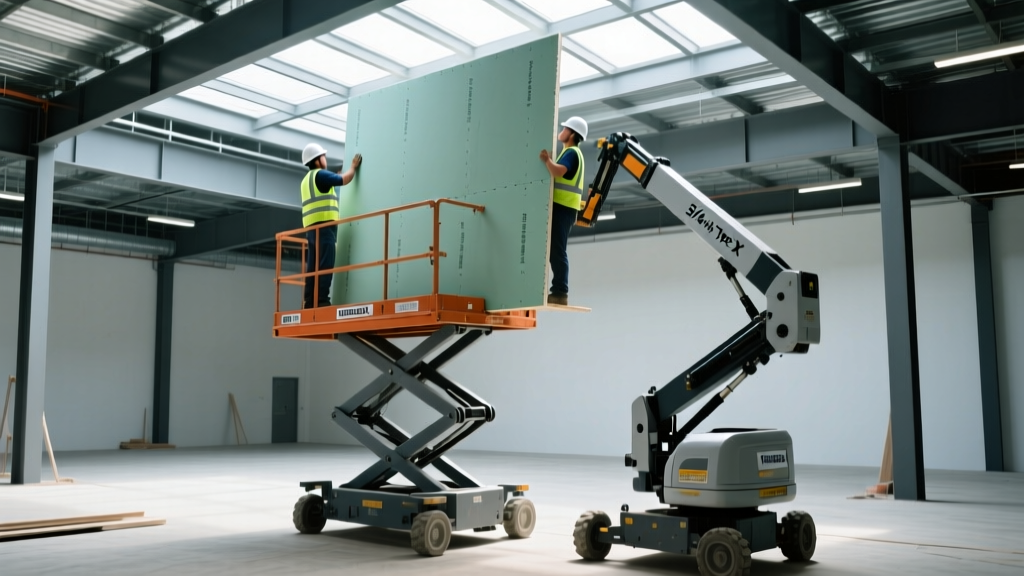
Gypsum Board Weight Matrix: By Thickness and Dimension
The weight of gypsum board is determined by its core density, the thickness of the gypsum plaster, and the fiberglass or paper facing. Specialty boards, such as moisture-resistant or fire-rated Type X, contain denser cores and non-combustible fibers, increasing their overall mass.
| Board Type | Thickness | Dimensions | Weight per Sq. Ft. | Total Sheet Weight |
|---|---|---|---|---|
| Standard Regular | 1/4" | 4' x 8' | 1.2 lbs | 38.4 lbs |
| Standard Regular | 3/8" | 4' x 8' | 1.4 lbs | 44.8 lbs |
| Standard Regular | 1/2" | 4' x 8' | 1.6 lbs | 51.2 lbs |
| UltraLight (e.g., USG Sheetrock) | 1/2" | 4' x 8' | 1.25 lbs | 40.0 lbs |
| Type X Fire-Rated | 5/8" | 4' x 8' | 2.2 lbs | 70.4 lbs |
| Type X Fire-Rated | 5/8" | 4' x 12' | 2.2 lbs | 105.6 lbs |
| Moisture/Mold Resistant (Green/Purple) | 5/8" | 4' x 8' | 2.3 lbs | 73.6 lbs |
| Glass Mat Exterior (e.g., DensGlass) | 5/8" | 4' x 8' | 2.4 lbs | 76.8 lbs |
How Drywall Weight Drives Freight and Delivery Surcharges
Gypsum board is one of the heaviest and most volume-intensive materials on a job site. Because it is dense but relatively fragile, it cannot be stacked infinitely high. This creates a "cube-out" or "weigh-out" dilemma for logistics providers.
Flatbed vs. LTL Shipping Realities
For large commercial orders, drywall is shipped via flatbed trucks. A standard flatbed trailer has a legal payload limit of roughly 44,000 to 48,000 pounds depending on state axle weight laws. If you are ordering 5/8" Type X board (70.4 lbs per 4x8 sheet), a single truck can only carry about 600 sheets before maxing out the weight limit, even if there is empty physical space on the trailer.
Conversely, 1/2" UltraLight panels allow you to fit roughly 1,000 sheets on the same truck before hitting the weight limit. In 2026, with regional flatbed freight rates averaging $2.80 to $3.50 per mile, reducing the number of required truckloads by switching to lightweight panels (where code permits) can save $1,500 to $2,500 in logistics costs on a multi-state material haul.
Local Delivery and Boom Truck Fees
For residential deliveries, suppliers use boom trucks equipped with hydraulic cranes to lift the material to upper floors or through second-story windows. Suppliers typically charge a base delivery fee (often $95 to $150) that includes a specific weight allowance, usually up to 4,000 lbs. If your order of heavy 5/8" moisture-resistant boards exceeds this threshold, you will face an overweight surcharge or be forced to accept split deliveries, doubling your freight fees.
Labor Productivity and Equipment Rental Costs
The most significant financial impact of gypsum board weight occurs during installation. The human body can only safely carry and maneuver so much mass before fatigue sets in, leading to slower production rates and increased risk of workplace injury.
The Lightweight Drywall ROI Calculation
Manufacturers like USG and CertainTeed have heavily invested in lightweight gypsum technology. A 1/2" lightweight panel weighs roughly 25% less than a standard 1/2" panel (40 lbs vs. 51.2 lbs). While the lightweight material carries a premium of roughly $1.50 to $2.50 per sheet, the labor savings often outweigh the material cost.
Hanging a 105-pound 4x12 sheet of 5/8" board on a ceiling requires a minimum of three workers or a mechanical lift. A two-person crew hanging 1/2" lightweight boards on walls can maintain a pace of 1,200 to 1,500 square feet per day. The same crew wrestling with heavy 5/8" boards may drop to 800 square feet per day due to the physical toll and the need for constant repositioning. At an average union or prevailing drywall labor rate of $45 to $65 per hour per worker in 2026, a 10% drop in productivity can add thousands of dollars to a mid-sized project.
Mechanical Lift Rentals
When ceiling-hanging heavy 5/8" Type X or glass-mat boards, mechanical drywall lifts are mandatory for safety and OSHA compliance. Renting a standard 11-foot drywall lift costs between $45 and $65 per day, or $350 to $450 per week. For a 4-week commercial ceiling project requiring three lifts to maintain schedule, you are adding roughly $3,500 to $4,500 in equipment rental overhead directly attributable to the weight of the material.
Disposal: The Landfill Tipping Fee Multiplier
Drywall generates massive amounts of waste. Off-cuts, damaged sheets, and demolition debris must be hauled away. Landfills charge "tipping fees" based on weight, typically measured by scaling the dump truck upon entry and exit.
As of 2026, municipal and private landfill tipping fees for construction and demolition (C&D) debris average between $50 and $90 per ton, with some strict environmental zones in states like California or Massachusetts charging upwards of $120 per ton for gypsum due to the hydrogen sulfide gas it can produce when decomposing anaerobically.
"A 10,000 square foot commercial demolition generating 15% drywall waste yields roughly 2.25 tons of gypsum scrap. At $85 per ton, the disposal cost alone is nearly $200. If you are demolishing double-layer 5/8" fire-rated assemblies, that weight—and the corresponding tipping fee—doubles."
— Construction Waste Management Institute, 2025 C&D Debris Report
Strategic Decision Framework: Choosing Your Board
Use the following matrix to make cost-optimized decisions regarding drywall weight for your specific project scenario.
| Project Scenario | Recommended Board | Weight Strategy & Cost Justification |
|---|---|---|
| Residential Walls & Ceilings | 1/2" UltraLight | Minimize Weight. The $2.00/sheet premium is easily recovered by faster hanging times and eliminating the need for ceiling lifts. |
| Commercial Fire-Rated Assemblies | 5/8" Type X | Accept Heavy Weight. Code mandates the mass for fire resistance. Budget for 3-man crews and mechanical lift rentals. |
| Curved Walls & Arches | 1/4" Flexible | Leverage Light Weight. 38 lbs per sheet allows single-worker handling and scoring/snapping without specialized tools. |
| Exterior Soffits & Tile Backing | 5/8" Glass Mat | Endure Heavy Weight. DensGlass is heavy (76 lbs) but prevents costly mold remediation and structural rot in wet environments. |
Frequently Asked Questions
Why is Type X drywall so much heavier than standard drywall?
Type X drywall contains a denser gypsum core mixed with glass fibers and other non-combustible materials. This added mass and density delay the calcination process (the release of chemically bound water) when exposed to fire, allowing the board to maintain its structural integrity for 1 to 2 hours during a blaze, which is why it weighs roughly 2.2 lbs per square foot compared to 1.6 lbs for standard board.
Does lightweight drywall have the same soundproofing qualities as standard weight?
Mass is a primary component of Sound Transmission Class (STC) ratings. Because 1/2" lightweight drywall has roughly 20% less mass than standard 1/2" drywall, a single-layer partition will yield a slightly lower STC rating. To compensate in multi-family or theater builds, contractors often use lightweight boards in a double-layer application with a viscoelastic damping compound (like Green Glue) between the layers, which provides superior acoustic decoupling while managing overall wall weight.
How many sheets of drywall can a standard half-ton pickup truck hold?
A standard half-ton pickup (e.g., Ford F-150, Chevy Silverado 1500) has a payload capacity of roughly 1,500 to 1,800 pounds. If you are hauling standard 51-pound 1/2" 4x8 sheets, you can safely carry a maximum of 30 sheets (1,530 lbs). If you exceed this, you risk damaging the truck's rear suspension and violating DOT weight limits on public roads.
Written by
Sarah WhitfieldSarah Whitfield is a chartered quantity surveyor (MRICS) and construction cost analyst with 15 years of experience in material pricing, procurement strategy, and project budgeting. She earned her degree in Construction Management from the University of Reading (UK) and has worked on projects ranging from $2M custom homes to $180M mixed-use developments across North America and Europe. Sarah currently leads cost estimating for BuildMat Insight, maintaining a proprietary database of 4,000+ material price points updated quarterly. She is a frequent contributor to RSMeans cost data panels and has presented at the International Cost Engineering Council (ICEC) congress. Based in Denver, CO, Sarah is an avid trail runner and volunteer mentor for Women in Construction.
More from Sarah Whitfield
View all
Wood & Lumber
What Are the Different Types of Wood? A Builder's Guide
Compare structural softwoods, finish hardwoods, and engineered lumber. Analyze Janka ratings, MOE values, and 2026 pricing for construction.
Aug 4, 2026

Walls & Panels
Steel Framing vs Wood Framing: Corrosion and Moisture Defense
Compare steel framing vs wood framing for moisture resistance. Learn about galvanized coatings, condensation risks, and corrosion protection strategies.
Jul 21, 2026

Stone & Masonry
How to Cut Stone Veneer: Wet Saw vs Grinder Comparison
Compare the best tools for cutting stone veneer. We review wet saws, angle grinders, and chop saws to help you achieve clean, chip-free cuts.
Jul 21, 2026