CertainTeed Impact Moisture Resistant Gypsum Board Selection Guide
Learn how to specify and install CertainTeed impact moisture resistant gypsum board for high-traffic wet zones. Compare assemblies, costs, and ASTM ratings.

The Architectural Dilemma: High-Traffic Wet Zones
Specifying wall assemblies for environments like hospital corridors, school locker rooms, commercial kitchens, and indoor aquatic centers requires balancing two opposing forces: severe physical abuse and persistent ambient moisture. Standard drywall fails under impact, while standard moisture-resistant (MR) board lacks the structural density to withstand cart traffic and physical blows. When architects and contractors search for a comprehensive solution, selecting the right CertainTeed impact moisture resistant gypsum board system becomes critical to avoiding premature facility degradation and costly warranty claims.
This guide breaks down the exact product lines, multi-layer assembly configurations, and installation protocols required to achieve Level 3 extreme impact resistance without sacrificing moisture and mold protection.
Decoding CertainTeed’s Impact and Moisture Matrix
CertainTeed does not rely on a single "magic" panel to solve every commercial challenge. Instead, they engineer specialized boards that are often combined in multi-layer assemblies to meet rigorous ASTM standards. Understanding the distinction between their impact-resistant and moisture-resistant lines is the first step in accurate specification.
ToughRock Extreme Impact vs. Abuse-Resistant
For high-impact zones, CertainTeed offers two primary tiers of reinforced gypsum:
- ToughRock Abuse-Resistant: Features a dense, heavy-duty core and a specialized face paper. It meets ASTM C1629 Level 2 (Abuse-Resistant), suitable for standard commercial hallways and retail backrooms.
- ToughRock Extreme Impact: Engineered with a high-density core, double-layer face paper, and an integrated fiberglass mesh facer. This product achieves ASTM C1629 Level 3 (Extreme Impact-Resistant), capable of withstanding severe blunt force and sharp object indentation common in hospital gurney corridors and loading docks.
Integrating Moisture-Guard and Mold-Guard Technologies
To address the moisture component, CertainTeed’s ToughRock Mold-Guard and Moisture-Guard panels feature a moisture-resistant core and treated face/back papers that achieve a score of 10 (the highest possible) under ASTM D3273 for mold resistance. However, in zones demanding both extreme impact and extreme moisture resistance, specifiers must utilize a hybrid multi-layer assembly or specify the specialized moisture-resistant variant of the Extreme Impact panel, depending on regional factory availability.
Specifier's Decision Framework
IF the zone is a school hallway (dry, high impact) → Specify Single-Layer ToughRock Extreme Impact.
IF the zone is a commercial kitchen (high moisture, moderate impact) → Specify Single-Layer ToughRock Mold-Guard with ceramic tile finish.
IF the zone is a hospital corridor or pool equipment room (high moisture, extreme impact) → Specify a Multi-Layer Assembly (Base: Mold-Guard / Face: Extreme Impact).
Assembly Configurations: Single vs. Multi-Layer Systems
According to the Gypsum Association's technical manuals, achieving maximum performance in dual-threat environments usually requires a multi-layer approach over 20-gauge or heavier steel studs. Below is a comparison of the most common assembly strategies for 2026 commercial projects.
| Assembly Type | Layer 1 (Base) | Layer 2 (Face) | Total Thickness | ASTM C1629 Rating |
|---|---|---|---|---|
| System A (Standard Wet) | N/A | 5/8" Mold-Guard | 5/8" | Level 1 (Standard) |
| System B (Heavy Abuse) | N/A | 5/8" Extreme Impact | 5/8" | Level 3 (Extreme) |
| System C (Dual-Threat) | 1/2" Mold-Guard | 5/8" Extreme Impact | 1-1/8" | Level 3 (Extreme) |
| System D (Max Fire/Wet) | 5/8" Fire-Shield C (MR Core) | 5/8" Extreme Impact | 1-1/4" | Level 3 + 2-Hr Fire |
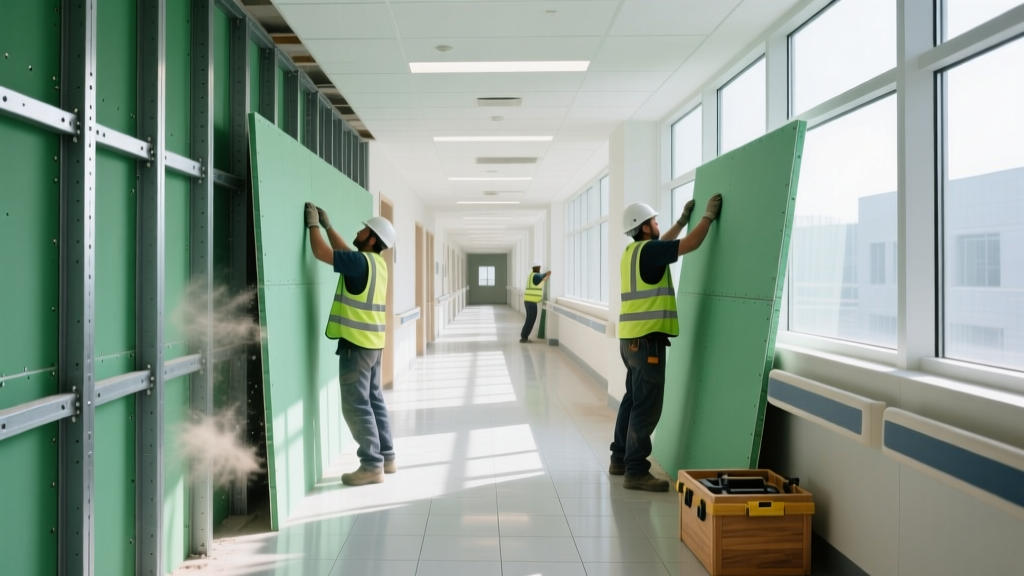
Installation Protocols for Dual-Threat Assemblies
Selecting the right CertainTeed impact moisture resistant gypsum board is only half the battle; improper fastening will compromise the entire assembly's structural integrity. When installing System C or D multi-layer configurations, contractors must adhere to strict fastening schedules.
Fastening and Screw Spacing
For multi-layer applications over steel framing, the base layer must be attached with 1-inch Type S drywall screws, while the face layer requires 1-5/8-inch or 2-inch Type S screws. The screw pattern is critical for impact deflection:
- Base Layer (Mold-Guard): Screws spaced 24 inches on center (o.c.) in the field and 8 inches o.c. on the edges. (Joints do not need to be taped).
- Face Layer (Extreme Impact): Screws spaced 12 inches o.c. in the field and 8 inches o.c. on the edges. Screws must penetrate the steel stud by at least 3/8 inch.
Never use standard paper drywall tape in moisture-prone areas, even if the face paper is moisture-resistant. Paper tape will harbor mold and delaminate if ambient humidity spikes before the HVAC system is fully balanced. Always use alkali-resistant fiberglass mesh tape embedded in a setting-type joint compound (e.g., CertainTeed ProForm Setting-Type 45 or 90) for the first coat, followed by a moisture-resistant topping compound.
2026 Cost Analysis and Budgeting
Budgeting for specialized gypsum assemblies requires looking beyond the per-sheet price. The total installed cost includes framing upgrades, specialized fasteners, premium joint compounds, and increased labor hours for multi-layer taping. Based on current commercial construction pricing data, here is what estimators should anticipate for material and labor costs.
- Standard MR Board (5/8"): $0.45 - $0.60 per sq. ft. (Material only)
- ToughRock Extreme Impact (5/8"): $0.95 - $1.25 per sq. ft. (Material only)
- System C (Dual-Threat Assembly): $2.10 - $2.60 per sq. ft. (Combined material for both layers, screws, and mesh tape)
- Premium Labor Multiplier: Expect a 30-40% increase in hanging and finishing labor costs for multi-layer impact systems compared to standard single-layer drywall, primarily due to the density of the board, increased screw counts, and specialized taping requirements.
Common Specification and Execution Mistakes
Even experienced project managers occasionally mismanage the intersection of impact and moisture resistance. Avoid these three costly errors:
- Ignoring the Bottom Track Gap: In wet zones (like pool equipment rooms or commercial laundry areas), gypsum board should never rest directly on the concrete slab. Maintain a 1/2-inch gap at the floor line and fill it with a high-quality, flexible polyurethane sealant. Capillary action will wick moisture into the dense impact core, causing the bottom 6 inches of the wall to swell and fail.
- Mismatched Framing Gauges: Hanging heavy, dense impact board on 25-gauge non-structural studs defeats the purpose. The kinetic energy from a gurney or cart impact will simply transfer through the board and bend the stud. Always specify a minimum of 20-gauge (or 16-gauge for high-risk loading zones) steel studs at 16 inches o.c. for impact-rated assemblies.
- Over-Sanding the Face Paper: The fiberglass mesh and double-layer face paper on CertainTeed's Extreme Impact boards are designed to resist tearing. If finishers aggressively over-sand the joints, they can fray the fiberglass matrix, creating a fuzzy, unpaintable surface that requires extensive skim-coating to fix.
Final Verification and Commissioning
Before closing out the project, ensure that all wall assemblies in dual-threat zones have been inspected for proper screw dimpling (no paper tearing) and that all penetrations (electrical boxes, plumbing escutcheons) are sealed with an intumescent, moisture-resistant acoustic sealant. For comprehensive fire and sound control details that intersect with these impact assemblies, always refer to the latest editions of the CertainTeed Gypsum Technical Documents and the ASTM C1629 Standard Classification for Abuse-Resistant Nondecorated Interior Gypsum Panel Products. Proper specification and rigorous installation oversight will ensure the wall system performs flawlessly for the lifespan of the facility.
Written by
Priya KapoorPriya Kapoor is a real estate market analyst and construction economics researcher with expertise in housing affordability, development feasibility, and infrastructure investment. She holds a Master of Regional Planning from Cornell University and previously worked as a senior analyst at CBRE's Investment Properties group, where she modeled returns for $4B in mixed-use development pipelines. Priya now runs an independent research practice advising developers, municipalities, and REITs on construction cost forecasting and market timing. She publishes the quarterly "BuildMat Market Pulse" report tracking material price indices across 12 commodity categories. Based in Austin, TX, Priya serves on the board of Habitat for Humanity Austin and is a marathon runner.
More from Priya Kapoor
View all
Construction Cost
Cost to Build a 1600 Sq Ft Home in 2026: Full Breakdown
Accurate 2026 cost to build a 1600 sq ft home—material, labor, and regional pricing breakdowns included. Plan your budget with real-time estimates.
Aug 11, 2026

Wood & Lumber
Name the Types of Wood for Pressure Treatment and Preservation
Learn how to name the types of wood best suited for pressure treatment. Compare species treatability, chemical retention levels, and 2026 preservation costs.
Aug 4, 2026

Stone & Masonry
Stone Veneer Suppliers Lindenhurst: 2026 Cost Analysis
Analyze 2026 stone veneer costs in Lindenhurst, NY. Compare local supplier pricing, delivery fees, and Suffolk County installation labor rates.
Aug 4, 2026