Mud for Drywall Performance Specs: ASTM Ratings and Shrinkage Data
Compare mud for drywall performance specs. Analyze ASTM C475 ratings, shrinkage percentages, setting times, and shear bond strengths for taping and topping.
The Governing Standards: ASTM C474 and C475
Joint compound—colloquially known as mud for drywall—is not merely a cosmetic filler; it is a highly engineered composite material governed by strict performance specifications. In North America, the manufacturing and testing of these compounds are dictated by two primary standards: ASTM C475 (Standard Specification for Joint Compound and Joint Tape for Finishing Gypsum Board) and ASTM C474 (Standard Test Methods for Joint Compound and Joint Tape for Finishing Gypsum Board).
ASTM C475 establishes the baseline physical requirements that all commercial mud for drywall must meet to be deemed code-compliant. These include minimum shear bond strengths, maximum moisture content limits, and specific flexibility thresholds. ASTM C474, conversely, outlines the exact laboratory procedures used to measure these metrics. Understanding the intersection of these two documents is critical for specifying the correct product in high-performance or fire-rated commercial assemblies.
- Shear Bond Strength: Minimum 15 lbs (66.7 N) for joint tape adhesion.
- Moisture Content (Setting-Type): Maximum 3.0% by weight prior to mixing.
- Flex Cracking: Must pass a 1/4-inch (6.4 mm) radius mandrel bend test without visible fracturing.
- Water Extraction: Maximum 20 grams of water extracted from a 100-gram sample under vacuum.
Drying vs. Setting Compounds: Chemical vs. Evaporative Cures
The most critical specification decision when selecting mud for drywall is choosing between drying-type and setting-type compounds. This choice dictates the curing mechanism, which directly impacts shrinkage, compressive strength, and scheduling on the job site.
The Chemistry of the Cure
Drying compounds (often sold in buckets as all-purpose, taping, or topping mud) rely on the evaporation of water to cure. Their base consists of calcium carbonate, limestone, mica, and vinyl polymers suspended in water. As the water evaporates into the ambient air and absorbs into the gypsum core, the polymers cross-link to form a solid matrix. Because water constitutes a significant portion of the wet volume, drying compounds inherently experience volumetric shrinkage.
Setting compounds (sold in dry bags, such as USG Durabond or ProForm ProSet) rely on a chemical hydration reaction. The primary active ingredient is calcium sulfate hemihydrate (calcined gypsum). When mixed with water, it undergoes an exothermic reaction, recrystallizing into calcium sulfate dihydrate. Because the water is chemically bound into the crystal structure rather than evaporating, setting compounds exhibit near-zero volumetric shrinkage and achieve significantly higher compressive strengths.
Performance Matrix: Setting vs. Drying Mud Specifications
The following matrix compares the physical specifications of a standard setting-type compound (USG Durabond 45) against a lightweight drying-type all-purpose compound (USG Sheetrock Plus 3) based on manufacturer technical data sheets and USG Joint Compound Systems documentation.
| Specification Metric | Setting-Type (Durabond 45) | Drying-Type (Plus 3 All-Purpose) |
|---|---|---|
| Curing Mechanism | Chemical Hydration | Water Evaporation |
| Volumetric Shrinkage | < 5% | 25% - 30% |
| Compressive Strength | ~1,200 psi | ~400 psi |
| Set / Dry Time | 45-65 minutes (chemical set) | 24 hours (dependent on humidity) |
| Sandability | Poor (requires hydro-sanding or scraping) | Excellent |
| Approx. Cost (2026) | $19 - $23 per 25 lb bag | $24 - $28 per 5-gallon bucket |
Shrinkage Rates and Crack Resistance by Product Tier
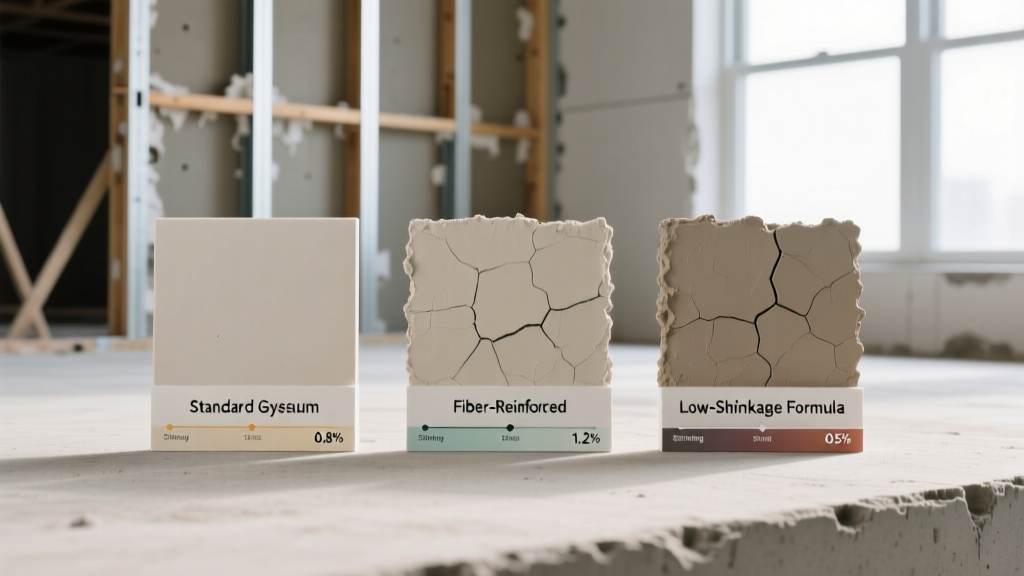
Shrinkage is the primary enemy of a flat drywall finish. As mud for drywall cures, volumetric loss pulls the material away from the gypsum board edges, creating depressions that require multiple skim coats to conceal. The Gypsum Association Technical Resources highlight that understanding product tiers is essential for minimizing labor costs associated with over-application.
- Heavyweight All-Purpose (e.g., USG Sheetrock Brand Joint Compound): Contains higher limestone content and less air entrainment. Experiences the highest shrinkage (up to 40% by volume). Best reserved for the taping coat where structural adhesion to the paper tape is prioritized over dimensional stability.
- Lightweight All-Purpose (e.g., USG Plus 3): Formulated with expanded perlite and higher polymer content, reducing the required water volume. Shrinkage is reduced to approximately 25%. Ideal for the second (filler) coat.
- Topping Compounds (e.g., ProForm ProMix Finish): Engineered with finer calcium carbonate particles and higher vinyl resin content. Shrinkage is tightly controlled around 15-20%. Designed strictly for the final skim coat where sandability and feather-edge blending are critical.
- Setting-Type (e.g., Durabond 45/90): Shrinkage is virtually non-existent (<5%). Mandated for deep fills, pre-filling gaps exceeding 1/8-inch, and the first coat in high-humidity or commercial environments where drying times are prohibitive.
Fire-Rated Assemblies: When Mud Dictates the UL Rating
A frequently overlooked specification in commercial construction is the role of joint compound in fire-rated assemblies. When a wall or ceiling is designed to achieve a 1-hour or 2-hour Underwriters Laboratories (UL) fire rating, the specific type of mud for drywall used is legally binding.
Substituting a lightweight topping compound for a specified setting-type compound in a rated assembly (such as UL Design U419 or U465) immediately voids the fire certification. Setting compounds contain chemically bound water (calcium sulfate dihydrate) that actively retards heat transfer during a fire event. Drying compounds lack this endothermic fire-resistive property once fully cured. Always verify the exact joint compound model number listed on the UL design sheet before specifying materials for rated partitions.
Troubleshooting Specification Failures in the Field
Even when high-quality mud for drywall is selected, improper application outside the material's physical specifications leads to catastrophic finish failures. Below is a diagnostic framework for the three most common spec-driven failures.
-
Blistering (Pinholes and Bubbles)
- Cause: Applying a low-viscosity topping mud over a highly porous, unprimed gypsum board. The board rapidly extracts the water from the mud, forcing trapped air out of the paper facing and into the compound.
- Specification Fix: Use a higher-viscosity all-purpose mud for the first coat, or apply a PVA primer to the board before skim coating. Ensure the mud is not over-mixed, which introduces microscopic air bubbles.
-
Joint Popping and Ridge Expansion
- Cause: Exceeding the maximum application thickness. ASTM standards and manufacturer specs dictate that no single coat of drying mud should exceed 1/8-inch in thickness. Thicker applications trap moisture against the paper tape, causing the gypsum core to expand and push the joint outward.
- Specification Fix: For gaps exceeding 1/8-inch, pre-fill with a setting-type compound (Durabond) and allow it to chemically set before applying the drying-type taping coat.
-
Flex Cracking at Board Intersections
- Cause: Using a compound that fails the ASTM C474 mandrel bend test in areas subject to structural deflection (e.g., floor trusses or long-span ceilings).
- Specification Fix: Transition to an elastomeric joint sealant or a specialized flexible setting compound at board intersections where lateral movement exceeds 1/16-inch.
Summary: Specifying for Performance
Selecting the correct mud for drywall requires moving beyond brand loyalty and focusing on the chemical and physical specifications required by the project. By aligning the curing mechanism (chemical vs. evaporative), shrinkage tolerances, and fire-rating requirements with the specific coat sequence, contractors can eliminate rework, ensure code compliance, and deliver a structurally sound, Level 5 finish.