Ballistic Gypsum Board Assemblies: Code Compliance Guide
Navigate code compliance for ballistic gypsum board assemblies. Covers UL 752 ratings, spall prevention, fire-rated integrations, and 2026 costs.

The 'Ballistic Gypsum Board' Misconception: Assemblies vs. Monolithic Panels
Architects and security consultants frequently specify 'ballistic gypsum board' in project documents for high-risk facilities like courthouses, police precincts, and executive suites. However, from a materials engineering standpoint, monolithic ballistic gypsum board does not exist. Standard gypsum (calcium sulfate dihydrate) is inherently brittle and shatters under high-velocity kinetic impact.
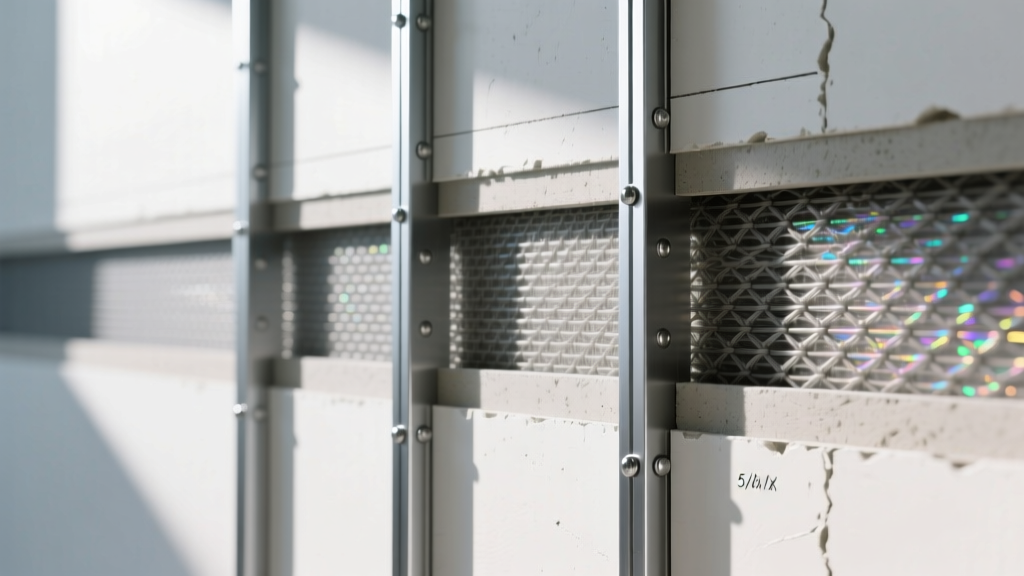
When the industry references ballistic drywall, it is specifying a composite wall assembly. This system pairs a concealed ballistic core—typically a woven roving fiberglass laminate, polycarbonate, or steel sheet—with standard 5/8-inch Type X gypsum board as the architectural facing. Understanding this distinction is the first step in achieving compliance with the International Building Code (IBC) and Underwriters Laboratories (UL) standards.
Decoding Ballistic Standards: UL 752 vs. NIJ 0108.01
Wall assemblies must be tested and certified to withstand specific ballistic threats. In the United States, commercial and municipal construction primarily relies on the UL 752 Standard for Bullet-Resisting Equipment, while federal and law enforcement applications may reference National Institute of Justice (NIJ) 0108.01 standards.
The required thickness of the hidden ballistic core dictates the depth of the wall cavity and the gauge of the steel framing required to support the immense dead load.
| UL 752 Level | Threat / Ammunition | Fiberglass Core Thickness | Weight (lbs/sq ft) |
|---|---|---|---|
| Level 1 | 9mm FMJ (3 shots) | 3/8 inch | 1.8 lbs |
| Level 3 | .44 Magnum (3 shots) | 3/4 inch | 3.5 lbs |
| Level 4 | .30 Caliber Rifle (1 shot) | 1 inch | 4.8 lbs |
| Level 8 | .308 Win / 7.62mm NATO (5 shots) | 1-1/4 inch | 6.2 lbs |
Fire Rating Integration: Maintaining ASTM E119 Continuity
The most complex code compliance hurdle for ballistic drywall systems occurs when the wall must also serve as a fire-resistance-rated barrier (e.g., a 2-hour corridor wall per IBC Chapter 7). Adding a dense, non-combustible-but-thermally-insulative fiberglass or polycarbonate core inside a UL 263 fire-rated wall assembly alters the thermal transmission dynamics.
The Gypsum Association Protocol
According to the Gypsum Association Fire Resistance Design Manual, you cannot simply insert a ballistic panel into an existing rated assembly and assume it maintains its fire rating. To ensure compliance:
- Mandatory Type X Facing: The gypsum board on both the threat side and the safe side must be a minimum 5/8-inch Type X (e.g., USG Sheetrock Firecode X or National Gypsum Gold Bond XP Fire-Shield). Standard 1/2-inch regular board will not provide the necessary calcination time to protect the structural studs.
- Stud Cavity Limitations: The ballistic core must not be tightly compressed against the gypsum board. A 1/4-inch air gap or mineral wool insulation buffer is often required to prevent the core from transferring heat directly to the interior drywall face during a fire event.
- Intumescent Sealants: Where the ballistic core meets the floor track or top track, standard acoustic caulk is insufficient. Code requires fire-stopping using intumescent sealant (e.g., Hilti CP 606) to prevent smoke migration through the stud cavity.
The Spall Factor: Why Gypsum Facing is Non-Negotiable
Why not just leave the ballistic fiberglass exposed or cover it with wood paneling? The answer lies in a phenomenon called spall.
When a high-velocity rifle round impacts a woven roving fiberglass panel, the kinetic energy is dispersed by shattering the resin and fraying the glass fibers. On the 'safe side' of the panel, this energy release causes shards of fiberglass and resin to eject backward at lethal velocities. The 5/8-inch Type X gypsum board acts as a mandatory spall catcher. The paper facing and dense gypsum core absorb the secondary fragmentation, ensuring that personnel on the protected side are not injured by the wall itself.
Approved Assembly Configurations & Penetration Rules
Code compliance extends beyond the materials; it governs how the wall is penetrated. A ballistic wall is only as strong as its weakest penetration.
- Electrical Boxes: Back-to-back electrical outlets are strictly prohibited in ballistic-rated assemblies. A bullet will pass directly through the hollow box. Codes require staggered outlets (separated by at least 24 inches horizontally) or the use of specialized ballistic putty pads (e.g., STI SpecSeal) wrapped around the box.
- HVAC Ducting: Continuous HVAC ducts penetrating a ballistic wall destroy the protection envelope. If air transfer is required, the duct must terminate at the wall, and a ballistic-rated transfer grille or a steel-lined offset duct must be utilized.
- Fastener Protocols: When hanging the 5/8-inch Type X facing, use 1-5/8-inch Type S bugle-head drywall screws spaced 8 inches on center. Critical: Ensure screw depth is perfectly calibrated. Over-driving the screw will fracture the gypsum core, compromising its spall-catching ability. Under-driving will leave the head proud, ruining the Level 4 or 5 architectural finish.
2026 Cost Estimation for Bullet-Resistant Drywall Systems
Budgeting for ballistic assemblies requires accounting for specialized labor, heavy material handling, and third-party inspection. The costs below reflect early 2026 commercial construction averages for a Level 3 (.44 Magnum) assembly.
| Component | Material Cost (per sq ft) | Labor Cost (per sq ft) |
|---|---|---|
| 20-gauge Steel Framing (16" O.C.) | $2.50 | $3.80 |
| Level 3 Fiberglass Ballistic Core | $38.00 - $45.00 | $8.50 |
| 5/8" Type X Gypsum (Both Sides) | $1.80 | $4.20 |
| Taping, Mudding (Level 4 Finish) | $0.60 | $3.50 |
| Total Installed Assembly | ~$42.90 - $49.90 | ~$20.00 |
Note: Total installed costs for Level 3 ballistic drywall assemblies typically range from $65.00 to $85.00 per square foot, factoring in contractor overhead, profit, and specialized hoisting equipment required to maneuver the 4x8-foot, 120-lb fiberglass panels.
Final Inspection and Certification
Upon completion, the general contractor must provide the building official with the manufacturer's certificate of compliance, detailing the specific UL 752 design number used. Any field modifications—such as cutting the ballistic core to accommodate an unapproved plumbing chase—will void the UL listing and fail the final life-safety inspection.
Written by
David NakamuraDavid Nakamura is a licensed architect (AIA) and construction technology writer focused on sustainable building methods, mass timber engineering, and high-performance building envelopes. He holds a Master of Architecture from the University of Washington and is a certified Passive House Consultant (CPHC). David spent eight years at the Seattle firm Mithun, where he led the design of three LEED Platinum projects, before founding his own practice specializing in net-zero residential design. He serves on the editorial advisory board of GreenBuilder Magazine and has authored peer-reviewed papers on cross-laminated timber (CLT) connections for the Journal of Structural Engineering. In his spare time, David teaches woodworking at Pratt Fine Arts Center and kayaks the Puget Sound.
More from David Nakamura
View all
Construction Cost
Labor Cost to Build a Deck Per Sq Ft: 2026 Installation Guide
Discover the exact labor cost to build a deck per sq ft in 2026. This installation guide breaks down contractor rates, complexity factors, and hidden fees.
Aug 4, 2026

Construction Cost
How Much Does It Cost to Build a 3 Bedroom House? Financing Guide
Learn exactly how much it costs to build a 3 bedroom house and explore 2026 financing options, construction loan types, and budget frameworks for your build.
Aug 4, 2026

Construction Cost
Cost to Build a Tennis Court: 2026 Guide
How much does it cost to build a tennis court in 2026? Breakdowns for asphalt, concrete, and synthetic surfaces plus fencing and lighting.
Jul 30, 2026