Glass Mat Gypsum Board vs Cement Board: Best Choice for Wet Areas
Compare glass mat gypsum board vs. cement board for wet areas. Analyze 2026 costs, ASTM standards, cutting methods, and mold resistance.

The Core Substrate Debate: Glass Mat Gypsum vs. Cement Board
When specifying substrates for high-moisture interiors, exterior sheathing, or tile backing, architects and contractors typically narrow the field to two heavy-duty contenders: glass mat gypsum board and traditional cement board. While both outperform standard paper-faced drywall in wet environments, their physical properties, installation requirements, and long-term failure modes differ drastically. Choosing the wrong material can lead to sagging tile, degraded sheathing, or severe OSHA compliance issues regarding airborne silica. This guide breaks down the technical specifications, real-world costs, and application-specific decision frameworks to help you select the exact right panel for your project.
Material Composition and Manufacturing Standards
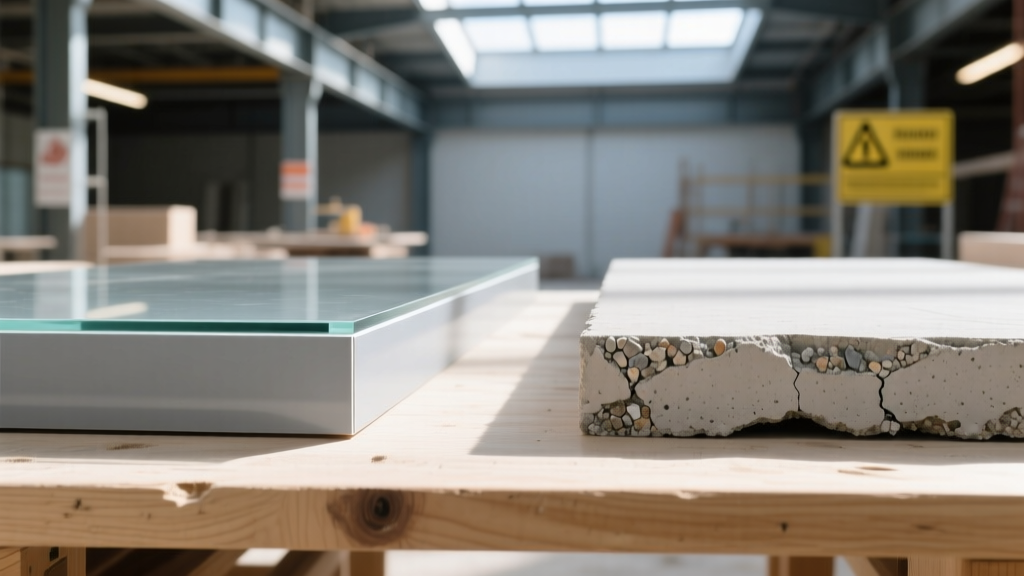
Understanding the core chemistry of these panels explains their performance differences. Glass mat gypsum board (governed by ASTM C1177) features a moisture-resistant gypsum core encapsulated by fiberglass mats on both the front and back. This eliminates the organic paper facing that traditional mold feeds on, yielding a panel that is inherently mold-resistant and highly stable when exposed to weather during construction delays.
Cement board (governed by ASTM C1325 for fiber-reinforced or ASTM C1186 for non-asbestos fiber-cement) is composed of Portland cement, aggregate, and cellulose or glass reinforcing fibers. It contains no gypsum. This makes it completely impervious to water degradation, but it also makes the panel significantly heavier, harder to cut, and prone to generating hazardous dust during fabrication.
Head-to-Head Technical Comparison Matrix
| Feature | Glass Mat Gypsum (5/8 in.) | Cement Board (1/2 in.) |
|---|---|---|
| Weight (per 4x8 sheet) | ~70 - 75 lbs | ~90 - 110 lbs (varies by brand) |
| Core Material | Treated Gypsum | Portland Cement & Aggregate |
| Facing Material | Fiberglass Mat | Integral Fiber Mesh / None |
| Cutting Method | Utility knife (score and snap) | Carbide scorer, shears, or diamond blade |
| Water Absorption (ASTM C473) | < 10% (varies by brand) | < 8% to 15% (highly brand dependent) |
| Mold Resistance (ASTM D3273) | Score of 10 (No growth) | Score of 10 (Inorganic core) |
| Silica Dust Generation | None (Gypsum dust only) | High (Requires OSHA PEL compliance) |
Real-World Cost Breakdown: Material and Labor
Looking solely at the material ticket price gives a skewed perspective. A standard 1/2-inch, 3x5 foot sheet of cement board (like USG Durock or James Hardie HardieBacker) typically retails between $14 and $18. A 5/8-inch, 4x8 foot sheet of glass mat gypsum (like Georgia-Pacific DensGlass or USG Securock) ranges from $20 to $28. On a pure per-square-foot material basis, cement board appears cheaper.
However, installed cost flips the equation. Glass mat gypsum board cuts cleanly with a standard utility knife, allowing a two-person crew to hang and finish a 400-square-foot bathroom in a single shift. Cement board requires scoring with a carbide tool, snapping, and often rasping the edges. If power tools are used to cut cement board, the crew must deploy HEPA vacuums and respirators to comply with OSHA's respirable crystalline silica standard (29 CFR 1926.1153), adding significant time and equipment overhead. When factoring in labor at current 2026 prevailing wages, glass mat gypsum often yields a 15% to 22% lower total installed cost for wall applications.
Application Decision Tree: When to Use Which?
Use this framework to specify the correct panel based on the specific environmental and structural demands of the zone.
1. Exterior Sheathing and Weather-Exposed Zones
- Verdict: Glass Mat Gypsum Board.
- Why: Products like DensGlass or Securock Glass-Mat Sheathing are engineered to withstand up to 12 months of weather exposure before cladding is applied. Cement board is too heavy for standard exterior wall framing spacing and lacks the sheer structural integration required for exterior bracing.
2. Shower Pans, Steam Rooms, and Continuous Immersion
- Verdict: Cement Board (or specialized extruded polystyrene foam boards).
- Why: While glass mat gypsum resists moisture, the gypsum core can eventually soften if subjected to continuous standing water or high-pressure steam penetration over decades. Cement board will not degrade even if the waterproofing membrane fails.
3. Standard Bathroom Walls and Kitchen Backsplashes
- Verdict: Glass Mat Gypsum Board.
- Why: It provides a superior, rigid tile backing that is lighter on the wall studs than cement board. When paired with a liquid-applied waterproofing membrane (like RedGard or Hydro Ban), it meets all ANSI A118.10 requirements for wet-area tile backing.
Installation Gotchas and Edge Cases
Even experienced drywall crews make critical errors when transitioning from standard drywall to high-performance substrates. Avoid these common failure points:
- Fastener Corrosion: Never use standard drywall screws on either substrate in wet areas. The alkaline nature of cement board and the moisture in wet zones will corrode standard phosphate-coated screws, leading to 'popping' and rust bleed-through. Specify hot-dipped galvanized or stainless-steel screws with a minimum 1-1/4 inch penetration into wood framing.
- Joint Treatment Mismatch: Cement board requires alkali-resistant fiberglass mesh tape embedded in thin-set mortar. Standard paper tape and joint compound will dissolve and fail. Glass mat gypsum can be treated with specific manufacturer-approved joint compounds and alkali-resistant mesh, or thin-set if it is being tiled over.
- Edge Sealing: When cutting glass mat gypsum, the exposed gypsum core at the cut edge is vulnerable. Always seal cut edges with a manufacturer-approved primer or sealant before applying liquid waterproofing membranes.
Top Product Specifications to Look For
When sourcing materials, verify the product data sheets for the following benchmarks to ensure you are getting commercial-grade performance:
- Georgia-Pacific DensGlass Sheathing: The industry benchmark for exterior applications. Look for the 5/8-inch Fire-Shield variant if you need to combine moisture resistance with a 1-hour fire rating (ASTM E119).
- USG Securock Glass-Mat Sheathing: Features a proprietary core that offers excellent screw-holding strength, critical for heavy exterior cladding attachments.
- CertainTeed GlasRoc: Highly regarded for interior high-moisture tile backing. Verify the specific product line, as GlasRoc is used for both sheathing and interior tile backer applications.
Frequently Asked Questions
Can I use glass mat gypsum board on a shower ceiling?
Yes, provided it is properly sealed with a liquid waterproofing membrane and tiled. Its lighter weight compared to cement board makes it significantly easier to install overhead without sagging, reducing the risk of adhesive failure during the curing process.
Does glass mat gypsum board require a vapor barrier behind it?
In exterior wall assemblies, the glass mat facing itself often acts as a weather-resistive barrier (WRB), but you must follow the specific manufacturer's instructions regarding secondary vapor retarders based on your local climate zone. In interior showers, a surface-applied liquid membrane is preferred over a polyethylene sheet behind the board to prevent moisture trapping.
How do I dispose of cut-offs from these materials?
Gypsum products can often be recycled at specialized construction and demolition (C&D) facilities, whereas cement board is typically classified as standard inert C&D debris and sent to a landfill. Always check local municipal guidelines, as gypsum disposal in standard landfills is restricted in some states due to hydrogen sulfide gas generation.
Written by
James ThorntonJames Thornton is a construction industry veteran with 25 years of hands-on experience in wood framing, lumber grading, and residential building codes. He started as a framing carpenter in rural Oregon, earned his ICC Residential Building Inspector certification, and eventually became a senior plan reviewer for the City of Portland Bureau of Development Services. James holds a B.S. in Wood Science & Technology from Oregon State University and is a certified lumber grader through the West Coast Lumber Inspection Bureau (WCLIB). He has inspected over 3,000 residential construction sites and authored the city's internal guide on advanced framing techniques (2x6 at 24" O.C.). James lives in Bend, OR, where he builds custom timber-frame cabins and competes in lumberjack sports.
More from James Thornton
View all
Insulation
Best Home Insulation Materials: Complete 2026 Guide
Compare top home insulation materials for 2026. Find R-values, installed costs per square foot, and best uses for fiberglass, spray foam, and mineral wool.
Aug 4, 2026

Sustainable Building
Certify Your Green Building Material for LEED and WELL
Step-by-step guide to certifying a green building material for LEED v5 and WELL v2. Master EPDs, HPDs, and VOC limits for 2026 project specifications.
Aug 4, 2026

Stone & Masonry
Veneer Stacked Stone Panels: Interior Design & Style Showcase
Discover how veneer stacked stone panels transform interiors. Explore modern design profiles, material pairings, and technical installation specs.
Aug 4, 2026