Best Drywall Screws for Gypsum Board: Brand Deep-Dive
Compare top drywall screw brands like Grabber, Grip-Rite, and USG. Learn which coarse, fine, or collated screws prevent pops and rust.
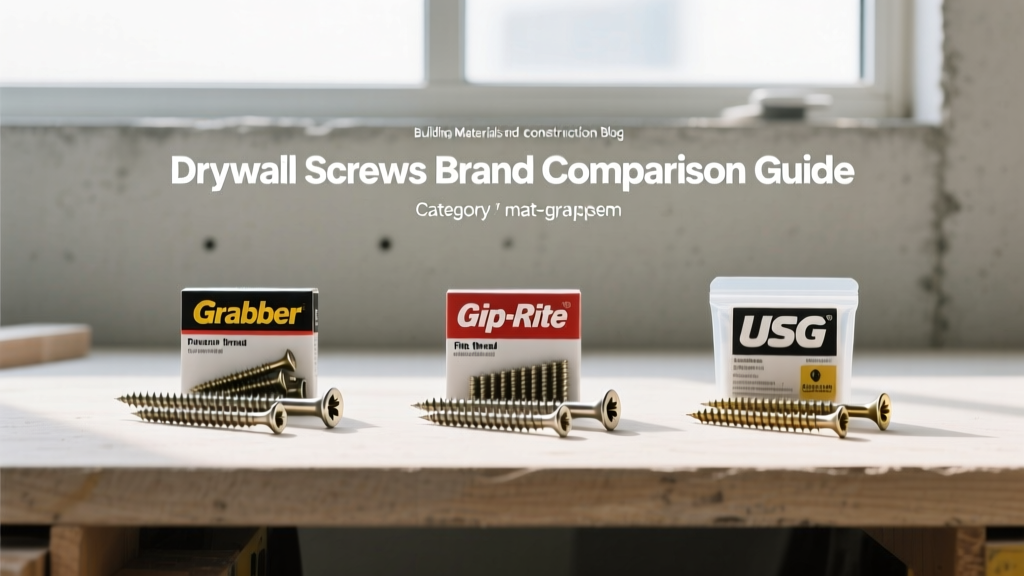
The Anatomy of ASTM C1002 Compliant Fasteners
Fastener failure in gypsum board assemblies rarely stems from the panel itself; it stems from the fastener. A single popped screw or stripped shank compromises the structural integrity and fire-resistance rating of the entire partition. When fastening standard gypsum drywall, drywall screws that comply with the ASTM C1002 Standard Specification for Steel Self-Piercing Tapping Screws are mandatory for commercial and high-grade residential work.
A premium drywall screw relies on three engineered features:
- Bugle Head: Unlike flat heads that cut paper, the convex radius of a bugle head creates a smooth dimple (approximately 1/32-inch deep) without severing the gypsum core's paper facing. This preserves the tensile holding power of the board.
- Hardened Steel Shank: Heat-treated to withstand high-torque auto-feed drivers without bending, though this makes them brittle under lateral shear loads.
- Phosphate Coating: A black, micro-porous finish that provides minimal corrosion resistance but offers excellent paint adhesion and reduces driving friction.
Coarse vs. Fine Thread: Substrate Decision Matrix
Using the wrong thread pitch is the leading cause of stripped fasteners in metal framing and blow-outs in wood framing. The Gypsum Association GA-216 Application and Finishing Guide dictates strict fastener spacing and type based on the substrate.
| Substrate Material | Thread Type | Pitch & Design | Point Type | Recommended Length (1/2" Board) |
|---|---|---|---|---|
| Wood Studs (S-P-F) | Coarse | Deep, wide-spaced threads | Gimlet (Sharp) | 1-1/4" or 1-5/8" |
| Light-Gauge Steel (20-25 ga) | Fine | Closely spaced, shallow threads | Needle (Sharp) | 1" or 1-1/4" |
| Heavy-Gauge Steel (16-18 ga) | Self-Drilling | Fine threads with drill flute | Tek (Drill Point) | 1" or 1-1/4" |
Brand Deep-Dive: Grabber, Grip-Rite, and USG
Not all ASTM-compliant screws perform identically on the job site. Heat-treating consistency, head-to-shank transition geometry, and collated strip reliability separate professional-grade fasteners from big-box commodities.
SFS Grabber (The Professional Standard)
Grabber (now under the SFS Group umbrella) remains the benchmark for commercial drywall contractors. Their proprietary heat-treating process yields a shank that resists snapping during high-speed auto-feed driving. The Grabber T-25 Torx-drive line is increasingly popular for high-density fiberglass-reinforced gypsum boards where Phillips heads cam-out under the required 40-inch-pound torque.
For dense wood species or engineered lumber (LVL/I-Joists), specify Grabber's 'W' thread profile. It features a twin-lead thread that clears sawdust faster, reducing the torque required and preventing the driver from bogging down.
Grip-Rite (The High-Volume Workhorse)
Grip-Rite dominates the residential and big-box retail sector. Their standard phosphate-coated lines are highly cost-effective, though quality control on the bugle head radius can vary slightly between manufacturing batches. For standard 1/2-inch lightweight gypsum on pine studs, Grip-Rite's 1-1/4" coarse thread screws offer the best cost-to-performance ratio. However, their fine-thread screws for 25-gauge steel occasionally struggle with the initial piercing phase compared to premium brands, requiring slightly higher downward pressure from the installer.
USG Sheetrock (The Integrated System)
USG Sheetrock Brand screws are engineered specifically to interface with their proprietary panel formulations. When installing USG's UltraLight panels, using USG-branded screws ensures the bugle head dimple perfectly matches the paper thickness of the UltraLight facing, minimizing the amount of joint compound needed to conceal the fastener. This integration can reduce finishing labor by up to 5% on large commercial projects.
Collated Auto-Feed Systems: Production vs. Precision
For hanging more than 2,000 square feet of board, loose screws are a liability. Collated screw systems (typically 30 screws per plastic strip at an 11-degree angle) paired with auto-feed drivers (like the Simpson Strong-Tie Quik Drive or Makita CFR750) increase hanging speed by 40%.
The Trade-off: Collated screws carry a 25-30% price premium over loose bulk boxes. Furthermore, if the auto-feed clutch is not calibrated daily, the plastic strip can interfere with the driver bit, resulting in shallow drives that require manual re-setting. Always run a test strip on a scrap piece of board and framing to verify depth before starting production.
Specialty Transitions: Glass Mat and Cement Board
Standard phosphate drywall screws are strictly prohibited in wet areas or when transitioning to non-gypsum substrates.
- Glass Mat Gypsum (e.g., DensArmor, Fiberock): The moisture-resistant facing requires fasteners with a polymer or ceramic coating (often gray or tan). Phosphate coatings will oxidize and bleed through the acrylic primer within 18 months.
- Cement Board Transitions: Never use drywall screws to fasten cement backer board. The hardened steel is too brittle and will snap under the torque required to countersink into cement. Use serrated wafer-head screws (e.g., Buildex Rock-On) specifically designed for cementitious matrices.
Failure Mode Analysis: Troubleshooting Field Defects
Cause: Wood framing moisture content drops from installation levels (often 15-19%) to interior equilibrium (8-10%). As the stud shrinks across its grain, it pulls away from the gypsum, leaving the screw head protruding.
Fix: Specify kiln-dried (KD) lumber with a maximum 12% moisture content. If using green lumber, delay taping and mudding for 30-45 days to allow framing to acclimate.
Cause: Over-driving the screw. If the bugle head penetrates deeper than 1/32-inch, it cuts through the paper facing, resulting in zero holding power. The joint compound will eventually crack over this void.
Fix: Adjust the depth-sensitive clutch on your drywall dimpler. The screw head should be flush with the bottom of the dimple, leaving the paper intact but slightly stretched.
2026 Bulk Pricing and Procurement Guide
Pricing for drywall fasteners fluctuates with raw steel indices. Below is the current 2026 procurement matrix for standard #6 and #8 coarse-thread screws (1-5/8" length) across major brands. Prices reflect contractor-tier bulk purchasing.
| Brand | 1 lb Box (~300 pcs) | 5 lb Box (~1,500 pcs) | 25 lb Bucket (~7,500 pcs) | Collated Strip Premium |
|---|---|---|---|---|
| SFS Grabber | $11.50 | $42.00 | $185.00 | + 28% |
| Grip-Rite | $8.25 | $31.50 | $140.00 | + 22% |
| USG Sheetrock | $10.00 | $38.00 | $165.00 | N/A (Loose only) |
Selecting the correct fastener is not merely a code compliance exercise; it is a critical variable in acoustic isolation, fire-rating preservation, and finishing labor costs. Match the thread to the substrate, calibrate your driver clutch daily, and reserve premium brands like Grabber for high-stress commercial assemblies where fastener failure is not an option.