Heavy Duty Drywall Anchors: Selection Taxonomy for Gypsum Board
Master the taxonomy of heavy duty drywall anchors. Learn to select toggle bolts, snaptoggles, and threaded anchors for 1/2-inch and 5/8-inch gypsum board.
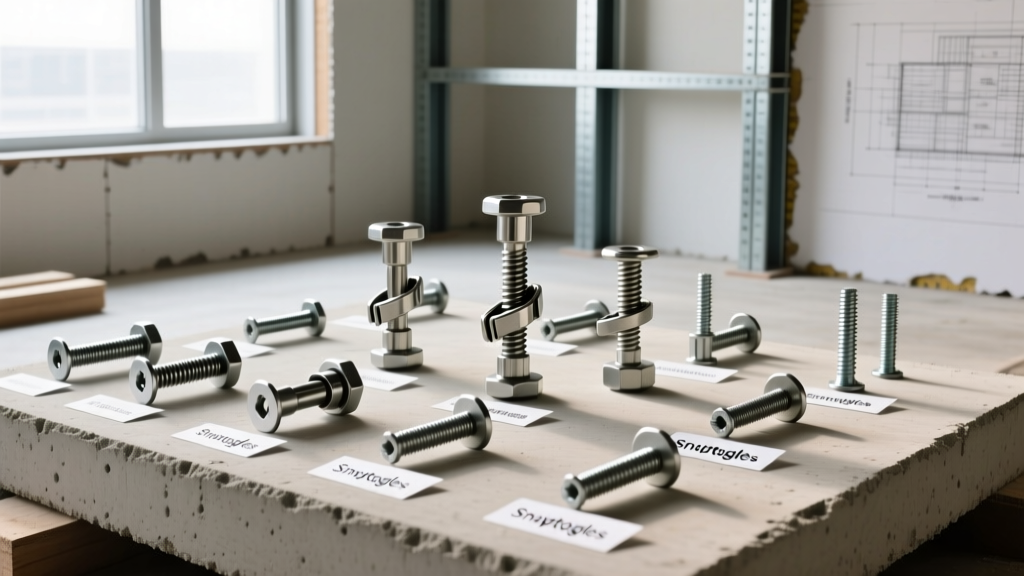
The Physics of Gypsum Board Load-Bearing Capacity
Gypsum board is a composite panel consisting of a calcium sulfate dihydrate core encased in a heavy paper or fiberglass mat facer. While it possesses excellent compressive strength and fire-resistance properties, its brittle, crystalline core exhibits remarkably low tensile and shear strength at localized point-loads. When a standard wood screw is driven directly into gypsum, the threads merely crush the surrounding core, creating a weak friction hold that typically fails under 10 to 15 pounds of tensile (pull-out) force.
To mount heavy objects—such as articulating TV arms, commercial cabinetry, or large mirrors—contractors must bypass the brittle core entirely. Heavy duty drywall anchors achieve this by distributing the applied load across a broad surface area on the unexposed back face of the gypsum panel. Understanding the taxonomy of these anchors is critical for structural integrity, as selecting the wrong mechanism can lead to catastrophic delamination of the paper facer or core pulverization.
Taxonomy of Heavy Duty Drywall Anchors
The market offers three primary categories of heavy-duty anchors engineered specifically for hollow gypsum wall assemblies. Each utilizes a distinct mechanical principle to achieve load distribution.
1. Strap Toggles (Snap Toggles)
Strap toggles represent the highest tier of drywall anchoring technology. The mechanism features a rigid, die-cast zinc or steel channel (the toggle) attached to two flexible nylon straps. The toggle folds flat, passes through a precisely drilled 1/2-inch hole, and springs open behind the drywall. Pulling the straps draws the channel flush against the back of the gypsum board, while a ratcheting nylon cap locks the assembly in place.
2. Threaded Toggle Bolts (Butterfly Anchors)
Threaded toggles utilize spring-loaded, hinged metal wings attached to a machine screw. The wings compress for insertion and expand once they clear the back of the drywall. While effective for medium-heavy static loads, they suffer from a critical functional flaw: if the machine screw is removed, the wings detach and fall behind the wall cavity, rendering the anchor single-use.
Furthermore, the large installation hole (often 5/8-inch or larger for heavy-duty variants) removes a significant volume of the gypsum core, slightly weakening the immediate surrounding matrix. They are best reserved for permanent, static installations like heavy shelving brackets where the hardware will not be repeatedly removed.
3. Heavy-Duty Expansion Anchors (Molly Bolts)
Molly bolts consist of a machine screw housed inside a slotted, zinc-plated steel sleeve. As the screw is tightened, the sleeve compresses longitudinally and expands radially behind the drywall, forming a broad mechanical umbrella. High-quality molly bolts feature anti-rotation barbs on the collar that bite into the paper face of the gypsum board, preventing the sleeve from spinning during installation.
According to data published by The Gypsum Association, expansion anchors provide superior shear strength compared to tensile strength. A 1/4-inch heavy-duty molly bolt can support up to 150 lbs in shear on 5/8-inch gypsum board, making it ideal for heavy wall-mounted cabinets where the primary force vector is downward rather than pull-out.
Selection Matrix: Matching Anchor to Gypsum Thickness
Selecting the correct heavy duty drywall anchor requires cross-referencing the panel thickness with the anticipated load vector. The following matrix outlines the operational parameters for standard residential and commercial gypsum boards, referencing specifications from major manufacturers like USG Drywall Systems and the National Gypsum Product Portfolio.
| Anchor Type | Panel Thickness | Max Tensile (Pull-Out) | Max Shear (Downward) | Required Hole Size | Reusability |
|---|---|---|---|---|---|
| Strap Toggle (1/4-20) | 1/2-inch Standard | 143 lbs | 265 lbs | 1/2 inch | Yes (Cap reusable) |
| Strap Toggle (1/4-20) | 5/8-inch Type X | 175 lbs | 310 lbs | 1/2 inch | Yes (Cap reusable) |
| Threaded Toggle (3/16) | 1/2-inch Standard | 85 lbs | 150 lbs | 1/2 inch | No (Wings drop) |
| Molly Bolt (1/4-20) | 1/2-inch Standard | 50 lbs | 110 lbs | 3/8 inch | Screw only |
| Molly Bolt (1/4-20) | 5/8-inch Type X | 75 lbs | 150 lbs | 3/8 inch | Screw only |
Edge Cases and Failure Modes in Drywall Anchoring
Even when utilizing the highest-rated heavy duty drywall anchors, installations frequently fail due to improper handling of the gypsum substrate. Recognizing these failure modes is essential for structural engineers and lead carpenters.
- Core Pulverization (The 'Hollow' Effect): Over-torquing a molly bolt or threaded toggle crushes the calcium sulfate core between the front collar and the rear wings. This creates a void inside the wall, eliminating the clamping force and allowing the anchor to spin freely. Always use a hand screwdriver for the final three turns; never use an impact driver to set a drywall anchor.
- Paper Facer Delamination: The structural integrity of a gypsum panel relies heavily on the tension of the paper facers. If an anchor collar is over-tightened against the wall, it can slice through the paper face. Once the paper tears, the load is transferred entirely to the weak gypsum core, resulting in immediate pull-out failure.
- Dynamic Fatigue Fracture: Static loads (like a heavy picture frame) distribute force evenly. Dynamic loads (like an articulating TV mount or a doorstop) create cyclic, leveraged stress. The repetitive micro-movements gradually fracture the gypsum crystals around the anchor hole. For dynamic applications, always double the calculated weight requirement and use a minimum of four strap toggles to distribute the kinetic energy.
Step-by-Step Installation Protocol for Maximum Shear Strength
To achieve the manufacturer-rated load capacities, the installation process must be executed with precision. The following protocol is optimized for strap toggles in 5/8-inch Type X gypsum board.
- Locate and Mark: Use a high-density stud finder to ensure the drill point is at least 1.5 inches away from any underlying wood or metal framing. Drilling too close to a stud can cause the toggle to snag on the framing member, preventing it from sitting flush against the drywall.
- Drill the Pilot Hole: Using a 1/2-inch unibit or a sharp spade bit, drill cleanly through the gypsum board. Operate the drill at a low RPM (under 800 RPM) to prevent tearing the rear paper facer. A torn rear facer reduces the bearing surface for the toggle channel.
- Vacuum the Cavity: Insert a shop-vac hose over the hole for 3 seconds. Gypsum dust left inside the cavity can jam the ratcheting nylon cap of a snap toggle, preventing it from locking securely against the front face.
- Insert and Seat: Pinch the toggle wings flat, insert them into the hole, and pull the straps firmly until you hear the channel click against the back of the drywall.
- Lock the Cap: Slide the nylon cap down the straps until it is flush with the wall surface. Do not push it past flush, as this will indent the gypsum core and compromise the wall finish.
- Break Off Excess: Bend the straps back and forth at the score line to snap them off cleanly at the cap.
- Drive the Machine Screw: Thread the 1/4-20 machine screw through your fixture and into the metal channel. Tighten until snug, stopping immediately when resistance increases. The fixture should be held firmly by the clamping force of the toggle, not by the torque of the screw.
Cost Analysis and Procurement
When budgeting for commercial fit-outs or high-end residential projects, the cost of heavy duty drywall anchors is negligible compared to the liability of a failed installation. Standard strap toggles (such as the TOGGLER brand) retail between $2.50 and $4.00 per unit in contractor packs. Threaded toggles average $1.50 per unit, while heavy-duty molly bolts can be procured for $0.80 to $1.20 each. Given that a single articulating TV mount requires a minimum of four anchors to safely handle dynamic leverage, allocating $16.00 for premium strap toggles is a mandatory insurance policy against drywall failure and property damage.