DensGlass Gypsum Board: Complete Specifications & Dimensions Guide
Explore exact DensGlass gypsum board specifications, dimensions, weight, and ASTM standards for exterior sheathing and fire-rated assemblies.

Core Material Composition and Facers
DensGlass gypsum board, manufactured by Georgia-Pacific, represents a specialized category of glass mat gypsum substrates designed primarily for exterior sheathing, parapets, and high-moisture interior applications. Unlike standard paper-faced drywall, DensGlass utilizes a hydrophobic, silicone-treated gypsum core encased in heavy-duty fiberglass mats on both the front and back surfaces. This composition eliminates the organic cellulose paper that serves as a food source for mold and a wicking mechanism for moisture.
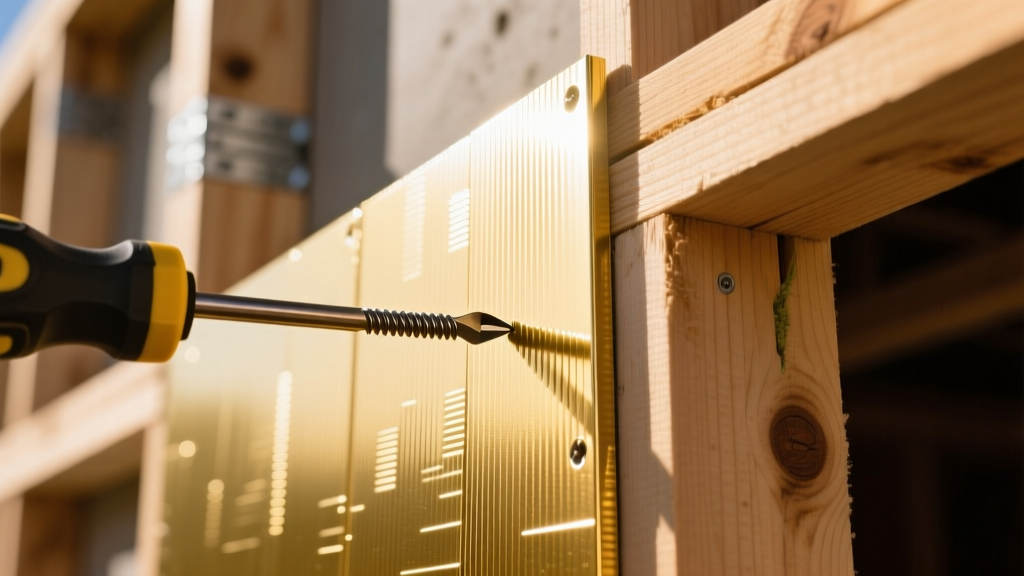
The front facer typically features a distinct golden or tan color, which acts as a visual identifier on the job site and provides a textured surface optimized for the adhesion of fluid-applied weather-resistive barriers (WRBs), exterior insulation, and direct-applied exterior finishes. According to the Gypsum Association, the absence of organic facers is the primary reason glass mat gypsum boards achieve superior dimensional stability when exposed to ambient moisture during construction delays.
Standard Dimensions and Manufacturing Tolerances
Procuring the correct panel size is critical for minimizing waste and aligning with standard framing spacings (16 inches or 24 inches on center). DensGlass sheathing is extruded and cut to precise imperial and metric tolerances governed by ASTM C1177.
| Specification | 1/2 Inch (12.7 mm) | 5/8 Inch (15.9 mm) Fireguard |
|---|---|---|
| Standard Width | 48 inches (1220 mm) | 48 inches (1220 mm) |
| Available Lengths | 8', 9', 10', 12' | 8', 9', 10', 12', 14' |
| Weight per Sq. Ft. | ~2.2 lbs (10.8 kg/m²) | ~2.6 lbs (12.7 kg/m²) |
| Edge Profile | Square Edge | Square Edge |
| Thickness Tolerance | ± 1/64 inch | ± 1/64 inch |
| Width Tolerance | ± 1/8 inch | ± 1/8 inch |
Note: Custom lengths up to 16 feet may be available for commercial high-rise projects via direct manufacturer special order, significantly reducing horizontal joint taping on multi-story shear walls.
Physical and Performance Specifications
When engineering exterior wall assemblies, structural and moisture performance data dictate the viability of the sheathing. The following metrics are tested under ASTM International standard protocols:
- Flexural Strength (ASTM C473): Minimum 50 lbf (parallel) and 30 lbf (perpendicular) for 1/2-inch boards; minimum 70 lbf (parallel) and 40 lbf (perpendicular) for 5/8-inch boards.
- Water Absorption (ASTM C473): Maximum 10% by weight after 2-hour submersion. Standard paper-faced gypsum routinely exceeds 40% under identical conditions.
- Surface Water Absorption: Maximum 1.0 gram. The fiberglass mat sheds bulk water, preventing core saturation during sudden rain events before the WRB is applied.
- Humidified Deflection (ASTM C473): Maximum 1/8 inch deflection when subjected to 90% relative humidity at 90°F for 48 hours. This rigidity prevents the 'pillowing' or sagging often seen in paper-faced boards exposed to prolonged dampness.
Fire-Rated Assemblies and ASTM Standards
While standard DensGlass sheathing provides baseline fire resistance, the 5/8-inch DensGlass Fireguard variant incorporates specialized glass fibers and core additives to achieve Type X fire ratings. This makes it mandatory for specific commercial applications, including exterior firewalls, parapet enclosures, and area separation walls.
Code Compliance Note: DensGlass Fireguard complies with ASTM C1177 and ASTM E119. When integrated into tested UL (Underwriters Laboratories) or ULC assemblies, 5/8-inch DensGlass can contribute to 1-hour and 2-hour fire-resistance ratings for exterior non-load-bearing and load-bearing steel stud walls. Always verify the specific UL Design Number (e.g., U419 or V450) required by your local building official.
Thermal and Acoustic Properties
Gypsum inherently possesses low thermal conductivity, but DensGlass is rarely used as a standalone thermal barrier. The R-value of the sheathing itself is approximately R-0.45 for 1/2-inch and R-0.56 for 5/8-inch. In modern commercial envelopes, this sheathing works in tandem with continuous exterior rigid foam insulation (polyiso or mineral wool) to eliminate thermal bridging across metal studs. Acoustically, the dense, silicone-treated core provides an STC (Sound Transmission Class) bump of 1 to 2 points compared to standard gypsum when used in multi-layer demising wall assemblies.
Decision Matrix: DensGlass vs. Standard Paper-Faced Sheathing
| Criterion | DensGlass (Fiberglass Mat) | Standard Exterior Gypsum (Paper) |
|---|---|---|
| Weather Exposure Limit | Up to 12 months | 30 to 60 days maximum |
| Mold Resistance (ASTM D3273) | Score of 10 (Highest) | Score of 0 to 3 (Poor) |
| Substrate for Direct-Applied Stucco | Approved (with lath) | Not Approved |
| Cost Premium | ~20% to 35% higher | Baseline |
Handling, Storage, and Exposure Limits
A critical advantage of DensGlass is its extended weather exposure window. According to Georgia-Pacific's official building products guidelines, DensGlass sheathing can withstand up to 12 months of continuous weather exposure before the application of exterior cladding or WRBs. However, this is not an invitation to abuse the material on site.
Storage and Edge Case Failures
- Flat Storage is Mandatory: Never store DensGlass panels on edge. The fiberglass mat provides excellent tensile strength, but the gypsum core remains brittle. Storing panels vertically on uneven ground will cause micro-fractures along the bottom edge, compromising the structural integrity of the panel when hoisted.
- Parapet Vulnerabilities: When capping parapets, horizontal surfaces must be sloped a minimum of 1/4 inch per foot. If DensGlass is used as a parapet substrate and left flat, ponding water will eventually degrade the silicone core treatment, leading to localized core softening.
- UV Degradation: While highly resistant to moisture, prolonged, direct ultraviolet exposure beyond 12 months can cause the fiberglass mat resins to become brittle. If a project is delayed beyond the 12-month window, the sheathing must be inspected, primed, or replaced.
Fastener Specifications and Joint Treatment
Installation failures with glass mat gypsum almost always trace back to incorrect fastener selection or improper joint treatment. The fiberglass facer is highly alkaline, which will rapidly corrode standard zinc-plated or uncoated drywall screws.
- Wood Framing: Use #8 or #10 hot-dipped galvanized or ceramic-coated bugle-head screws. Minimum penetration into the wood stud must be 5/8 inch.
- Steel Framing: Use #6 or #8 corrosion-resistant self-drilling screws with a minimum flange width of 0.3 inches. Penetration through the steel stud must be at least 3/8 inch.
- Spacing: Fasteners should be spaced 8 inches on center along intermediate studs and 6 inches on center at panel edges and ends for exterior shear applications.
The Joint Treatment Trap
Do not use standard paper drywall tape or standard joint compound on DensGlass sheathing. For exterior applications where the joints will be covered by a fluid-applied WRB, joints should be taped with alkali-resistant fiberglass mesh tape and embedded in a compatible exterior-grade joint treatment or the WRB mastic itself. Using paper tape behind a fluid-applied membrane will result in tape rot, causing the membrane to split at the seams during structural wind-load deflection.
Written by
Elena RodriguezElena Rodriguez is a civil engineer and technical writer specializing in concrete technology, masonry systems, and ASTM/ACI compliance. She earned her B.S. in Civil Engineering from Texas A&M University and spent a decade at a materials testing laboratory, performing over 2,000 concrete compressive strength tests and masonry prism evaluations. Elena is an ACI-certified Field Testing Technician (Grade I) and a member of ASTM Committee C12 on Natural Building Stone. She currently consults on forensic engineering cases involving concrete failures and moisture intrusion. Based in San Antonio, TX, Elena is a proud member of the Society of Women Engineers (SWE) and coaches her daughter's FIRST Robotics team.
More from Elena Rodriguez
View all
Walls & Panels
Cost Analysis: Light Gauge Steel Framing Advantages and Disadvantages
Evaluate light gauge steel framing advantages and disadvantages through a strict cost analysis lens, comparing material, labor, and lifecycle expenses.
Aug 4, 2026

Walls & Panels
Gypsum Board Types: Exact Specifications, Thickness & Dimensions
Compare standard, Type X, and moisture-resistant gypsum board types. Get exact specifications, thicknesses, dimensions, and ASTM standards for your project.
Aug 4, 2026

Fire Resistance
Best Fire-Resistant Outdoor Decking Materials: 2026 Buyer Guide
Discover the best fire-resistant outdoor decking materials for 2026. Compare Class A PVC, aluminum, and hardwood options for WUI compliance and safety.
Aug 4, 2026