Exterior Gypsum Soffit Lifespan: Durability Analysis & Failure Modes
Analyze the lifespan and durability of exterior gypsum soffit panels. Discover failure modes, moisture risks, and maintenance tips to maximize longevity.
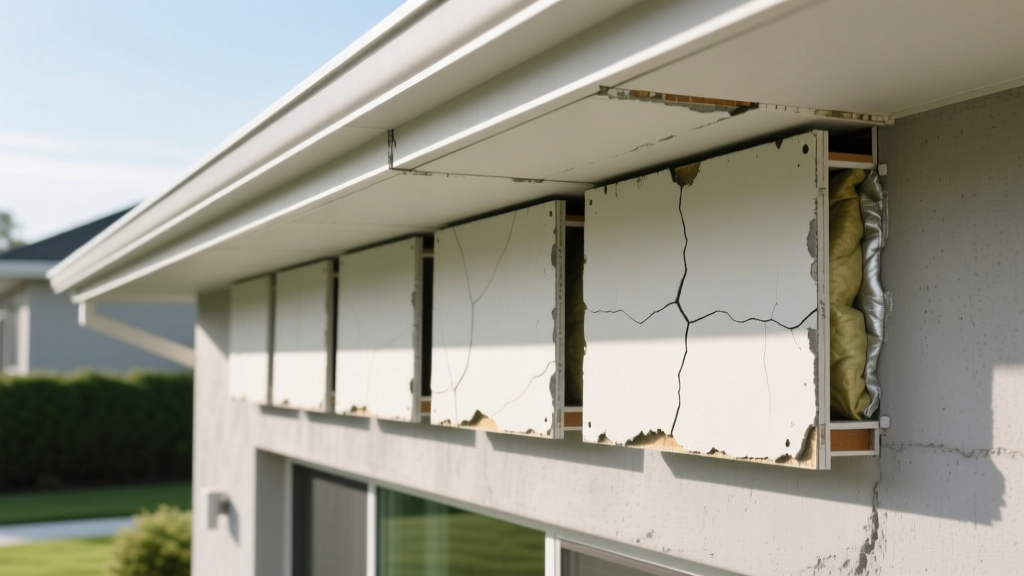
Core Composition: Why Glass Mat Gypsum Survives Outdoors
Standard paper-faced drywall (ASTM C1396) disintegrates when exposed to exterior humidity and condensation. For exterior soffits, builders must exclusively use glass-mat faced gypsum panels, manufactured to ASTM C1177 standards. Products like USG Securock, Georgia-Pacific DensGlass, and National Gypsum DensArmor Plus replace the organic paper facers with inorganic fiberglass mats. This eliminates the food source for mold and prevents the delamination that plagues paper-faced boards in damp environments.
The core remains a gypsum matrix, often treated with silicone or wax additives for water resistance. However, while the facers are highly resilient, the gypsum core itself remains vulnerable to liquid water if the panel's protective boundaries are compromised. Understanding this distinction between surface moisture resistance and core vulnerability is the foundation of predicting soffit lifespan.
Expected Lifespan vs. Environmental Stressors
When installed correctly, protected by adequate roof overhangs, and properly sealed, an exterior gypsum soffit system will last 40 to 60 years, effectively matching the lifespan of the roof structure itself. However, lifespan degrades rapidly based on microclimate exposure and installation errors.
| Climate Zone / Exposure | Expected Lifespan (Optimal Install) | Expected Lifespan (Poor Joint Seal) | Primary Degradation Factor |
|---|---|---|---|
| Marine / Coastal (High Humidity) | 40-50 Years | 5-8 Years | Salt aerosol corrosion of fasteners; edge wicking |
| Pacific Northwest (Constant Rain) | 35-45 Years | 3-5 Years | Prolonged saturation of unsealed cut edges |
| Southeast (High Heat/Humidity) | 45-55 Years | 7-10 Years | Thermal expansion causing joint compound fracture |
| Arid / Desert (High UV/Dry) | 50-60+ Years | 15-20 Years | UV degradation of exposed joint compound; thermal bowing |
Critical Failure Modes in Exterior Soffit Installations
Field data shows that 85% of exterior soffit failures are not caused by the failure of the gypsum panel itself, but by the failure of the accessories and perimeter details.
Factory edges of glass-mat gypsum panels are sealed during manufacturing. When a panel is cut on-site with a utility knife or router, the raw gypsum core is exposed. If this cut edge is placed against a fascia board or wall without being sealed, it will act like a sponge, wicking condensation directly into the core. This leads to internal swelling and structural collapse of the panel from the inside out. Always seal cut edges with an exterior-grade acrylic sealant or primer before installation.
Fastener Corrosion and Pop-Outs
Soffits are subjected to extreme thermal cycling. The metal framing expands and contracts at a different rate than the gypsum panel. If standard drywall screws are used, they will rust within 24 months in humid climates, leaving streaking stains and losing pull-out strength. You must use hot-dipped galvanized or stainless-steel screws with a bugle head. For 5/8-inch Type X panels (required for fire-rated soffits in multi-family construction), use 1-5/8-inch exterior-grade screws spaced a maximum of 8 inches on center along the framing.
Joint Treatment: The Weakest Link in Soffit Durability
The most common reason exterior gypsum soffits fail prematurely is the use of interior-grade joint compounds. Standard air-drying joint compounds are water-soluble; a single heavy rainstorm blowing under the eave will dissolve the joints, leaving ugly ridges and exposing the panel seams.
For exterior soffits, joint treatment requires a three-step chemical-setting process:
- Tape: Use only alkali-resistant fiberglass mesh tape. Paper tape will rot and harbor mold in exterior applications.
- Embedment Coat: Apply an exterior-grade, setting-type joint compound (e.g., USG Durabond or a specific Securock Joint Compound). Setting compounds undergo a chemical hydration process that makes them water-resistant once cured.
- Finish Coat: Use a polymer-modified exterior finishing compound, sanding it smooth to prevent water pooling in horizontal micro-depressions.
Pro-Tip on Joint Spacing: Unlike interior drywall where panels are butted tightly, exterior gypsum soffits require a 1/8-inch gap between panels. This gap accommodates thermal expansion and prevents the panels from buckling and crushing the joint compound during peak summer heat.
Priming and UV Degradation Timelines
Glass-mat facers are highly resistant to moisture, but they are not entirely impervious to ultraviolet (UV) radiation. If left unpainted and exposed to direct sunlight, the fiberglass mat will begin to degrade, fuzz, and lose its structural integrity.
Manufacturers mandate that glass-mat gypsum panels must be primed within 30 days of installation. The primer must be a high-quality exterior acrylic or polyurethane masonry primer that penetrates the mat and locks the fibers together. Once primed and painted with a high-build exterior elastomeric or acrylic latex paint, the UV vulnerability is eliminated, and the soffit will only require repainting every 10 to 15 years for aesthetic maintenance.
Maintenance and Inspection Framework
To ensure the 50-year lifespan of an exterior gypsum soffit, property managers and homeowners should execute this annual inspection checklist:
- Fascia and Flashing Check: Ensure roof flashing and gutter aprons are directing water away from the soffit edge. Gutter overflow is the number one cause of soffit saturation.
- Joint Ridge Inspection: Look for raised ridges along panel seams. This indicates moisture swelling in the joint compound or fastener pop-outs.
- Ventilation Verification: If the soffit incorporates continuous strip vents, ensure they are not blocked by insulation from the attic side. Proper attic ventilation prevents interior condensation from forming on the backside of the soffit panels.
- Paint Adhesion Test: Check for peeling or chalking paint, particularly on south-facing eaves where UV exposure is highest. Address peeling immediately to protect the glass mat underneath.
Cost vs. Lifespan ROI in 2026
While exterior glass-mat gypsum panels carry a premium over standard interior boards or alternative materials like aluminum or vinyl soffit panels, the ROI justifies the cost in high-end residential and commercial builds.
As of 2026, a 5/8-inch Type X glass-mat panel costs between $18.00 and $24.00 per 4x8 sheet (roughly $0.56 to $0.75 per square foot). Factoring in exterior fasteners, alkali-resistant tape, setting-type compound, and exterior primer, the total installed material cost ranges from $2.80 to $4.10 per square foot. Labor for exterior finishing adds another $3.50 to $5.50 per square foot.
Compared to aluminum soffit systems, which can dent, rattle in high winds, and suffer from oil-canning (visible waviness), exterior gypsum provides a perfectly flat, monolithic ceiling plane that accepts recessed lighting and heavy crown molding without sagging. The 50-year structural lifespan of the gypsum core, when protected from liquid water, makes it the most cost-effective premium soffit substrate on the market.