Foil Backed Gypsum Board: Specs, Dimensions & Perm Ratings
Review exact specifications, dimensions, and perm ratings for foil backed gypsum board to ensure proper vapor control in exterior wall assemblies.

Core Material Composition and Manufacturing Specs
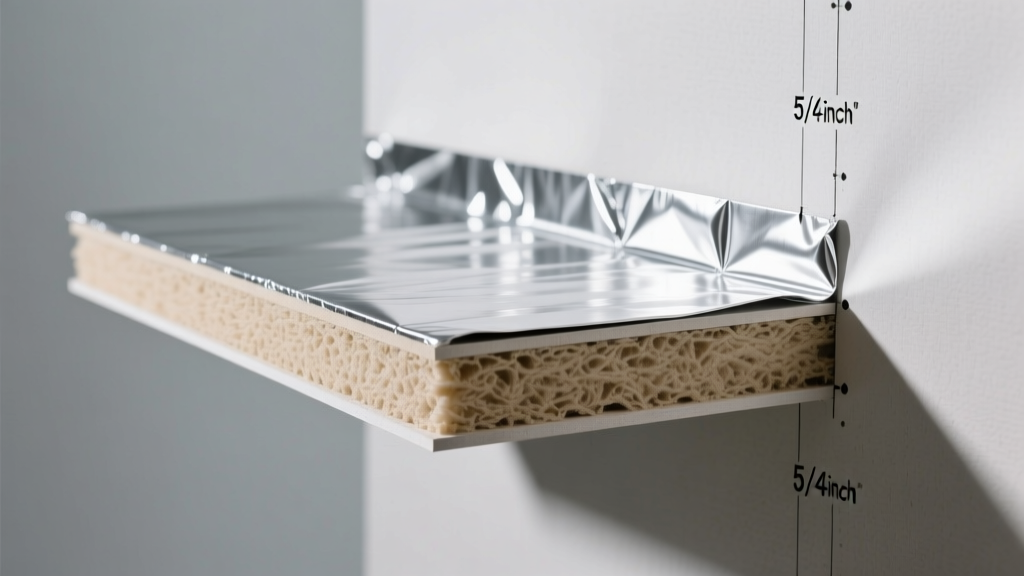
Foil backed gypsum board is a specialized interior lining panel engineered to act as a continuous Class I vapor retarder. The panel consists of a non-combustible calcium sulfate dihydrate (gypsum) core, encased on the front face by a smooth, natural-finish paper designed for joint treatment and painting. The back face, however, replaces standard paper with a continuous sheet of aluminum foil, typically ranging from 0.0005 to 0.001 inches in thickness. This foil layer is laminated to the gypsum core using specialized, moisture-resistant adhesives that maintain structural integrity without compromising the board's fire-resistive properties.
The primary function of the aluminum backing is to restrict the diffusion of water vapor through the wall assembly. Unlike vapor-retarding paints, which can be compromised by poor application or surface punctures, the foil layer provides a factory-applied, uniform barrier that maintains its integrity regardless of the interior finish applied to the front face. According to testing under The Gypsum Association guidelines, the foil backing does not alter the structural shear values or the fire-resistance ratings of the underlying gypsum core, allowing these panels to be used interchangeably with standard drywall in rated assemblies.
Under the International Residential Code (IRC) and ASTM E96 testing standards, a Class I vapor retarder must have a permeance rating of 0.1 perms or less. High-quality foil backed gypsum board consistently achieves a perm rating of 0.03 to 0.05 perms, effectively halting vapor diffusion while still allowing the wall cavity to dry to the exterior if bulk water intrusion occurs.
Standard Dimensions, Tolerances, and Weight
Manufacturers produce foil backed panels in dimensions that align with standard framing layouts, minimizing off-cuts and ensuring the vapor barrier remains as continuous as possible. The panels are available in both 1/2-inch and 5/8-inch thicknesses, with the latter primarily utilizing a Type X (fire-rated) core.
| Specification | 1/2-Inch Regular | 5/8-Inch Type X | ASTM Standard |
|---|---|---|---|
| Thickness | 1/2" (12.7 mm) ± 1/64" | 5/8" (15.9 mm) ± 1/64" | ASTM C1396 |
| Width | 48" (1220 mm) ± 3/32" | 48" (1220 mm) ± 3/32" | ASTM C1396 |
| Standard Lengths | 8', 9', 10', 12' | 8', 9', 10', 12', 14', 16' | ASTM C1396 |
| Weight (per sq. ft.) | ~1.6 lbs/sq ft | ~2.2 lbs/sq ft | N/A |
| Edge Profile | Tapered | Tapered | ASTM C1396 |
Perm Ratings, Moisture Dynamics, and Climate Restrictions
The defining specification of foil backed gypsum board is its permeance rating. Testing via the desiccant method (ASTM E96 Procedure A) consistently yields a water vapor transmission rate of less than 0.05 perms. This makes it one of the most effective vapor retarders available in residential and commercial framing.
The Inward Solar Vapor Drive Failure Mode
While the < 0.1 perm rating is highly beneficial in cold climates, it is a catastrophic liability in hot, humid climates. According to the U.S. Department of Energy, vapor retarders must be installed on the warm-in-winter side of the insulation. In IECC Climate Zones 1 through 3 (e.g., Florida, Texas, Southern California), the primary vapor drive during the cooling season is inward. When sun strikes a moisture-holding exterior cladding like brick or stucco, vapor is driven into the wall cavity. If foil backed drywall is installed on the interior, it traps this moisture inside the cavity, leading to condensation on the back of the drywall, mold growth, and structural rot.
Therefore, foil backed gypsum board is strictly specified for IECC Climate Zones 5, 6, 7, 8, and Marine 4, where the dominant vapor drive in winter moves from the warm, humid interior toward the cold, dry exterior.
Product Line Comparison and 2026 Pricing
Pricing for foil backed panels carries a premium over standard drywall due to the cost of the aluminum lamination process and lower production volumes. As of early 2026, contractors should budget a 40% to 60% premium over standard white board. Below is a comparison of the primary offerings from major North American manufacturers.
| Manufacturer | Product Line | Core Type | Avg. Price (4x8 Sheet) |
|---|---|---|---|
| USG | Sheetrock Brand Foil-Backed | Regular & Type X | $26.50 - $35.00 |
| CertainTeed | Foil-Backed Gypsum Board | Regular & Firecode C | $27.00 - $36.50 |
| National Gypsum | Gold Bond Brand Foil-Backed | Regular & Type X | $25.50 - $34.00 |
Installation Constraints and Edge Sealing Protocols
The vapor-retarding properties of foil backed gypsum board are only effective if the installation maintains the continuity of the foil layer. Standard drywall installation practices must be modified to account for the impermeable backing.
- Fastener Selection: Use Type S (for steel studs) or Type W (for wood studs) bugle-head screws. Screw length must be carefully calculated: for 1/2-inch board on wood, use 1-1/4" screws; for 5/8-inch board, use 1-5/8" screws. Over-penetration will punch unnecessary holes through the foil backing, creating micro-leaks in the vapor barrier.
- Fastener Spacing: Maximum 16 inches on center (o.c.) for walls and 12 inches o.c. for ceilings, adhering strictly to the center of the framing member.
- Perimeter Sealing: The tapered edges on the front face are finished with standard paper tape and joint compound. However, the cut edges at the floor, ceiling, and intersecting walls expose the gypsum core. These perimeters must be sealed using a continuous bead of acoustical sealant or a specialized butyl/foil tape (such as 3M Aluminum Foil Tape 425) applied to the back edge before the board is set against the framing.
- Electrical Boxes: Every cutout for an electrical outlet or switch punctures the foil. Installers must apply pre-formed vapor dam patches or bead a high-grade acoustical sealant around the flange of the electrical box on the interior side to restore the vapor barrier continuity.
Fire Resistance and Thermal Considerations
A common misconception is that the aluminum foil backing alters the fire-resistance rating of the wall assembly. Aluminum melts at approximately 1,220°F (660°C). In a standard ASTM E119 fire test, the temperature on the unexposed side of a 1-hour rated 5/8-inch Type X wall assembly rarely exceeds 250°F to 300°F above ambient before the assembly fails due to core calcination. Therefore, the foil remains intact and does not compromise the fire rating. Foil backed Type X panels are fully approved for use in UL Design U419 and similar 1-hour and 2-hour rated partitions.
Thermally, the foil facing provides a negligible R-value (approximately R-0.05) and should never be calculated as part of the wall's thermal insulation assembly. Its reflective properties are irrelevant when covered by interior paint, wallpaper, or drywall mud.
Frequently Asked Specifications Questions
Can foil backed gypsum board be used as an exterior sheathing?
No. The paper face and gypsum core are not designed for exterior weather exposure. The foil backing is strictly an interior vapor retarder. For exterior applications requiring foil-faced barriers, specify foil-faced polyisocyanate insulation boards or specialized glass-mat exterior sheathing.
Does the foil facing affect the adhesion of wallpaper or texture?
The front face of foil backed drywall is identical to standard drywall. The foil is exclusively on the back. You can apply primer, paint, texture, or wallpaper to the front face using standard protocols without any adhesion issues.
How do I repair a punctured foil backing after installation?
If the foil is accidentally torn or punctured during rough-in (e.g., by HVAC contractors running flex duct), the breach must be sealed. Clean the area and apply a 4-inch wide strip of self-adhesive aluminum foil HVAC tape, ensuring at least 2 inches of overlap on the intact foil surrounding the puncture.
Written by
Priya KapoorPriya Kapoor is a real estate market analyst and construction economics researcher with expertise in housing affordability, development feasibility, and infrastructure investment. She holds a Master of Regional Planning from Cornell University and previously worked as a senior analyst at CBRE's Investment Properties group, where she modeled returns for $4B in mixed-use development pipelines. Priya now runs an independent research practice advising developers, municipalities, and REITs on construction cost forecasting and market timing. She publishes the quarterly "BuildMat Market Pulse" report tracking material price indices across 12 commodity categories. Based in Austin, TX, Priya serves on the board of Habitat for Humanity Austin and is a marathon runner.
More from Priya Kapoor
View all
Construction Cost
Cost to Build a 1600 Sq Ft Home in 2026: Full Breakdown
Accurate 2026 cost to build a 1600 sq ft home—material, labor, and regional pricing breakdowns included. Plan your budget with real-time estimates.
Aug 11, 2026

Wood & Lumber
Name the Types of Wood for Pressure Treatment and Preservation
Learn how to name the types of wood best suited for pressure treatment. Compare species treatability, chemical retention levels, and 2026 preservation costs.
Aug 4, 2026

Stone & Masonry
Stone Veneer Suppliers Lindenhurst: 2026 Cost Analysis
Analyze 2026 stone veneer costs in Lindenhurst, NY. Compare local supplier pricing, delivery fees, and Suffolk County installation labor rates.
Aug 4, 2026