Fire Resistant Gypsum Board Cost Analysis & 2026 Pricing Guide
Analyze fire resistant gypsum board costs in 2026. Compare Type X vs Type C pricing, installation labor rates, and long-term ROI for commercial builds.

The True Cost of Fire Protection: Beyond the Sheet Price
Specifying fire resistant gypsum board is rarely a simple material swap; it is a systemic upgrade that alters framing requirements, fastener schedules, and finishing protocols. When estimating budgets for commercial, multi-family, or mixed-use projects in 2026, contractors and developers must look past the per-sheet price tag. The true cost of a fire-rated assembly encompasses specialized core materials, multi-layer installation labor, rigorous inspection protocols, and ancillary firestopping components.
According to the Gypsum Association Fire Resistance Design Manual, achieving specific hourly ratings (1-hour, 2-hour, or 4-hour) dictates not just the board type, but the exact stud gauge, screw spacing, and joint treatment. Failing to account for these assembly-level variables leads to severe budget overruns and costly inspection failures.
Material (Type X): $0.50 - $0.65 per sq. ft.
Material (Type C): $0.65 - $0.85 per sq. ft.
Labor (Fire-Rated Assembly): $2.50 - $4.50 per sq. ft.
Total Installed Cost: $3.50 - $6.50+ per sq. ft. depending on hourly rating and framing complexity.
Material Cost Breakdown: Type X vs. Type C vs. Specialty
The term 'fire resistant gypsum board' covers a spectrum of products engineered with glass fibers, vermiculite, and other core additives to delay calcination (the release of chemically bound water) under extreme heat. Understanding the material tiers is critical for accurate takeoffs.
| Board Classification | Standard Thickness | Core Composition | Max Single-Layer Rating | 2026 Material Cost / Sq. Ft. |
|---|---|---|---|---|
| Standard Gypsum | 1/2" or 5/8" | Standard gypsum core | Non-Rated | $0.35 - $0.45 |
| Type X | 5/8" | Gypsum + Glass Fibers | 1-Hour | $0.50 - $0.65 |
| Type C (Enhanced) | 5/8" | Gypsum + Fibers + Vermiculite | 1-Hour (Thinner framing) | $0.65 - $0.85 |
| Shaftliner (1") | 1" or 2x 5/8" | High-density Type X core | 2-Hour (Area Separation) | $1.20 - $1.60 |
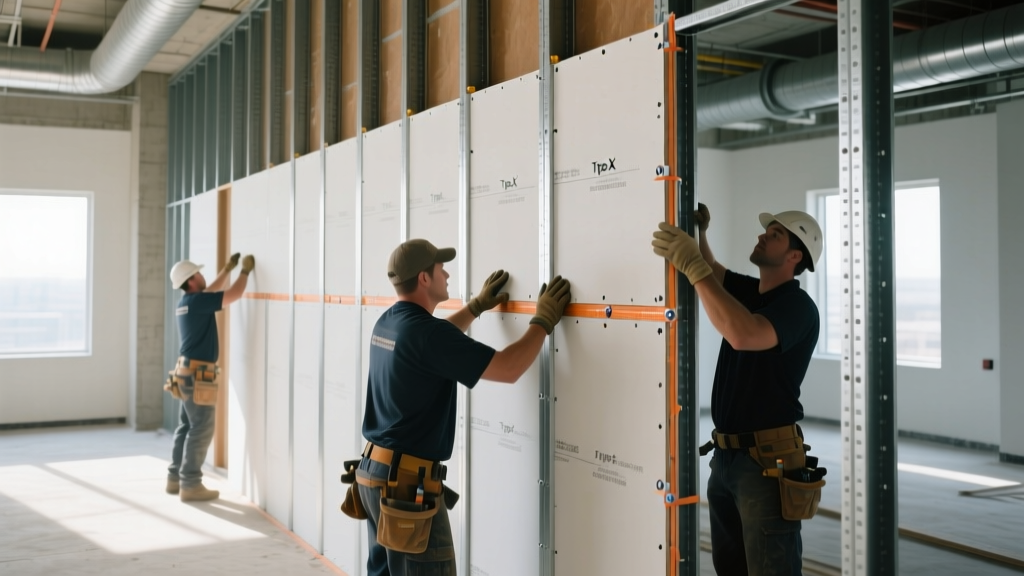
While Type X (such as the USG Sheetrock Firecode line) remains the baseline for 1-hour rated walls and corridor enclosures, Type C is increasingly specified in 2026 for projects requiring 2-hour ratings without the labor burden of triple-layer applications. The vermiculite in Type C shrinks less under intense heat, maintaining the structural integrity of the board face paper longer. For elevator shafts and stairwells, 1-inch shaftliner panels command a premium but eliminate the need for interior framing access during installation.
Labor Variables: Why Installation Doubles the Budget
The most common budgeting error in fire-rated construction is applying standard drywall labor rates to fire-rated assemblies. Installing fire resistant gypsum board to meet ASTM E119 standards requires strict adherence to Underwriters Laboratories (UL) or Warnock Hersey design specifications.
Multi-Layer vs. Single-Layer Systems
A standard 1-hour wood-stud wall might use a single layer of 5/8" Type X on each side. However, achieving a 2-hour rating often requires two layers of 5/8" board per side. This does not merely double the material cost; it exponentially increases labor time.
- Base Layer Installation: Must be fastened with 1-1/4" Type S bugle-head screws, spaced 12 inches on center (o.c.) in the field and 8 inches o.c. on the edges.
- Face Layer Installation: Requires longer screws (typically 2" or 2-1/8") to penetrate the base layer and bite deeply into the framing. Fastener spacing usually tightens to 8 inches o.c. in the field and 12 inches o.c. on edges, depending on the specific UL design.
- Joint Staggering: Vertical and horizontal joints between the base and face layers must be staggered by a minimum of 10 inches to prevent continuous thermal pathways.
Expect labor rates for multi-layer fire-rated assemblies to range from $3.00 to $4.50 per square foot, compared to $1.50 to $2.00 for standard single-layer hanging and taping.
Not all fire-rated UL designs require the base layer to be taped and mudded. However, if the specific design calls for base-layer joint treatment, skipping this step to save time will result in an automatic inspection failure. Always verify the exact joint treatment requirements in the approved UL directory for your specific assembly design before instructing your finishing crew.
Hidden Costs: Firestopping and Inspection Failures
The gypsum board itself is only one component of a fire-rated assembly. The intersections, penetrations, and perimeter details are where budgets frequently bleed and inspections fail. When calculating the total cost of fire resistant gypsum board systems, you must factor in ancillary firestopping materials.
Penetration Sealing and Perimeter Caulking
Whenever electrical boxes, HVAC ducts, or plumbing pipes penetrate a fire-rated gypsum wall, the integrity of the hourly rating is compromised. Restoring this rating requires specialized materials:
- Intumescent Firestop Sealant: Costs between $8 and $14 per 28 oz. tube. A single commercial floor with extensive MEP (Mechanical, Electrical, Plumbing) rough-ins can easily consume 50 to 100 tubes, adding $500 to $1,400 in pure material costs per floor.
- Putty Pads: Required for electrical boxes installed on opposite sides of a fire-rated stud cavity within 24 horizontal inches of each other. Intumescent putty pads cost $3 to $6 each.
- Head-of-Wall Firestopping: The gap between the top track of the drywall partition and the structural deck above must be sealed with fire-rated mineral wool and elastomeric firestop sealant to accommodate dynamic movement while maintaining the fire rating. Budget an additional $2.50 to $4.00 per linear foot for this detail.
The Cost of Rework
According to NFPA codes and standards adopted by local jurisdictions, fire-rated assemblies are subject to rigorous special inspections. If an inspector finds that a framer used standard drywall screws instead of approved Type S or Type G fasteners, or if the finishing crew used standard joint compound instead of fire-code setting-type compound where mandated, the assembly must be torn out or retrofitted. The cost of demolition, material replacement, and schedule delays can easily exceed $10,000 per failed inspection zone.
Long-Term ROI: Insurance and Code Compliance
While the upfront capital expenditure for premium fire resistant gypsum board systems is higher, the financial analysis must include the operational lifecycle of the building. Upgrading from a 1-hour to a 2-hour fire separation assembly in multi-family residential or mixed-use commercial projects yields tangible financial returns.
Builder's Risk and Property Insurance Reductions
Insurance underwriters heavily weight the fire-resistance ratings of structural assemblies when calculating premiums. Buildings utilizing Type C gypsum board in critical shaft enclosures and area separation walls often qualify for reduced builder's risk premiums during construction, and lower commercial property insurance rates post-occupancy. A 5% to 10% reduction in annual insurance premiums on a $20 million commercial asset can offset the initial $15,000 to $30,000 premium paid for upgraded gypsum materials within the first two to three years of operation.
Future Tenant Flexibility
Commercial spaces built with robust, multi-layer Type X or Type C demising walls offer superior acoustic attenuation (STC ratings of 55 to 65) alongside their fire ratings. This dual-performance characteristic makes the leasable space more attractive to high-value tenants (such as medical offices or legal firms), allowing developers to command higher price-per-square-foot lease rates, effectively subsidizing the initial drywall investment.
Strategic Procurement for 2026 Projects
To optimize costs without compromising life-safety compliance, project managers should adopt a targeted specification strategy. Avoid blanket-specifying Type C or multi-layer systems across the entire project. Instead, utilize advanced BIM (Building Information Modeling) coordination to map exact UL design requirements room-by-room. Use standard 5/8" Type X for basic 1-hour corridor walls, reserve enhanced Type C for complex 2-hour shaft enclosures where framing depth is restricted, and deploy 1-inch shaftliners exclusively for property line and elevator shaft applications. By aligning material procurement precisely with the architectural fire protection plan, contractors can reduce overall gypsum spend by 12% to 18% while maintaining flawless code compliance.
Written by
Priya KapoorPriya Kapoor is a real estate market analyst and construction economics researcher with expertise in housing affordability, development feasibility, and infrastructure investment. She holds a Master of Regional Planning from Cornell University and previously worked as a senior analyst at CBRE's Investment Properties group, where she modeled returns for $4B in mixed-use development pipelines. Priya now runs an independent research practice advising developers, municipalities, and REITs on construction cost forecasting and market timing. She publishes the quarterly "BuildMat Market Pulse" report tracking material price indices across 12 commodity categories. Based in Austin, TX, Priya serves on the board of Habitat for Humanity Austin and is a marathon runner.
More from Priya Kapoor
View all
Construction Cost
Cost to Build a 1600 Sq Ft Home in 2026: Full Breakdown
Accurate 2026 cost to build a 1600 sq ft home—material, labor, and regional pricing breakdowns included. Plan your budget with real-time estimates.
Aug 11, 2026

Wood & Lumber
Name the Types of Wood for Pressure Treatment and Preservation
Learn how to name the types of wood best suited for pressure treatment. Compare species treatability, chemical retention levels, and 2026 preservation costs.
Aug 4, 2026

Stone & Masonry
Stone Veneer Suppliers Lindenhurst: 2026 Cost Analysis
Analyze 2026 stone veneer costs in Lindenhurst, NY. Compare local supplier pricing, delivery fees, and Suffolk County installation labor rates.
Aug 4, 2026