What Is Gypsum Board Made Of? Core Composition & Repair Fixes
Discover what is gypsum board made of and how its core composition dictates repair strategies for sagging, mold, and screw pops.

The Anatomy of Drywall: What Is Gypsum Board Made Of?
To effectively troubleshoot and repair drywall defects, you must first answer a fundamental question: what is gypsum board made of? At its core, gypsum board is a composite panel consisting of a noncombustible calcium sulfate dihydrate (CaSO4·2H2O) core encased in a paper or glass-mat facer. According to the Gypsum Association, the gypsum core contains approximately 21% chemically combined water, which is responsible for the material's inherent fire resistance. When exposed to heat, this water is released as steam, delaying heat transmission.
However, modern drywall is not just raw gypsum. The core is heavily modified with additives: starch acts as a binder between the core and the paper facer, fiberglass strands are added for tensile strength (in Type X), and wax or silicone emulsions are introduced for moisture resistance. Understanding this exact chemical and structural makeup is the difference between a permanent repair and a recurring failure.
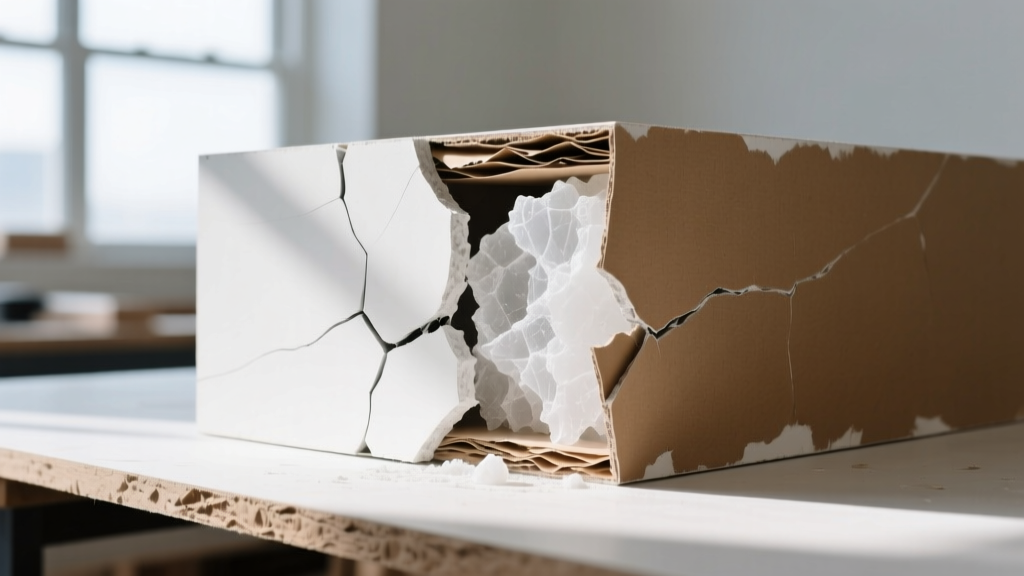
Composition-Driven Failure Modes
Every common drywall defect traces back to a specific component of the board's anatomy. The following matrix maps the material component to its most frequent failure mode and the required repair approach.
| Material Component | Primary Function | Common Failure Mode | Repair Strategy |
|---|---|---|---|
| Calcium Sulfate Core | Structural bulk, fire resistance | Core crushing, screw pops, sagging | Setting-type compound reinforcement |
| Paper Facer (Recycled) | Tensile strength, surface finish | Delamination, bubbling, tearing | Facer sealing and oil-based primers |
| Starch Binder | Adheres paper to core | Mold growth, moisture reactivation | Shellac primers, setting compounds |
| Fiberglass Strands | Fire rating (Type X) | Loss of fire integrity at seams | Fire-rated joint compound application |
Paper Facer Delamination and the Starch Problem
When homeowners ask what is gypsum board made of, they rarely consider the starch binder. Starch is a carbohydrate, and when the paper facer is exposed to high humidity or minor leaks, this starch becomes an immediate food source for mold spores. Furthermore, when you attempt to repair a bubbled or delaminated paper facer using standard water-based drying joint compound (like USG Sheetrock Brand All-Purpose), the water in the compound reactivates the starch, causing the paper to bubble again.
Expert Repair Protocol: Never apply water-based drying compound over exposed, damaged paper facers. First, seal the damaged paper with an oil-based or shellac-based primer like Zinsser B-I-N. Once sealed, use a setting-type compound (e.g., USG Durabond 90) which cures via chemical crystallization rather than water evaporation, preventing starch reactivation.
Core Crushing and Screw Pops
The dihydrate gypsum core is relatively soft. In 2026, the industry standard for residential walls is 1/2-inch lightweight panels, which cost roughly $14 to $18 per 4x8 sheet. While lightweight panels reduce installer fatigue, their lower-density core is more susceptible to crushing behind drywall screws if over-driven. When the wood framing shrinks seasonally, the crushed gypsum cannot hold the screw head, resulting in a 'screw pop'.
Repairing a screw pop requires addressing the compromised core. Do not simply remove the popped screw; this leaves a void in the crushed gypsum. Instead, drive a new 1-1/4-inch coarse-thread drywall screw exactly two inches above the pop to bite into fresh, uncompromised core and framing. Fill both dimples with a 45-minute setting compound (like Easy Sand 45), which structurally mimics the original gypsum core's crystalline hardness, unlike lightweight spackle which will shrink and crack.
Moisture Intrusion: How Core Additives Dictate Repair Strategies
Not all gypsum board is created equal. The ASTM C1396 standard outlines specific compositional requirements for different board types, which directly alters how you must approach water damage repairs.
Standard vs. Moisture-Resistant (Green/Purple Board)
Moisture-resistant gypsum board incorporates wax or silicone emulsions into the core and utilizes treated, water-repellent paper facers. If a green or purple board suffers minor water staining without structural sagging, the repair requires specific alkaline-resistant joint tapes and setting compounds. Standard paper tape can trap moisture against the treated facer, leading to edge blistering. Use fiberglass mesh tape embedded in a high-strength setting compound to ensure the patch bonds to the silicone-treated paper.
Repairing Fire-Rated Type X Core
Type X gypsum board contains a minimum of 15% fiberglass strands by weight in the core to hold the calcined gypsum together during a fire. If you are patching a hole in a garage firewall or multi-family separation wall, you cannot use standard scrap drywall. You must use a certified Type X patch (such as USG Sheetrock Brand Firecode C) and seal the perimeter with a fire-rated acoustic sealant. Standard joint compound does not contain the necessary intumescent or fiberglass properties to maintain the 1-hour or 2-hour fire rating of the assembly.
Expert Troubleshooting Matrix: Symptom to Fix
Use this diagnostic framework to identify the root cause of your drywall defect based on its material composition and apply the correct 2026-standard repair.
- Symptom: Joint tape blistering along the ceiling line.
Material Cause: The starch in the paper tape absorbed ambient moisture before the joint compound set, or the paper facer of the board itself delaminated.
Exact Fix: Cut out the blistered tape. Apply a thin coat of Zinsser Cover Stain (oil-based) to the exposed gypsum to seal the starch. Apply fiberglass mesh tape and embed with ProForm Easy Sand 20 setting compound. - Symptom: Nail/Screw rust bleeding through the paint.
Material Cause: Moisture penetrating the paper facer reached the uncoated steel fastener, oxidizing the metal. The gypsum core's natural moisture content accelerated the reaction.
Exact Fix: Countersink the rusted fastener slightly deeper without breaking the paper. Spot-prime the rust with a rust-inhibitive metal primer. Fill the dimple with setting-type compound and finish with a high-build PVA drywall primer before painting. - Symptom: Wavy, sagging ceiling drywall between joists.
Material Cause: The calcium sulfate core absorbed atmospheric humidity, losing its structural rigidity. This is common with 1/2-inch standard board installed on 24-inch on-center joists.
Exact Fix: The core is permanently compromised and cannot be patched. You must remove the sagging panels and replace them with 5/8-inch standard gypsum board or specialized 1/2-inch sag-resistant ceiling board, fastening every 7 inches along the joists.
Final Considerations for Material-Specific Repairs
Understanding what is gypsum board made of transforms drywall repair from a superficial cosmetic task into a structural restoration process. Always match your repair compounds to the chemical nature of the board. For deep core gouges, rely on setting-type compounds that replicate the dihydrate crystallization process. For paper facer damage, always neutralize the starch binder with solvent-based sealers before introducing water-based finishing materials. For comprehensive guidelines on assessing water damage and material degradation, refer to the USG technical data sheets for specific product tolerances and installation requirements.
Written by
Priya KapoorPriya Kapoor is a real estate market analyst and construction economics researcher with expertise in housing affordability, development feasibility, and infrastructure investment. She holds a Master of Regional Planning from Cornell University and previously worked as a senior analyst at CBRE's Investment Properties group, where she modeled returns for $4B in mixed-use development pipelines. Priya now runs an independent research practice advising developers, municipalities, and REITs on construction cost forecasting and market timing. She publishes the quarterly "BuildMat Market Pulse" report tracking material price indices across 12 commodity categories. Based in Austin, TX, Priya serves on the board of Habitat for Humanity Austin and is a marathon runner.
More from Priya Kapoor
View all
Construction Cost
Cost to Build a 1600 Sq Ft Home in 2026: Full Breakdown
Accurate 2026 cost to build a 1600 sq ft home—material, labor, and regional pricing breakdowns included. Plan your budget with real-time estimates.
Aug 11, 2026

Wood & Lumber
Name the Types of Wood for Pressure Treatment and Preservation
Learn how to name the types of wood best suited for pressure treatment. Compare species treatability, chemical retention levels, and 2026 preservation costs.
Aug 4, 2026

Stone & Masonry
Stone Veneer Suppliers Lindenhurst: 2026 Cost Analysis
Analyze 2026 stone veneer costs in Lindenhurst, NY. Compare local supplier pricing, delivery fees, and Suffolk County installation labor rates.
Aug 4, 2026