Composition of Gypsum Board: A Builder's Selection Guide
Learn how the composition of gypsum board dictates performance. Compare core additives, facers, and fire ratings to select the right drywall for any project.

The Core Anatomy: What Exactly is Inside Your Drywall?
Selecting the correct drywall requires looking past the surface finish and understanding the fundamental composition of gypsum board. At its core, gypsum board is a panel of calcium sulfate dihydrate ($CaSO_4 \cdot 2H_2O$), sandwiched between protective facers. However, the raw mineral undergoes a rigorous chemical transformation before it reaches the job site.
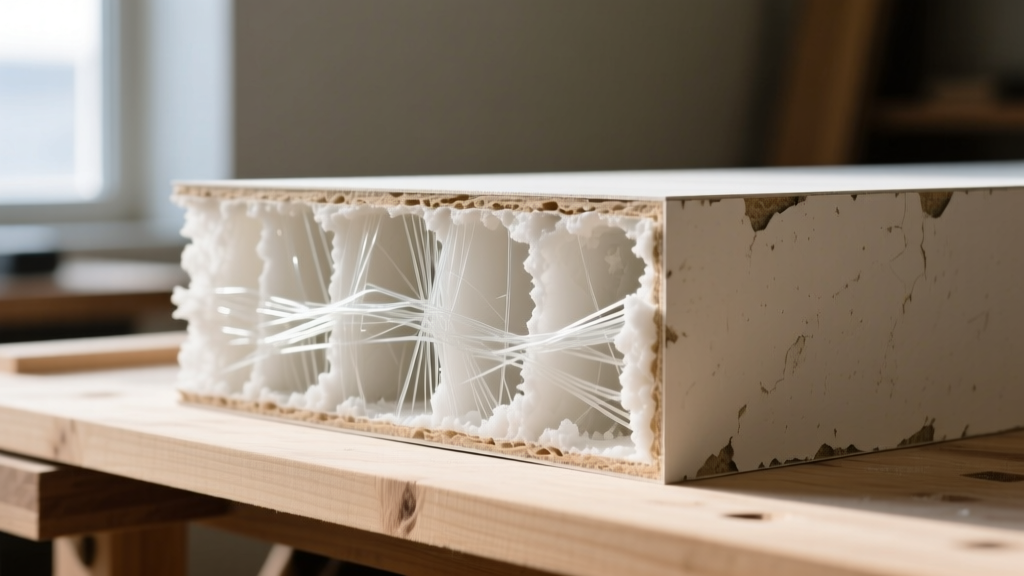
During manufacturing, raw or synthetic gypsum is crushed and heated in a process called calcination. This drives off approximately 75% of the chemically combined water, converting the dihydrate into calcium sulfate hemihydrate (commonly known as stucco or plaster of Paris). In the board plant, this hemihydrate is mixed with water, specific chemical additives, and foaming agents to form a slurry. As the slurry sets between the facers, it rehydrates back into calcium sulfate dihydrate, interlocking into a dense, crystalline matrix.
The fire-resistive properties of gypsum are inherent to its composition. Calcium sulfate dihydrate contains roughly 21% chemically combined water by weight. When exposed to fire, the board undergoes calcination in reverse: the heat forces the release of this water as steam. This endothermic reaction actively cools the surrounding area and delays heat transfer to the structural framing, a critical factor in achieving ASTM E119 fire-resistance ratings.
How Core Additives Dictate Performance (Selection Matrix)
Pure gypsum is relatively brittle, heavy, and susceptible to moisture. Modern formulations rely on precise core additives to engineer boards for specific environmental stresses. According to the Gypsum Association, altering the slurry chemistry is how manufacturers achieve distinct product categories under ASTM C1396.
| Board Type | Primary Core Additives | Facer Material | Failure Mode Prevented |
|---|---|---|---|
| Standard (Regular) | Starch (for paper adhesion), paper pulp, foaming agents | Recycled manila/gray paper | Basic impact and delamination |
| Type X (Fire-Rated) | Glass fibers (min 1% by weight), vermiculite | Heavy-duty paper | Core shrinkage and cracking during fire exposure |
| Moisture-Resistant (MR) | Siloxane or wax emulsions, mildewcides | Moisture-resistant green/purple paper | Core softening and mold growth in high humidity |
| Sound-Damping | Viscoelastic polymers, constrained layer damping (CLD) | Specialty acoustic paper | Airborne and impact sound transmission (STC ratings) |
| Glass Mat (Exterior) | Silicone-based water repellents, Portland cement blends | Woven fiberglass mat | Total core degradation from liquid water and UV exposure |
Facers and Backers: The Unsung Heroes of Board Selection
While the core provides structural mass and fire resistance, the facers dictate the board's tensile strength, moisture handling, and finishing capabilities. The composition of the facer is just as critical as the core when specifying materials for complex assemblies.
When to Specify Glass Mat vs. Paper Facers
Standard paper facers are manufactured from recycled newsprint and cardboard, providing excellent tensile strength and a surface that readily accepts joint compound. However, paper is inherently cellulose-based, making it a food source for mold when exposed to prolonged moisture.
For environments where liquid water is a certainty—such as commercial shower surrounds, exterior soffits, or tile backer boards in wet rooms—specify a glass mat gypsum board (e.g., Georgia-Pacific DensGlass or USG Securock). The fiberglass mat is inorganic and completely impervious to rot. Warning: Glass mat boards do not accept standard finishing compounds the same way paper does; they are designed to be covered by tile, cladding, or specialized exterior coatings.
Foil-Backed Gypsum for Vapor Control
In cold climates, interior moisture migration can condense inside wall cavities, leading to interstitial rot. Foil-backed gypsum board features a layer of aluminum foil laminated to the back paper. This acts as a Class I vapor retarder (perm rating < 0.1), eliminating the need for a separate polyethylene sheeting layer and reducing installation labor.
Synthetic vs. Natural Gypsum: Does the Source Matter?
A common question among specifiers is whether synthetic gypsum is inferior to mined natural gypsum. According to data from the U.S. Environmental Protection Agency (EPA), synthetic gypsum—primarily Flue-Gas Desulfurization (FGD) gypsum captured from coal-fired power plant smokestacks—now accounts for a significant portion of the North American supply.
FGD gypsum is often chemically purer (frequently exceeding 95% calcium sulfate dihydrate) than mined natural gypsum, which can contain clay, shale, and dolomite impurities. From a performance and composition standpoint, high-quality synthetic gypsum board performs identically to natural gypsum board and contributes to LEED credits for recycled content.
Real-World Selection Scenarios Based on Composition
Understanding these compositional differences allows builders to avoid costly callbacks and assembly failures. Apply this decision framework to your next project:
- Scenario 1: Multi-Family Party Wall (Sound Control)
The Mistake: Using multiple layers of standard 1/2" board to add mass.
The Compositional Fix: Specify 5/8" sound-damping board with a viscoelastic polymer core (e.g., CertainTeed SilentFX or National Gypsum SoundBreak XP). The polymer layer shears under acoustic vibration, converting sound energy into microscopic amounts of heat, achieving STC 50+ in a single-layer assembly. - Scenario 2: Commercial Elevator Shaft (Fire & Shaftliner)
The Mistake: Using standard Type X board on a 2-hour shaftwall assembly.
The Compositional Fix: Specify 1" Type X or Type C gypsum shaftliner. Type C contains a higher density of glass fibers and form-stabilizing additives (like expanded vermiculite) that prevent the core from shrinking and pulling away from the H-studs when the chemically bound water boils off at 212°F. - Scenario 3: Unconditioned Garage Ceiling Below Living Space
The Mistake: Using standard 1/2" board, which sags over time due to humidity and gravity.
The Compositional Fix: Specify 5/8" standard or sag-resistant board. The increased thickness, combined with a denser core formulation and specialized fiberglass mesh reinforcement in the slurry, provides the rigidity required for 24-inch joist spacing without sagging.
Environmental and Health Considerations in Modern Formulations
Modern gypsum board composition has evolved to address indoor air quality. Historically, some imported gypsum boards emitted volatile organic compounds (VOCs) and hydrogen sulfide due to impurities in the fly ash or improper calcination temperatures. Today, reputable North American manufacturers adhere to strict ASTM C1396 limits and third-party certifications like UL GREENGUARD Gold.
When selecting boards for sensitive environments like hospitals or schools, verify that the product's Safety Data Sheet (SDS) confirms the absence of added formaldehyde in the core additives and that the paper facers are treated with non-off-gassing biocides rather than volatile chemical sprays. By mastering the composition of gypsum board, specifiers can engineer assemblies that are not only code-compliant but optimized for longevity, acoustics, and fire safety.
Written by
David NakamuraDavid Nakamura is a licensed architect (AIA) and construction technology writer focused on sustainable building methods, mass timber engineering, and high-performance building envelopes. He holds a Master of Architecture from the University of Washington and is a certified Passive House Consultant (CPHC). David spent eight years at the Seattle firm Mithun, where he led the design of three LEED Platinum projects, before founding his own practice specializing in net-zero residential design. He serves on the editorial advisory board of GreenBuilder Magazine and has authored peer-reviewed papers on cross-laminated timber (CLT) connections for the Journal of Structural Engineering. In his spare time, David teaches woodworking at Pratt Fine Arts Center and kayaks the Puget Sound.
More from David Nakamura
View all
Construction Cost
Labor Cost to Build a Deck Per Sq Ft: 2026 Installation Guide
Discover the exact labor cost to build a deck per sq ft in 2026. This installation guide breaks down contractor rates, complexity factors, and hidden fees.
Aug 4, 2026

Construction Cost
How Much Does It Cost to Build a 3 Bedroom House? Financing Guide
Learn exactly how much it costs to build a 3 bedroom house and explore 2026 financing options, construction loan types, and budget frameworks for your build.
Aug 4, 2026

Construction Cost
Cost to Build a Tennis Court: 2026 Guide
How much does it cost to build a tennis court in 2026? Breakdowns for asphalt, concrete, and synthetic surfaces plus fencing and lighting.
Jul 30, 2026