Blue Board Gypsum Cost Guide: 2026 Pricing and Labor Analysis
Analyze 2026 blue board gypsum costs, including material pricing, veneer plaster labor rates, and ROI compared to Level 5 drywall finishes.

The True Cost of Blue Board Gypsum in 2026
When architects and high-end residential builders demand walls that are rock-hard, acoustically superior, and completely free of fastener pops or seam ghosting, standard drywall falls short. Enter blue board gypsum—a specialized plaster base panel designed specifically to receive a veneer plaster finish. Unlike standard white-faced drywall, blue board features a highly absorbent, chemically treated face paper that controls the suction and curing rate of wet plaster. However, achieving this premium, masonry-like finish requires a significant budget adjustment. In 2026, the cost of blue board gypsum systems is driven less by the panels themselves and more by the highly specialized labor required to trowel the veneer plaster.
- Material Only (Panels + Tape + Plaster): $1.25 – $1.85 per sq. ft.
- Total Installed (Material + Labor): $5.50 – $8.50 per sq. ft.
- Typical Project Size (2,500 sq. ft. home): $13,750 – $21,250 total wall/ceiling cost.
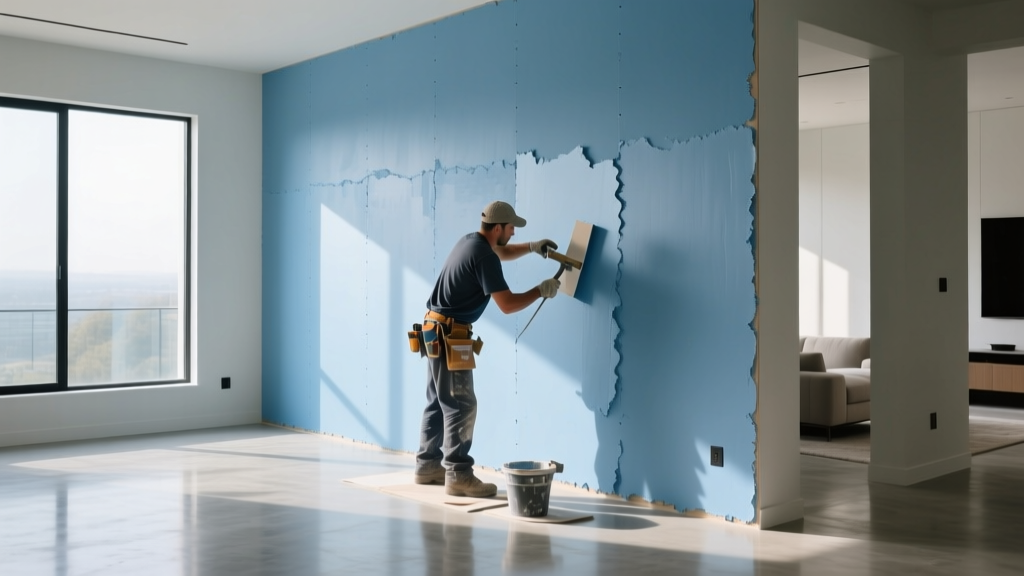
Material vs. Labor: Where Your Budget Actually Goes
A common misconception among general contractors is that blue board itself is prohibitively expensive. In reality, the gypsum panels are surprisingly affordable. The financial barrier to entry is the plastering labor market, which has seen a steady contraction in skilled tradespeople over the last decade, driving hourly rates and per-square-foot bids upward.
Material Cost Breakdown
For a standard 1/2-inch thick, 4x8-foot panel, expect to pay between $18.00 and $26.00 per sheet ($0.56 to $0.81 per square foot). This represents only a 15% to 25% premium over high-quality ultralight standard drywall. However, you must also factor in the specialized joint treatment materials. You cannot use standard all-purpose joint compound on blue board; you must use a setting-type compound (like USG Durabond) and specialized plaster base tape to prevent the moisture from the wet plaster from degrading the seams.
The Labor Premium
Hanging blue board costs roughly the same as hanging standard drywall ($0.50 to $0.85 per square foot). The exponential cost increase occurs during the plastering phase. A two-coat veneer plaster system (a scratch/brown coat followed by a finish coat) requires master plasterers. In 2026, skilled plastering crews charge between $3.50 and $6.00 per square foot for labor alone, depending on regional union rates and the complexity of the ceiling work.
2026 Blue Board Product Matrix
| Brand / Product Line | Core Type | Water Resistance | Avg. Price (4x8 Sheet) |
|---|---|---|---|
| USG Imperial® Brand | Standard Gypsum | No | $18.50 - $21.00 |
| USG Diamond® Brand | Water-Resistant Core | Yes (Moisture-Resistant) | $23.00 - $26.00 |
| Gold Bond® Kal-Kore® | Standard Gypsum | No | $18.00 - $20.50 |
| CertainTeed Plaster Base | Standard Gypsum | No | $19.00 - $22.00 |
The Physics of Absorption: Why Material Costs Vary
To understand the value proposition of blue board, you must understand the physics of veneer plaster. According to standards set by the Gypsum Association and ASTM C1396, plaster base boards are engineered for specific water absorption rates. When wet plaster is applied to a wall, the substrate must pull a precise amount of moisture out of the mix to initiate the chemical curing process.
If you apply veneer plaster to standard white-faced drywall, the paper does not absorb water uniformly. The plaster dries too quickly in some areas and remains soupy in others, leading to catastrophic cracking, delamination, and a phenomenon known as "plaster burn." Blue board features a specialized, multi-ply face paper that acts as a controlled wick. It draws moisture out of the plaster at a uniform, predictable rate across the entire 32-square-foot panel. This engineered precision is why you cannot substitute standard drywall to save money on a veneer plaster project—the risk of total system failure is near 100%.
Blue Board vs. Level 5 Drywall: A Financial Showdown
General contractors often attempt to value-engineer a blue board specification down to a Level 5 drywall finish. While both provide a smooth, premium aesthetic, their long-term performance and cost structures differ wildly.
Level 5 Drywall
- Installed Cost: $2.50 – $4.00 / sq. ft.
- Surface Hardness: Low (prone to dents and dings).
- Acoustics: Standard STC ratings.
- Best For: Standard residential, commercial offices, budget-conscious luxury.
Blue Board + Veneer Plaster
- Installed Cost: $5.50 – $8.50 / sq. ft.
- Surface Hardness: Extremely High (resists impacts, furniture dents).
- Acoustics: Superior sound dampening due to plaster density.
- Best For: Historic restorations, high-traffic luxury homes, museums, acoustic studios.
While the upfront cost of blue board is roughly double that of Level 5 drywall, the lifecycle cost often evens out in high-traffic commercial spaces or luxury estates. Veneer plaster rarely requires the patching and repainting maintenance that standard drywall mud requires after impact damage.
Critical Edge Cases and Installation Gotchas
Budget overruns on blue board projects rarely stem from the initial estimate; they stem from improper installation protocols that require expensive tear-outs. Keep these critical edge cases in mind when planning your 2026 construction budget:
- The Tape Delamination Trap: Standard drywall paper tape is not rated for the high moisture content of veneer plaster. If a drywall crew tapes the blue board joints with standard paper tape before the plasterers arrive, the moisture from the plaster will reactivate the tape adhesive, causing bubbling and joint failure. You must budget for and specify fiberglass mesh tape or specialized plaster base tape embedded in a setting-type compound.
- The Tile Backer Misconception: Blue board (even water-resistant variants like USG Diamond) is not a cement board. It cannot be used as a tile backer in shower surrounds or wet rooms. If your architectural drawings show tile over blue board in a bathroom, issue an RFI immediately. The cost to remediate failed tile over degraded gypsum is astronomical.
- Temperature and Curing Delays: Veneer plaster requires strict climate control. If the building's HVAC is not operational and the interior temperature drops below 55°F (13°C), the plaster will not cure properly, leading to weak, chalky finishes. Budget for temporary heating solutions if plastering is scheduled during winter months.
"The biggest mistake estimators make with blue board is treating it like a drywall swap. It's a masonry-adjacent trade. If you don't allocate budget for specialized joint treatment and temporary climate control during the plaster cure, your punch list will be a nightmare." — Senior Project Manager, High-End Residential Contracting.
Strategic Sourcing and Procurement Tips
To optimize your material spend on blue board gypsum, avoid purchasing through standard retail big-box home improvement stores, which carry heavy markups and limited stock of specialized plaster bases. Instead, establish accounts with commercial building material distributors.
Order in full pallets (typically 40 to 50 sheets) to secure volume pricing and reduce freight surcharges. Furthermore, lead times for specialized plaster bases like USG Diamond can stretch to 3 or 4 weeks in secondary markets due to lower manufacturing runs compared to standard white board. Integrate blue board procurement into your critical path schedule early, ensuring the panels are acclimatized in the building for at least 48 hours before the hanging crew begins work to prevent thermal expansion issues post-installation.
Written by
Priya KapoorPriya Kapoor is a real estate market analyst and construction economics researcher with expertise in housing affordability, development feasibility, and infrastructure investment. She holds a Master of Regional Planning from Cornell University and previously worked as a senior analyst at CBRE's Investment Properties group, where she modeled returns for $4B in mixed-use development pipelines. Priya now runs an independent research practice advising developers, municipalities, and REITs on construction cost forecasting and market timing. She publishes the quarterly "BuildMat Market Pulse" report tracking material price indices across 12 commodity categories. Based in Austin, TX, Priya serves on the board of Habitat for Humanity Austin and is a marathon runner.
More from Priya Kapoor
View all
Construction Cost
Cost to Build a 1600 Sq Ft Home in 2026: Full Breakdown
Accurate 2026 cost to build a 1600 sq ft home—material, labor, and regional pricing breakdowns included. Plan your budget with real-time estimates.
Aug 11, 2026

Wood & Lumber
Name the Types of Wood for Pressure Treatment and Preservation
Learn how to name the types of wood best suited for pressure treatment. Compare species treatability, chemical retention levels, and 2026 preservation costs.
Aug 4, 2026

Stone & Masonry
Stone Veneer Suppliers Lindenhurst: 2026 Cost Analysis
Analyze 2026 stone veneer costs in Lindenhurst, NY. Compare local supplier pricing, delivery fees, and Suffolk County installation labor rates.
Aug 4, 2026