Gypsum Board Weight Guide: Specs by Thickness, Type, and Brand
Calculate exact gypsum board weight by thickness and type. Compare standard, Type X, and ultralight drywall specs for structural loads and labor planning.

The Physics of Drywall: Why Gypsum Board Weight Dictates Design
Specifying the correct drywall requires looking beyond fire ratings and moisture resistance. Gypsum board weight directly impacts structural dead load calculations, framing deflection limits, and installation ergonomics. A standard 5/8-inch panel adds over 70 pounds per 4x8 sheet to a ceiling assembly. When multiplied across a 10,000-square-foot commercial project, the aggregate dead load of the ceiling membrane alone can exceed 22,000 pounds. Understanding these mass variables is critical for structural engineers, framers, and drywall contractors to prevent joist sagging, optimize material handling, and reduce labor fatigue.
Comprehensive Weight Matrix by Thickness and Core Type
The mass of a gypsum panel is determined by its core density, facing materials, and thickness. The introduction of ultralight core technology over the last decade has fundamentally shifted weight baselines. Below is the definitive weight matrix for standard 4x8 (32 sq. ft.) panels across the most common core formulations.
| Thickness | Standard Core (lbs/sq ft) | Type X Fire-Rated (lbs/sq ft) | Ultralight Core (lbs/sq ft) | 4x8 Sheet Weight (Standard vs. Ultra) |
|---|---|---|---|---|
| 1/4 inch | 1.20 | N/A | N/A | 38.4 lbs / N/A |
| 3/8 inch | 1.56 | N/A | 1.25 | 49.9 lbs / 40.0 lbs |
| 1/2 inch | 1.60 | 1.80 | 1.25 | 51.2 lbs / 40.0 lbs |
| 5/8 inch | 2.20 | 2.30 | 1.65 (Type X) | 70.4 lbs / 52.8 lbs |
The Ultralight Core Advantage: Material Science in Action
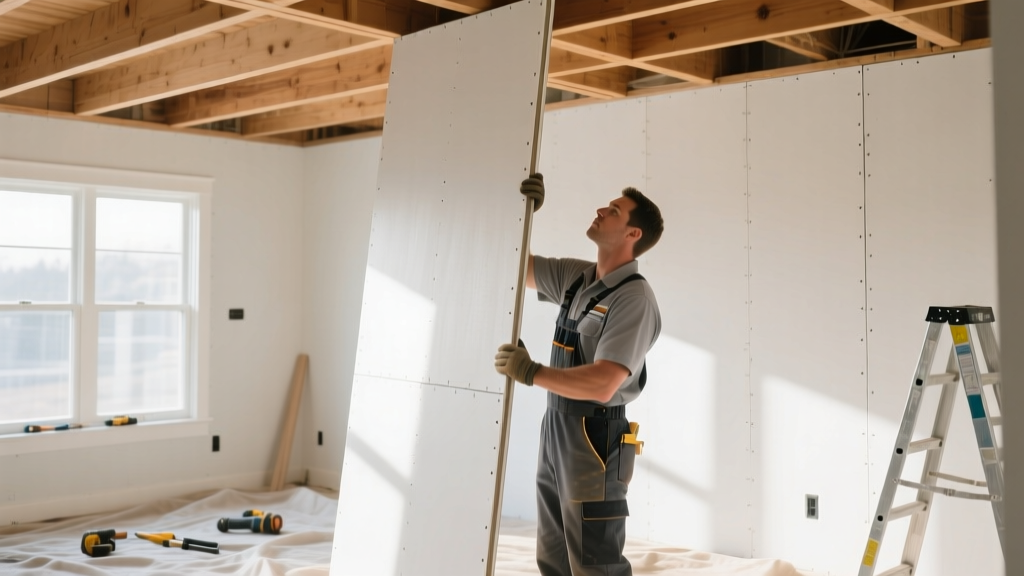
Products like USG Sheetrock UltraLight and CertainTeed Easi-Lite achieve a 25% to 30% weight reduction without sacrificing structural rigidity or fire resistance. Manufacturers accomplish this by replacing heavy, solid gypsum crystals with a matrix of expanded perlite, polymer-modified starch binders, and lower-density calcined gypsum. The result is a 1/2-inch panel that weighs just 40 pounds—allowing a single installer to comfortably carry and position a 4x8 sheet overhead, a task that typically requires two workers with standard 51-pound panels.
Specialty Boards: When Gypsum Board Weight Spikes
Standard and ultralight panels represent the baseline, but specialized environments demand boards with secondary facings or reinforced cores. These additions drastically alter the weight profile:
- Glass Mat Gypsum (e.g., Georgia-Pacific DensGlass): Replaces paper facings with fiberglass mats and utilizes a denser, moisture-treated core. A 5/8-inch DensGlass panel weighs approximately 2.45 lbs/sq ft (78.4 lbs per 4x8 sheet), primarily due to the heavy exterior-grade core treatments.
- Foil-Backed Panels: The addition of a laminated aluminum foil vapor retarder adds negligible mass (roughly 0.05 lbs/sq ft), keeping the overall weight nearly identical to standard panels.
- Abuse-Resistant Type X: Boards designed for high-traffic corridors (like USG Sheetrock AbuseGuard) incorporate embedded fiberglass mesh and higher-density gypsum cores to withstand impact. Expect a 5/8-inch abuse-resistant panel to weigh up to 2.60 lbs/sq ft (83.2 lbs per sheet).
Project Load Calculation Framework
To accurately estimate the total dead load contribution of your drywall, follow this calculation sequence. This is critical for structural engineers verifying truss and joist capacities.
- Determine Net Area: 2,500 sq. ft. of ceiling space.
- Select Panel Spec: 5/8-inch Standard Type X (2.30 lbs/sq ft) vs. 5/8-inch Ultralight Type X (1.65 lbs/sq ft).
- Calculate Standard Load: 2,500 sq ft × 2.30 lbs = 5,750 lbs total dead load.
- Calculate Ultralight Load: 2,500 sq ft × 1.65 lbs = 4,125 lbs total dead load.
- Identify Delta: Specifying ultralight removes 1,625 lbs of permanent structural stress from the roof trusses.
Ergonomics, Logistics, and Labor Economics
The physical mass of drywall directly correlates with jobsite injury rates and installation speed. According to OSHA ergonomics guidelines, repetitive lifting of materials exceeding 50 pounds significantly increases the risk of musculoskeletal disorders (MSDs), particularly in the lower back and shoulders.
Labor Efficiency Metrics
When bidding a project, contractors must factor in the hidden costs of heavy materials. Hanging standard 5/8-inch drywall on a 12-foot ceiling requires mechanical panel lifters or two-person crews due to the 70+ pound sheet weight. By switching to 1/2-inch ultralight panels (where code permits for fire ratings via specialized assembly designs), a single installer can maneuver the 40-pound sheets into place, reducing hanging time by up to 20% and eliminating the rental cost for secondary lifting equipment on smaller residential jobs.
Acoustic Mass vs. Decoupling Strategies
A common misconception in acoustic design is that heavier gypsum board always yields a higher Sound Transmission Class (STC) rating. While the Mass Law dictates that doubling the mass of a partition increases STC by roughly 6 decibels, modern acoustic engineering favors decoupling over raw weight. Instead of specifying heavy, double-layer 5/8-inch standard drywall (which adds 4.4 lbs/sq ft to the wall), acoustic consultants now specify a single layer of 5/8-inch board mounted on resilient channels or staggered studs. This achieves superior low-frequency sound isolation while keeping the overall gypsum board weight and framing load to a minimum.
Frequently Asked Questions
Does ultralight gypsum board sag on ceilings?
No, provided it is installed correctly. Early generations of lightweight drywall in the 1990s suffered from ceiling sag due to weaker core formulations. Modern ultralight panels (post-2010 formulations) utilize advanced polymer binders that meet or exceed the sag-resistance standards set by ASTM C1396. They are fully rated for 24-inch on-center ceiling joist spacing, identical to standard 1/2-inch panels.
How does moisture affect drywall weight over time?
Standard paper-faced gypsum is highly hygroscopic. If exposed to chronic high humidity (above 80% RH) or minor leaks, a standard 1/2-inch panel can absorb enough ambient moisture to increase its weight by 5% to 10%, leading to fastener pull-through and joint tape blistering. For high-humidity environments, specify glass mat or moisture-resistant (green/purple board) options, which feature treated cores and hydrophobic facings that prevent moisture absorption and subsequent weight gain.
What is the weight of a 4x12 sheet of 5/8-inch Type X?
A 4x12 sheet covers 48 square feet. Using the standard Type X weight of 2.30 lbs/sq ft, a single 4x12 panel weighs approximately 110.4 pounds. These sheets strictly require mechanical lifters or a three-person crew for safe overhead installation and are typically reserved for commercial spaces with 12-foot ceiling heights to minimize horizontal butt joints.
Written by
Priya KapoorPriya Kapoor is a real estate market analyst and construction economics researcher with expertise in housing affordability, development feasibility, and infrastructure investment. She holds a Master of Regional Planning from Cornell University and previously worked as a senior analyst at CBRE's Investment Properties group, where she modeled returns for $4B in mixed-use development pipelines. Priya now runs an independent research practice advising developers, municipalities, and REITs on construction cost forecasting and market timing. She publishes the quarterly "BuildMat Market Pulse" report tracking material price indices across 12 commodity categories. Based in Austin, TX, Priya serves on the board of Habitat for Humanity Austin and is a marathon runner.
More from Priya Kapoor
View all
Construction Cost
Cost to Build a 1600 Sq Ft Home in 2026: Full Breakdown
Accurate 2026 cost to build a 1600 sq ft home—material, labor, and regional pricing breakdowns included. Plan your budget with real-time estimates.
Aug 11, 2026

Wood & Lumber
Name the Types of Wood for Pressure Treatment and Preservation
Learn how to name the types of wood best suited for pressure treatment. Compare species treatability, chemical retention levels, and 2026 preservation costs.
Aug 4, 2026

Stone & Masonry
Stone Veneer Suppliers Lindenhurst: 2026 Cost Analysis
Analyze 2026 stone veneer costs in Lindenhurst, NY. Compare local supplier pricing, delivery fees, and Suffolk County installation labor rates.
Aug 4, 2026