Code Compliance for Gypsum Board Joint Compound Selection
Ensure your gypsum board joint compound meets ASTM C475, fire, and VOC codes. A complete compliance guide for contractors and inspectors.

The Regulatory Landscape: ASTM C475 and Beyond
When building inspectors evaluate drywall installations, they rarely scrutinize the brand of gypsum board joint compound used—until a fire-rated assembly is tested, a moisture barrier fails, or an indoor air quality audit flags excessive off-gassing. Compliance is not merely about achieving a smooth Level 4 or Level 5 finish; it is about ensuring the chemical and physical properties of the mud align with the engineered design of the wall or ceiling system. Under the International Building Code (IBC) and International Residential Code (IRC), joint treatment materials must conform to specific standards, primarily ASTM C475 (Specification for Joint Compound and Joint Tape) and ASTM C474 (Test Methods for Joint Treatment Materials).
Failing to specify the correct gypsum board joint compound for a given environment or fire rating is a frequent cause of failed inspections and costly rework. This guide breaks down the exact code requirements, testing parameters, and material specifications required for compliant installations in 2026.
Breaking Down ASTM C475 / C474 Requirements
ASTM C475 classifies joint compounds into three primary categories, each with strict performance thresholds tested under ASTM C474. Inspectors rely on these classifications to verify that the material on-site matches the architectural specifications:
- Embedding (Taping) Compound: Must possess high tensile strength and bond tightly to paper or fiberglass tape. It is formulated with higher glue content to resist blistering.
- Topping Compound: Designed for minimal shrinkage and easy sanding. It has lower tensile strength and must never be used for the tape-embedding coat.
- All-Purpose Compound: Formulated to meet the minimum tensile requirements for embedding while maintaining acceptable shrinkage rates for topping. It is the only pre-mixed drying compound legally permitted for all coats in standard, non-fire-rated assemblies.
Never use pre-mixed drying-type (all-purpose or taping) joint compound for the first coat in a UL-listed fire-rated assembly unless explicitly permitted by the specific UL design. Drying compounds shrink as water evaporates, which can pull away from the tape and create micro-fissures. Setting-type compounds undergo a chemical hydration process that expands slightly, sealing the joint completely.
Fire-Rated Assemblies: UL and ULC Joint Restraints
The most critical compliance intersection for gypsum board joint compound occurs in fire-resistance-rated partitions (e.g., 1-hour or 2-hour walls). Underwriters Laboratories (UL) and ULC Standards dictate the exact materials permitted in tested assemblies. The joint compound is not just a cosmetic finisher; it is an intumescent and structural sealant that prevents the passage of flames and superheated gases.
Compound Types vs. Fire Rating Compliance Matrix
| Compound Type | Curing Mechanism | Permitted in Fire-Rated Joints? | Required Application Stage | Common Product Examples |
|---|---|---|---|---|
| Setting-Type (Powder) | Chemical Hydration | Yes (Mandatory for most UL designs) | First coat (embedding) and fill coats | USG Durabond 45/90, ProForm Quick Set |
| All-Purpose (Pre-Mixed) | Air Drying (Evaporation) | Rarely (Only if UL design explicitly lists it) | Fill and finish coats (never embedding) | USG All-Purpose, CGC All-Purpose |
| Topping (Pre-Mixed) | Air Drying (Evaporation) | No (Lacks structural tensile strength) | Final skim coat only (Level 5) | USG Plus 3, ProForm Topping |
| Lightweight All-Purpose | Air Drying (Evaporation) | Verify with Manufacturer | Fill and finish coats | USG Lightweight All-Purpose |
For example, in a standard 1-hour wood-stud fire wall (such as UL Design U305), the code requires the joints to be taped and finished with a minimum of two coats. The embedding coat must be a setting-type gypsum board joint compound to ensure zero shrinkage at the critical gypsum core seams. If an inspector cores a joint and finds air-dried all-purpose mud embedding the tape in a rated shaft wall, the assembly fails inspection and must be torn out.
Moisture and Mold Resistance: ASTM D3273 & D6329
In high-humidity environments—such as commercial restrooms, indoor pool enclosures, and healthcare facilities—code compliance extends to mold and moisture resistance. Standard joint compounds contain organic binders (like starch and cellulose) that serve as a primary food source for Aspergillus niger and other common indoor molds when exposed to prolonged moisture.
When installing moisture-resistant gypsum board (commonly known as green board or purple board), the joint compound must match the environmental rating of the panel. According to ASTM D3273 (Standard Test Method for Resistance to Growth of Mold on the Surface of Interior Coatings in an Environmental Chamber), standard pre-mixed mud will fail the 4-week mold incubation test when subjected to 95% relative humidity.
Compliant Mud Selection for Wet Areas
To maintain code compliance in damp areas, contractors must utilize one of the following:
- Setting-Type Compounds: Because they are cementitious and lack the organic starches found in pre-mixed mud, setting-type compounds (e.g., 45-minute or 90-minute setting) are inherently highly resistant to mold growth. They are the safest choice for embedding tape in wet-area applications.
- Specifically Formulated Mold-Resistant Pre-Mixed: Some manufacturers add EPA-registered fungicides (like Mergal or IPBC) to their pre-mixed compounds. These products must carry a verified ASTM D3273 score of 10 (no mold growth). Always check the technical data sheet (TDS) for the specific D3273 score before applying in a healthcare or high-moisture environment.
If the moisture-resistant gypsum board is being used as a substrate for direct-applied ceramic tile (in non-continuous wet areas like residential kitchen backsplashes), the joint compound must be completely protected by the thinset and tile. However, for commercial showers, code mandates cement backer board or glass-mat gypsum; joint compound of any type is strictly prohibited in the tile-setting bed of these assemblies.
VOC Limits and Indoor Air Quality Codes
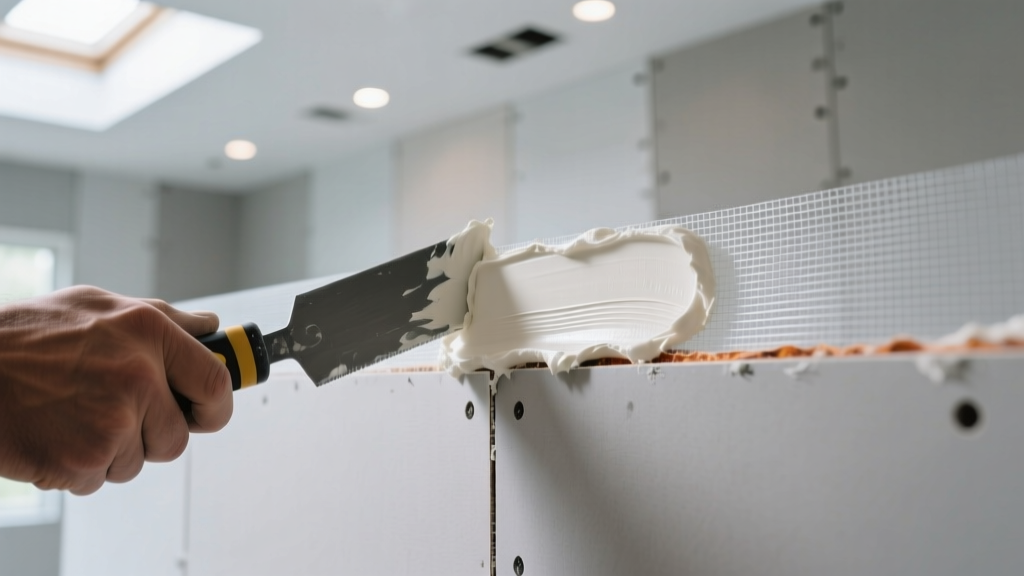
Indoor air quality (IAQ) codes have tightened significantly. Under LEED v4.1, the California Air Resources Board (CARB) ATCM, and the South Coast Air Quality Management District (SCAQMD) Rule 1168, gypsum board joint compound is classified as an interior flat paint/coating or specialized architectural coating. The legal limit for Volatile Organic Compounds (VOCs) in joint compounds is strictly capped at < 50 grams per liter (g/L) for most jurisdictions, with some green building standards demanding < 5 g/L.
Calculating VOC Thresholds for 2026 Projects
Contractors and procurement managers must verify the VOC content on the product's Safety Data Sheet (SDS) or Environmental Product Declaration (EPD). A common compliance trap occurs when distributors substitute a standard-grade compound with a regional, non-compliant formulation to save on freight costs.
- Standard Compliance: Ensure the product label explicitly states "Complies with SCAQMD Rule 1168" and "CARB 2007".
- LEED v4.1 EQ Credit: Requires third-party certification, such as Greenguard Gold or UL ECOLOGO. The joint compound must emit less than 0.5 mg/m³ of total VOCs after 168 hours in a dynamic environmental chamber.
- California Title 24 / CHPS: Requires strict adherence to CDPH Standard Method v1.2 for classroom and healthcare environments, limiting specific individual chemical emissions (like formaldehyde and acetaldehyde) far beyond total VOC limits.
Finish Levels: GA-214 Code Alignment
While the Gypsum Association’s GA-214 (Recommended Levels of Gypsum Board Finish) is technically an industry standard rather than a statutory building code, it is universally adopted by reference in architectural master specifications (such as CSI MasterFormat Section 09 29 00). When an inspector or architect references "Level 4" or "Level 5" in the contract documents, GA-214 becomes the legally binding standard for compliance.
GA-214 Compliance Checkpoints by Level
Misapplication of gypsum board joint compound across finish levels leads to visual defects, glancing-light failures, and rejected handovers. Here is the exact compound layering required for compliance:
- Level 0 & 1: Tape embedded in joint compound. No further coats required. (Used in concealed plenums or fire-taping only).
- Level 2: One additional coat over the tape and fasteners. (Used as a substrate for heavy textures or tile backing).
- Level 3: Two separate coats over tape, one coat over fasteners. (Required for medium-to-heavy spray textures).
- Level 4: Three separate coats over tape, two coats over fasteners. (The standard for flat paint and light textures. Crucial: Topping compound must be used for the final coat to ensure zero joint banding under LED glancing light).
- Level 5: All Level 4 requirements, plus a continuous skim coat of topping compound (or specialized Level 5 primer-surfacer) applied over the entire gypsum board surface. This is legally required in areas with severe glancing light, high-gloss paints, or dark architectural colors.
Inspector Red Flags: Common Code Violations
To pass drywall inspections on the first attempt, site supervisors must audit the joint compound staging area. Inspectors frequently issue corrections for the following violations:
- Expired Setting Compounds: Setting-type powders have a shelf life of 6 to 9 months. If the humidity breaches the bag, the hemihydrate gypsum begins to pre-hydrate. An inspector will reject bags that are rock-hard or show signs of moisture intrusion, as the compound will not achieve its rated compressive strength.
- Improper Thinning: Adding water to pre-mixed joint compound to make it "spread easier" breaks the chemical binder ratio. This violates ASTM C474 tensile strength requirements and leads to cohesive failure (powdering) and edge-cracking. If thinning is necessary, the manufacturer's TDS must explicitly permit it, usually limiting addition to 1 pint of water per 5-gallon bucket.
- Mixing Incompatible Chemistries: Applying a high-alkali setting compound (pH 11-12) directly over an acidic primer, or applying a water-based topping compound over an unsealed, highly porous setting compound without a drywall sealer, can cause chemical burning, yellowing, or delamination.
- Missing Fire-Stopping at Penetrations: Joint compound is not a firestop sealant. Using drywall mud to pack gaps around electrical boxes or plumbing penetrations in a rated wall is a severe fire code violation. These gaps require ASTM E814 tested intumescent firestop putty or caulk.
By aligning your material procurement and application techniques with ASTM C475, UL fire designs, and GA-214 finish levels, you eliminate the guesswork from drywall compliance. Always keep the manufacturer's Technical Data Sheets (TDS) and the specific UL design printouts in the job site trailer; when an inspector questions a joint treatment method, handing them the verified engineering documentation is the fastest way to secure approval.
Written by
James ThorntonJames Thornton is a construction industry veteran with 25 years of hands-on experience in wood framing, lumber grading, and residential building codes. He started as a framing carpenter in rural Oregon, earned his ICC Residential Building Inspector certification, and eventually became a senior plan reviewer for the City of Portland Bureau of Development Services. James holds a B.S. in Wood Science & Technology from Oregon State University and is a certified lumber grader through the West Coast Lumber Inspection Bureau (WCLIB). He has inspected over 3,000 residential construction sites and authored the city's internal guide on advanced framing techniques (2x6 at 24" O.C.). James lives in Bend, OR, where he builds custom timber-frame cabins and competes in lumberjack sports.
More from James Thornton
View all
Insulation
Best Home Insulation Materials: Complete 2026 Guide
Compare top home insulation materials for 2026. Find R-values, installed costs per square foot, and best uses for fiberglass, spray foam, and mineral wool.
Aug 4, 2026

Sustainable Building
Certify Your Green Building Material for LEED and WELL
Step-by-step guide to certifying a green building material for LEED v5 and WELL v2. Master EPDs, HPDs, and VOC limits for 2026 project specifications.
Aug 4, 2026

Stone & Masonry
Veneer Stacked Stone Panels: Interior Design & Style Showcase
Discover how veneer stacked stone panels transform interiors. Explore modern design profiles, material pairings, and technical installation specs.
Aug 4, 2026