Is Gypsum Board Fire Resistant? The Complete Type X Product Guide
Discover if gypsum board is fire resistant. Compare Type X and Type C drywall, ASTM E119 ratings, top products, and critical installation rules.

The Chemistry of Fire Resistance: Calcination
To answer whether gypsum board is fire resistant, you must look at its chemical composition. Gypsum is calcium sulfate dihydrate (CaSO4·2H2O). By weight, standard gypsum core contains approximately 21% chemically combined water and 79% calcium sulfate. When exposed to fire, the core undergoes a process called calcination.
As temperatures reach 212°F (100°C), the chemically bound water begins to vaporize. This phase change absorbs massive amounts of thermal energy, effectively holding the temperature of the unexposed side of the board at or near 212°F until all the free water is driven off. Only after this water is entirely depleted will the temperature of the gypsum core begin to rise above 212°F, eventually leading to structural degradation of the calcined board. This built-in endothermic reaction is what makes gypsum an inherently fire-resistive material.
Product Matrix: Standard vs. Type X vs. Type C
Not all gypsum board offers the same level of protection. Under ASTM C1396 (Standard Specification for Gypsum Board), manufacturers produce distinct grades engineered for specific fire-endurance requirements. The primary difference lies in core density, thickness, and the inclusion of glass fibers and vermiculite to prevent the calcined core from shrinking and cracking under extreme heat.
| Board Type | Standard Thickness | Core Additives | Typical Assembly Rating | Est. Material Cost (per sq. ft.) |
|---|---|---|---|---|
| Standard Gypsum | 1/2" or 5/8" | None (Standard starch binders) | 15-30 Minutes | $0.45 - $0.55 |
| Type X | 5/8" | Glass fibers (prevents core cracking) | 1 Hour (minimum requirement) | $0.65 - $0.85 |
| Type C (Enhanced) | 1/2" or 5/8" | High-density glass fibers + Vermiculite | 1 to 4 Hours (depending on assembly) | $0.85 - $1.15 |
The 'Assembly Rating' Reality (ASTM E119)
A critical misconception in construction is that a single sheet of drywall possesses a standalone fire rating. In reality, fire ratings are assigned to entire wall or ceiling assemblies tested under ASTM E119 standards via the Gypsum Association's Fire Resistance Design Manual. The rating measures the assembly's ability to contain a fire, maintain structural integrity, and prevent heat transmission to the unexposed side.
Achieving a 1-Hour Rating
A standard 1-hour fire-rated wall assembly typically requires a single layer of 5/8-inch Type X gypsum board applied to both sides of 3-5/8-inch steel studs (25-gauge or heavier). The joints must be taped and finished. If the joints are left untaped, the assembly will fail in as little as 15 minutes because fire and hot gases will bypass the calcined core through the seams.
Achieving a 2-Hour (or Higher) Rating
To achieve a 2-hour rating, assemblies usually require multiple layers of drywall. For example, a 2-hour rated shaft wall often utilizes a base layer of 1-inch gypsum liner board between the studs, faced with two layers of 5/8-inch Type C gypsum board on the exterior. Type C boards, such as the National Gypsum Gold Bond XP Fire-Shield line, incorporate vermiculite, which expands when heated, compensating for the shrinkage of the calcined gypsum and keeping the barrier intact far longer than standard Type X.
Top Fire-Rated Gypsum Products for Commercial & Residential
When specifying materials for fire-rated partitions, stairwells, or mechanical shafts, rely on tested products from major manufacturers. Below are the industry benchmarks for fire-resistive gypsum boards.
- USG Sheetrock Brand Firecode X: The industry standard 5/8-inch Type X board. Features a noncombustible, fiber-reinforced core. Ideal for standard 1-hour and 2-hour multi-layer assemblies. Available in tapered or square edges. Price: ~$0.72 / sq. ft.
- USG Sheetrock Brand Firecode C: An enhanced Type C board that utilizes a proprietary core formula with higher glass fiber content and vermiculite. Allows for thinner, lighter assemblies that still achieve 2-hour and 3-hour ratings, reducing dead load on steel framing. Price: ~$0.95 / sq. ft.
- CertainTeed Firestop 60: A specialized 1/2-inch Type C board designed specifically to provide a 1-hour rating in a single-layer application on wood or steel studs, reducing material costs and installation time compared to traditional 5/8-inch Type X requirements. Price: ~$0.88 / sq. ft.
WARNING: Installation Failures That Void Fire Ratings
Specifying Type X drywall is useless if the installation violates the tested assembly parameters. The most common field failures include:
- Improper Fastener Spacing: Fire-rated assemblies strictly require screws to be spaced a maximum of 12 inches on center (o.c.) on ceilings and 16 inches o.c. on walls. Standard non-rated walls allow 24-inch ceiling spacing, which will result in premature board collapse during a fire.
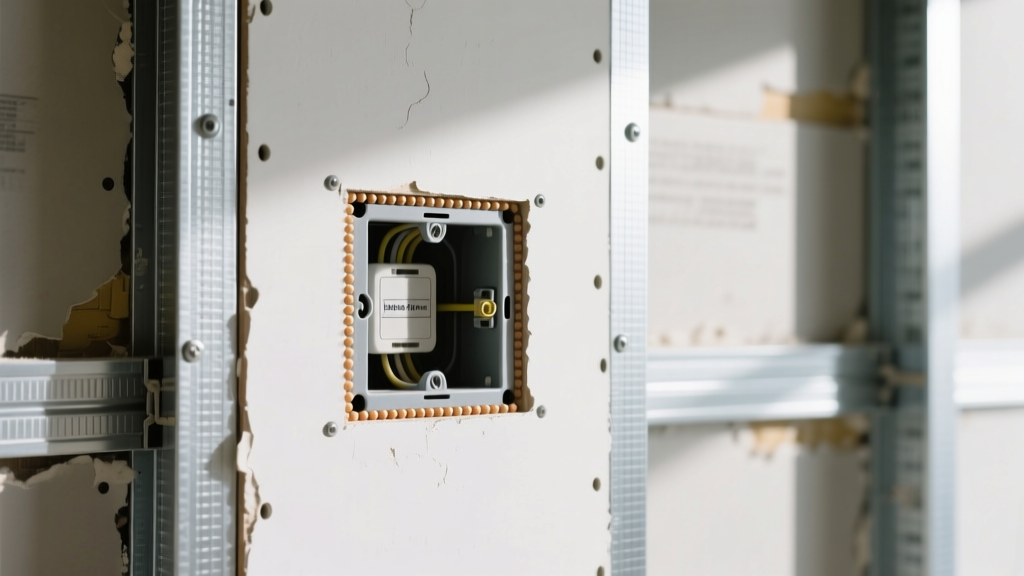
- Missing Intumescent Putty Pads: When electrical boxes penetrate a fire-rated wall, the back of the box must be wrapped in an intumescent fire putty pad (e.g., 3M Fire Barrier Putty). Without this, the plastic box melts, creating a direct chimney for fire to bypass the drywall.
- Incorrect Joint Compound: Setting-type compounds (like USG Durabond) or all-purpose pre-mixed compounds must be used. Lightweight, dust-control compounds lack the thermal mass required to protect the taped seams during the first 30 minutes of a fire.
Specification Decision Framework
Use this framework to determine which fire-resistive gypsum board to specify for your project:
- Is the partition rated? If the architectural plans do not specify a fire rating (e.g., standard interior office demising walls), use standard 1/2-inch gypsum board to save on material and framing costs.
- Is it a standard 1-hour or 2-hour rated wall? Specify 5/8-inch Type X gypsum board. It is universally available, cost-effective, and satisfies 90% of commercial fire-rating requirements, including corridor walls and tenant separations.
- Are there strict weight limits or shaft constraints? If you are lining an elevator shaft or a multi-story mechanical chase where framing depth and dead-load are restricted, specify 1/2-inch or 5/8-inch Type C board. The vermiculite core allows you to achieve 2-hour ratings with fewer layers, saving space and structural steel costs.
- Is moisture also a concern? For fire-rated walls in commercial kitchens or parking garage stairwells, you must specify a Fire-Shield/Moisture-Guard hybrid board (e.g., Gold Bond XP Fire-Shield). Standard Type X will degrade if exposed to ambient humidity over time, compromising the core's structural integrity before a fire even occurs.
Expert FAQ on Fire-Resistant Drywall
Can I paint fire-rated gypsum board with standard latex paint?
Yes. Standard acrylic or latex paints do not compromise the fire rating of the assembly. However, if the assembly requires an intumescent coating for structural steel protection, that is a separate liquid-applied product, not a standard wall paint.
Does the paper facing on drywall burn?
The paper facers on both sides of the board are combustible. However, they represent less than 1% of the board's total mass. In an ASTM E119 test, the paper burns off almost immediately, but the underlying calcination process of the gypsum core takes over to retard heat transfer.
Is cement board more fire-resistant than Type X gypsum?
While cement board (like Durock) is entirely non-combustible and will not calcinate, it conducts heat much faster than gypsum. Gypsum's endothermic water-release makes it a vastly superior insulator against heat transfer, which is why gypsum, not cement board, is the standard for protecting structural steel and creating fire-rated tenant separations.
Written by
Priya KapoorPriya Kapoor is a real estate market analyst and construction economics researcher with expertise in housing affordability, development feasibility, and infrastructure investment. She holds a Master of Regional Planning from Cornell University and previously worked as a senior analyst at CBRE's Investment Properties group, where she modeled returns for $4B in mixed-use development pipelines. Priya now runs an independent research practice advising developers, municipalities, and REITs on construction cost forecasting and market timing. She publishes the quarterly "BuildMat Market Pulse" report tracking material price indices across 12 commodity categories. Based in Austin, TX, Priya serves on the board of Habitat for Humanity Austin and is a marathon runner.
More from Priya Kapoor
View all
Construction Cost
Cost to Build a 1600 Sq Ft Home in 2026: Full Breakdown
Accurate 2026 cost to build a 1600 sq ft home—material, labor, and regional pricing breakdowns included. Plan your budget with real-time estimates.
Aug 11, 2026

Wood & Lumber
Name the Types of Wood for Pressure Treatment and Preservation
Learn how to name the types of wood best suited for pressure treatment. Compare species treatability, chemical retention levels, and 2026 preservation costs.
Aug 4, 2026

Stone & Masonry
Stone Veneer Suppliers Lindenhurst: 2026 Cost Analysis
Analyze 2026 stone veneer costs in Lindenhurst, NY. Compare local supplier pricing, delivery fees, and Suffolk County installation labor rates.
Aug 4, 2026