Pool Plaster vs. Glass Mat Gypsum: Material Taxonomy for Indoor Pool Enclosures
Compare pool plaster and moisture-resistant glass mat gypsum board. Learn the material taxonomy for selecting finishes in indoor pool enclosures.
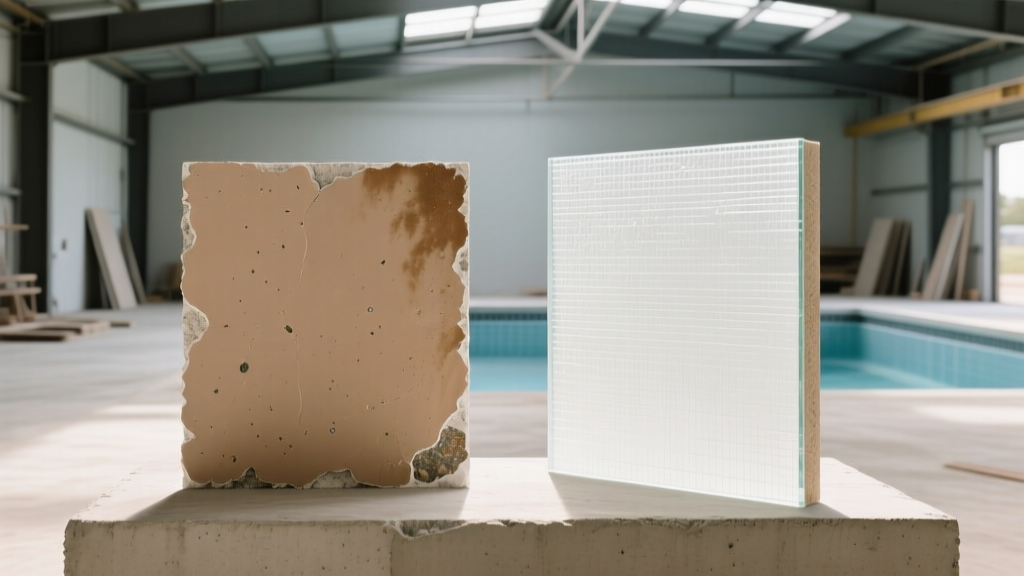
The Fundamental Divide: Submerged Cementitious vs. Above-Water Gypsum
Designing an indoor aquatic facility requires a strict demarcation between submerged finishes and enclosure wall assemblies. The material taxonomy for these two zones is governed by entirely different chemical and structural realities. While pool plaster (a cementitious matrix) is engineered for continuous hydrostatic pressure and submersion, gypsum-based products are strictly limited to the climate-controlled enclosure above the waterline. Confusing these material classes—or attempting to use gypsum-based plasters in submerged applications—results in catastrophic structural failure due to the inherent water solubility of calcium sulfate.
Material Taxonomy: Pool Plaster Finishes (The Submerged Zone)
The term 'pool plaster' encompasses a spectrum of hydraulic cementitious finishes applied to the interior shell of concrete or gunite pools. According to the Pool & Hot Tub Alliance (PHTA), modern plaster formulations are categorized by their aggregate composition, which dictates longevity, texture, and chemical resistance.
- Marcite (Standard White Plaster): A 1:1 or 1:2 mix of white Portland cement and ground marble dust. Applied at a thickness of 3/8 to 1/2 inch. It is the most economical option but highly susceptible to etching from aggressive water chemistry (low pH or low calcium hardness). Expected lifespan: 7 to 10 years.
- Quartz Plaster: Replaces a portion of the marble dust with graded quartz sand and incorporates polymer modifiers. The quartz aggregate provides superior tensile strength and resistance to chemical etching. Applied at 3/8 inch. Expected lifespan: 12 to 15 years.
- Pebble Finishes: Utilizes hydraulic cement blended with natural river pebbles or glass beads. Applied at 1/2 to 3/4 inch. The dense aggregate matrix is virtually impervious to standard pool acid washes and staining. Expected lifespan: 20+ years.
Material Taxonomy: Gypsum Board Classifications (The Enclosure Zone)
The walls and ceilings enclosing the pool room must manage extreme humidity, chlorine off-gassing, and thermal bridging. Standard gypsum board (ASTM C1396) is entirely inappropriate for this environment. The Gypsum Association classifies moisture-managing panels into specific tiers for aquatic enclosures.
1. Moisture-Resistant (MR) Gypsum Board
Often identified by green face paper, MR board features a water-resistant core and facing. However, it is designed only for intermittent moisture exposure (e.g., residential bathroom walls behind tile). It lacks the continuous vapor management required for an indoor pool room and will eventually delaminate under constant 60%+ relative humidity.
2. Glass Mat Water-Resistant Gypsum Board
Governed by ASTM C1178, this panel replaces paper facers with fiberglass mats and utilizes a siloxane-treated, highly water-resistant core. Products like USG Securock or Georgia-Pacific DensElement are the industry standard for pool room walls above the splash line. The glass mat prevents mold growth (as it contains no cellulose food source) and allows the assembly to 'breathe,' facilitating vapor diffusion.
3. Cementitious Backer Board (Non-Gypsum Alternative)
While technically not a gypsum product (governed by ASTM C1325), cement board is frequently specified alongside glass mat gypsum in aquatic facilities. It is strictly required for the 'splash zone'—walls directly adjacent to the pool coping where direct water contact occurs. It is often mistakenly categorized with gypsum boards by general contractors, leading to improper fastening and framing assumptions.
Vapor Permeance and Dehumidification Dynamics
Indoor pools require aggressive mechanical dehumidification (typically maintaining 50-60% RH and an air temperature 2°F above the water temperature). The vapor drive in these spaces is intense. As noted in the Building Science Corporation's guidelines on indoor pools, enclosing the pool room with low-permeance materials can trap condensation inside the wall cavity, rotting the steel or wood studs.
Glass mat gypsum board typically exhibits a vapor permeance of 15 to 25 perms (Class I vapor retarder equivalent when painted with standard latex, but highly permeable when left unpainted or primed with vapor-permeable coatings). This allows incidental moisture within the wall cavity to dry inward toward the pool room's dehumidification system, rather than accumulating and causing structural degradation.
Transition Zones: Coping, Tile, and Moisture Management
The most critical failure point in indoor pool construction is the transition between the submerged pool plaster, the pool coping, and the enclosure wall. You cannot run glass mat gypsum board down to the water line. The detailing must follow a strict sequence to manage capillary break and splash water.
- Terminate the Gypsum: Stop the glass mat gypsum board exactly 6 inches above the finished pool deck elevation. Do not let it touch the concrete slab.
- Install a Weep Screed: Fasten a continuous PVC or stainless steel weep screed at the base of the gypsum termination. This provides a capillary break and a drainage plane for any condensation running down the wall cavity.
- Transition to Cement Board: From the deck level up to 6 inches (the splash zone), install ASTM C1325 cementitious backer board. This material can withstand direct pool water splashing and the harsh chemical cleaners used on pool decks.
- Seal the Coping Joint: The expansion joint between the pool coping and the wall assembly must be sealed with a high-movement, chlorine-resistant polyurethane sealant (e.g., Sikaflex-1A or MasterSeal NP 1). Never use silicone in submerged or pool-deck joints, as it degrades rapidly under continuous UV and chlorine exposure.
2026 Cost and Lifespan Projections
Accurate budgeting for aquatic facilities requires separating the submerged plaster costs from the enclosure wall costs. The following table outlines current material and installed cost ranges for 2026, reflecting recent supply chain stabilization in cementitious and fiberglass mat products.
| Material Classification | 2026 Installed Cost (per sq. ft.) | Expected Lifespan | Governing Standard |
|---|---|---|---|
| Marcite Pool Plaster | $6.50 - $8.00 | 7 - 10 Years | PHTA / NPC |
| Quartz Pool Plaster | $10.00 - $13.50 | 12 - 15 Years | PHTA / NPC |
| Pebble Pool Plaster | $17.00 - $24.00 | 20+ Years | PHTA / NPC |
| Glass Mat Gypsum Board (Material Only) | $2.15 - $2.85 | 40+ Years (if detailed correctly) | ASTM C1178 |
| Cementitious Backer Board (Material Only) | $1.85 - $2.40 | 50+ Years | ASTM C1325 |
Selecting the correct material taxonomy ensures that the pool plaster maintains its structural integrity under hydrostatic load, while the glass mat gypsum enclosure manages the aggressive vapor drive without fostering mold or structural rot. Always verify that the general contractor understands the hard boundary between the cementitious submerged zone and the gypsum-based vapor-permeable enclosure zone.