How to Cut Gypsum Board Without Violating Fire Codes
Learn how to cut gypsum board while maintaining fire, acoustic, and moisture code compliance. Expert guide on Type X clearances and sealing.
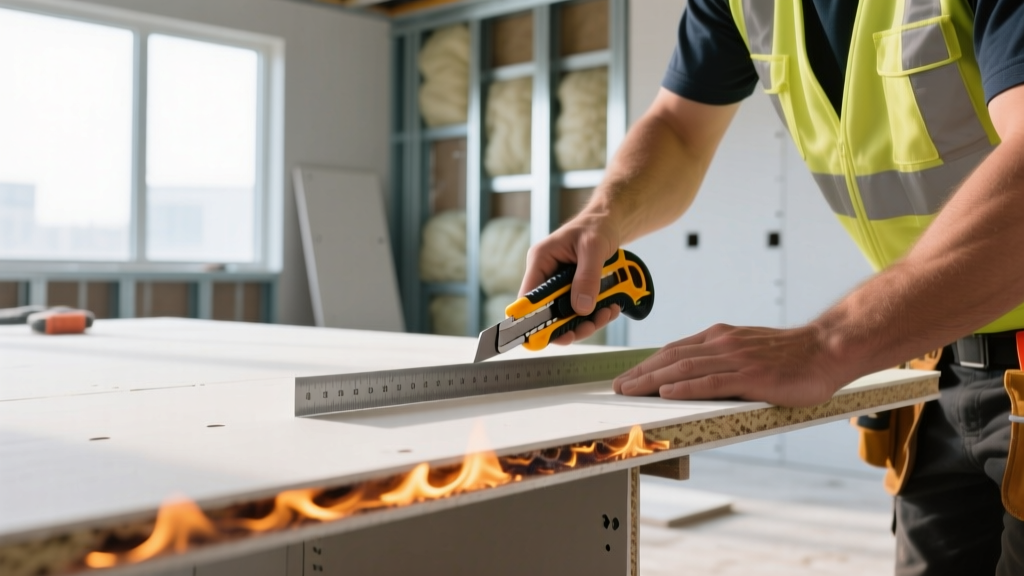
The Hidden Code Violations in Drywall Cutting
Cutting gypsum board for electrical, plumbing, and HVAC penetrations is a routine task that frequently triggers code inspection failures. While framing and hanging errors are easily spotted, the micro-violations created during the cutting and sealing of drywall membranes often compromise the entire tested assembly. When you learn how to cut gypsum board for rated walls, the objective shifts from simply making the panel fit to preserving the continuous fire, acoustic, and moisture barriers required by the International Building Code (IBC) and National Electrical Code (NEC).
Type X and Type C fire-rated gypsum boards (such as USG Sheetrock Firecode X or CertainTeed Abuse-Resistant) rely on a continuous membrane to delay heat transmission. A jagged cut or an oversized hole for an electrical box destroys the localized integrity of the glass-fiber-reinforced core. This guide details the exact tolerances, tool selections, and firestop protocols required to cut gypsum board while maintaining strict code compliance in 2026.
Tool Selection Matrix for Code-Compliant Edges
The tool you choose dictates the edge quality of the gypsum core. Crushed or torn paper facers at the cut edge will not hold joint compound properly and create micro-gaps that violate firestop annular space requirements. Below is a comparison of cutting methods and their compliance implications.
| Tool | Best Application | Edge Quality | Code Compliance Risk |
|---|---|---|---|
| Scoring Knife (Utility) | Straight seams, butt joints | Excellent | Low. Cleanest edge, preserves paper facing integrity. |
| Drywall Router (with vacuum) | Electrical boxes, switches | Good | Medium. High dust can interfere with firestop adhesion if not vacuumed. |
| Jab Saw (Keyhole) | Small plumbing penetrations | Poor | High. Leaves jagged edges requiring excessive intumescent sealant. |
| Rotary Hole Cutter | HVAC registers, recessed lights | Excellent | Low. Perfect circles maintain exact annular clearances for collars. |
Expert Directive: When cutting Type X gypsum board, avoid using reciprocating saws or coarse-toothed jab saws near the edges of electrical boxes. The vibration pulls the glass fibers out of the gypsum matrix, weakening the board's structural cohesion during a fire event. Use a sharp drywall router with a dust-extraction shroud to maintain OSHA indoor air quality standards while preserving the core.
Preserving Fire Ratings in Type X and Type C Assemblies
The most critical phase of cutting gypsum board is managing the gaps left behind. The Gypsum Association's GA-600 Fire Resistance and Sound Control Design Manual explicitly outlines how penetrations must be treated to maintain the hourly rating of the wall or ceiling assembly.
Electrical Box Cutout Tolerances (NEC 314.21)
Under the National Electrical Code (NEC) Article 314.21, the gap between the electrical box and the cut edge of the gypsum board must not exceed 1/8 inch (3 mm). If your cut is oversized, the wall fails both the NEC and the IBC fire separation requirements.
- Compliant Fix for Oversized Cuts: If the gap exceeds 1/8 inch, you cannot simply fill it with standard joint compound. You must apply an intumescent firestop putty pad (e.g., 3M Fire Barrier Putty Pad PP+3) to the back or front of the box, or use a listed firestop sealant like 3M Fire Barrier Sealant CP 25WB+.
- Box-to-Box Limitations: In rated assemblies, electrical boxes on opposite sides of a staggered-stud wall must be separated by a minimum horizontal distance of 24 inches. Cutting holes too close together compromises the acoustic and fire barrier, regardless of how cleanly you cut the board.
Membrane Penetration Limits (IBC Section 714)
For plumbing and HVAC penetrations, IBC Section 714 limits the size and frequency of unprotected penetrations. You can cut holes for pipes and ducts, but the annular space (the gap between the pipe and the drywall) must be sealed with a UL-listed firestop system tested for the specific pipe material (PVC, copper, cast iron) and wall assembly.
Code Warning: Never cut a hole for a combustible pipe (like PVC) in a rated gypsum wall without installing an intumescent firestop collar. During a fire, the PVC will melt away, leaving a massive hole. The intumescent material expands up to 10x its volume when heated, crushing the melting pipe and sealing the breach.

Sealing Cut Edges: Acoustic and Moisture Protocols
Beyond fire safety, cutting gypsum board exposes the vulnerable inner core to moisture and creates pathways for sound flanking. Proper edge treatment is mandatory for specialized boards.
Moisture-Resistant Board (Green/Purple)
When cutting moisture-resistant gypsum board (such as USG Mold Tough or CertainTeed M2Tech) for bathroom installations, the exposed gypsum core at the cut edge acts as a wick for water. Before applying tile backer or waterproofing membranes over the cut edge, you must seal the raw gypsum with a mold-resistant primer or a dedicated edge sealer. Failing to seal cut edges behind tile is a primary cause of mold remediation callbacks.
Acoustic Wall Assemblies (STC 50+)
In multi-family residential or commercial projects requiring high Sound Transmission Class (STC) ratings, any unsealed cutout will drastically reduce acoustic performance. A 1% gap in a drywall membrane can reduce the STC rating by up to 5 points. After cutting and installing the board, the perimeter and all penetration gaps must be sealed with a non-hardening acoustical sealant (e.g., Tremco Acoustical Sealant or OSI SC175). Standard acrylic painter's caulk hardens over time and will crack, creating acoustic leaks.
Step-by-Step: Executing a Rated Penetration Cut
Follow this precise sequence to ensure your cuts pass municipal inspections on the first walkthrough.
- Locate and Mark: Use a laser level and stud finder to map the exact center of the electrical box or pipe. Mark the outline on the Type X gypsum board, adding exactly 1/16 inch of clearance on all sides to account for router bit deflection.
- Score the Perimeter (Optional but Recommended): For critical fire-rated walls, lightly score the outline with a utility knife before routing. This pre-cuts the paper facing, preventing the router from tearing the paper if it slips.
- Execute the Cut: Using a drywall router with a sharp 1/8-inch spiral bit and a vacuum attachment, plunge into the center of the marked area and route outward to the line, moving counter-clockwise to maintain control.
- Clear the Dust: Immediately vacuum the cut edge and the inside of the electrical box. Residual gypsum dust prevents firestop sealants from adhering to the paper facing.
- Measure the Annular Space: Use a feeler gauge to verify the gap between the box/pipe and the drywall is 1/8 inch or less. If it exceeds this, prepare your intumescent firestop materials.
- Apply Firestop/Acoustic Sealant: Inject the specified UL-listed sealant into the gap, ensuring a minimum depth of 5/8 inch (matching the thickness of the Type X board). Tool the sealant smooth with a putty knife.
Common Inspection Failures and Corrections
Municipal inspectors and third-party firestop special inspectors (per IBC Section 1705.8) look for specific red flags when evaluating cut gypsum board. Avoid these frequent failures:
- Failure: Using expanding spray foam (e.g., Great Stuff) to seal gaps around plumbing penetrations in rated walls.
Correction: Standard polyurethane foam is highly combustible and not UL-listed for firestopping. Replace it with a tested mineral wool packing and intumescent caulk system. - Failure: Cutting access panels into rated shaft walls without using a listed, rated access door.
Correction: Any cutout for an access panel in a 1-hour or 2-hour shaft wall must be fitted with a UL-classified fire-rated access door (e.g., Cendrex or Babcock-Davis) that matches the hourly rating of the gypsum assembly. - Failure: Leaving the top gap of a drywall partition unsealed at the deck above.
Correction: IBC requires the membrane to be tight to the deck or sealed with firestop caulk. Cut the board to within 1/4 inch of the deck and fill the gap with acoustic firestop sealant to prevent smoke migration.
Mastering how to cut gypsum board is ultimately about respecting the tested assembly. By adhering to NEC gap tolerances, utilizing the correct cutting tools to preserve the gypsum core, and applying verified firestop and acoustic sealants, you ensure the wall performs exactly as engineered during a fire or acoustic test.
Written by
David NakamuraDavid Nakamura is a licensed architect (AIA) and construction technology writer focused on sustainable building methods, mass timber engineering, and high-performance building envelopes. He holds a Master of Architecture from the University of Washington and is a certified Passive House Consultant (CPHC). David spent eight years at the Seattle firm Mithun, where he led the design of three LEED Platinum projects, before founding his own practice specializing in net-zero residential design. He serves on the editorial advisory board of GreenBuilder Magazine and has authored peer-reviewed papers on cross-laminated timber (CLT) connections for the Journal of Structural Engineering. In his spare time, David teaches woodworking at Pratt Fine Arts Center and kayaks the Puget Sound.
More from David Nakamura
View all
Construction Cost
Labor Cost to Build a Deck Per Sq Ft: 2026 Installation Guide
Discover the exact labor cost to build a deck per sq ft in 2026. This installation guide breaks down contractor rates, complexity factors, and hidden fees.
Aug 4, 2026

Construction Cost
How Much Does It Cost to Build a 3 Bedroom House? Financing Guide
Learn exactly how much it costs to build a 3 bedroom house and explore 2026 financing options, construction loan types, and budget frameworks for your build.
Aug 4, 2026

Construction Cost
Cost to Build a Tennis Court: 2026 Guide
How much does it cost to build a tennis court in 2026? Breakdowns for asphalt, concrete, and synthetic surfaces plus fencing and lighting.
Jul 30, 2026