Moisture Meter for Drywall: Assessing Water Damage and Board Lifespan
Learn how to use a moisture meter for drywall to assess water damage, prevent mold, and determine whether to dry or replace compromised gypsum boards.
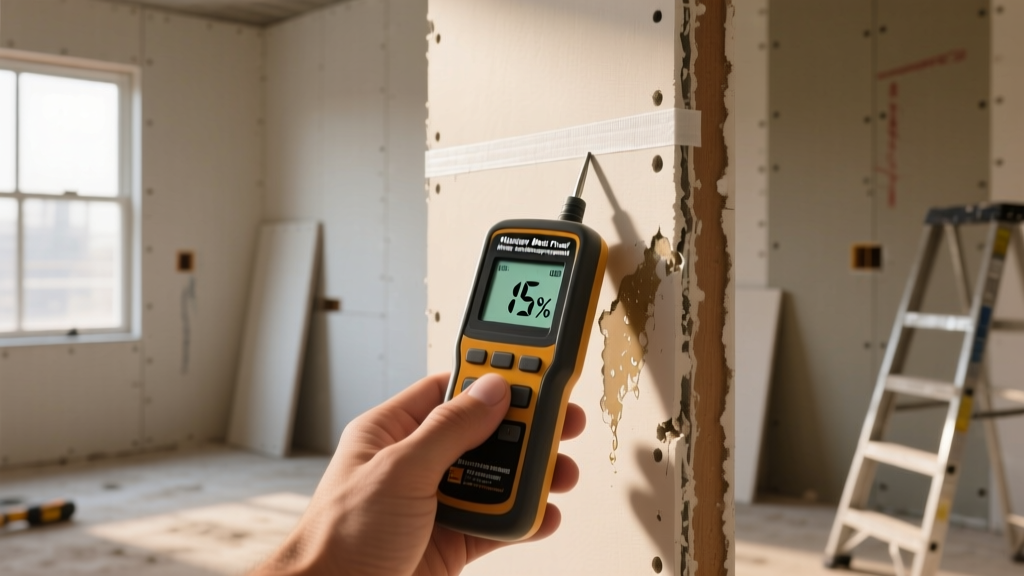
The Hygroscopic Nature of Gypsum: Why Moisture Dictates Lifespan
Standard gypsum board is engineered for exceptional longevity in stable environments, routinely lasting 50 to 70 years without structural degradation. However, the chemical composition of the core—calcium sulfate dihydrate—makes it inherently hygroscopic. When a moisture meter for drywall registers elevated readings, it indicates that water molecules are actively infiltrating the crystalline structure of the gypsum and the cellulose paper facings. This intrusion triggers a rapid cascade of failure modes: the paper facing delaminates, the core loses its compressive and flexural strength, and the embedded metal fasteners begin to corrode, ultimately leading to catastrophic board failure and mold colonization.
Accurately assessing the remaining lifespan of water-exposed drywall requires moving beyond visual inspections. Staining and bubbling paint are late-stage indicators. By the time these visual cues manifest, the internal moisture content (MC) has often exceeded critical thresholds, rendering the board unsalvageable. Utilizing a calibrated moisture meter allows building inspectors, restoration professionals, and homeowners to quantify the exact saturation level, map the perimeter of the intrusion, and make data-driven decisions regarding remediation versus replacement.
Pinless vs. Pin-Type: Selecting the Right Moisture Meter for Drywall
Not all moisture meters interact with gypsum board identically. The choice between pin-type and pinless (electromagnetic) sensors fundamentally alters your diagnostic capability, especially on finished, painted, or textured walls. For comprehensive lifespan analysis, understanding the operational limits of each is mandatory.
| Feature | Pinless (Electromagnetic) Meters | Pin-Type (Resistance) Meters |
|---|---|---|
| Measurement Depth | 0.25 to 1.5 inches (scans through paint) | Surface to 0.5 inches (depends on pin length) |
| Surface Damage | None (non-destructive) | Leaves permanent puncture marks |
| Best Use Case | Mapping large areas, finding hidden leaks behind finished walls | Verifying exact MC of exposed gypsum core during demolition |
| Interference Risks | Metal studs, foil-backed insulation, wire mesh | Surface salts, high-gloss epoxy paints |
| Top 2026 Models | Wagner Orion 910, Protimeter Protimeter MMS2 | Delmhorst J-2000, General Tools MMD4E |
Expert Recommendation: For in-situ lifespan analysis of finished walls, a dual-depth pinless meter like the Wagner Orion 910 is the industry standard. It allows you to scan at 0.25 inches to check the paper facing and switch to 0.75 inches to measure the saturation of the gypsum core itself, all without damaging the paint. Reserve pin-type meters exclusively for exposed core testing during active demolition and drying phases.
Field Diagnostic Protocol: Mapping the Moisture Intrusion Zone
Taking a single reading in the center of a water stain provides an incomplete picture of the damage. To accurately assess whether the drywall's lifespan can be preserved, follow this systematic diagnostic protocol:
- Establish a Baseline: Locate a known dry area of the same wall (ideally on a different floor or opposite side of the structure). Record the baseline MC. In climate-controlled interiors, standard drywall typically reads between 5% and 12% MC.
- Grid Scanning: Using a pinless meter, scan the affected area in a 12-inch by 12-inch grid pattern. Mark the perimeter where the readings transition from the elevated zone back to the baseline MC. This maps the true extent of the capillary wicking, which often extends 12 to 24 inches beyond the visible water stain.
- Check the Bottom Plate: Gypsum board acts like a sponge via capillary action. Always press the meter firmly against the bottom 2 inches of the drywall, directly above the floor track. If the bottom edge reads above 17% MC while the middle of the wall reads 12%, the wall cavity is holding pooled water, and the bottom 24 inches of the board must be cut out and replaced.
- Verify with Pin Probes: At the mapped perimeter and the center of the highest reading, insert pin probes directly into the gypsum core (bypassing the paper facing) to confirm the internal saturation level.
The 48-Hour Rule: Interpreting Readings for Repair vs. Replacement
Once you have mapped the moisture gradient, the decision to dry and preserve the board or demolish and replace it hinges on both the meter readings and the exposure timeline. According to CDC guidelines on mold control and IICRC S500 water damage restoration standards, the following decision matrix applies to standard and moisture-resistant gypsum boards:
Drywall Remediation Decision Framework
- Zone 1: Safe & Stable (5% - 12% MC)
Action: No remediation required. The board retains its full structural lifespan and fire-rating integrity. - Zone 2: Elevated but Dryable (12% - 17% MC, Wet < 24 Hours)
Action: Deploy Low Grain Refrigerant (LGR) dehumidifiers (e.g., AlorAir Sentinel HDi35) and high-velocity axial air movers. Target an ambient relative humidity (RH) of 40% or lower. Re-scan with the moisture meter every 12 hours. If MC drops below 12% within 48 hours, the board is salvaged. Apply an antimicrobial encapsulant to the paper facing as a precaution. - Zone 3: Critical Saturation (17% - 25% MC, or Wet > 48 Hours)
Action: Immediate demolition. At 17% MC, the hydrogen bonds in the gypsum core begin to break down, causing irreversible sagging and fastener pull-through. Furthermore, the 48-hour threshold guarantees mold germination within the wall cavity. Cut the drywall 12 inches above the highest moisture reading, treat the exposed framing, and install new board. - Zone 4: Category 2 or 3 Water Exposure (Gray/Black Water)
Action: Immediate demolition regardless of MC readings or time. Pathogens and chemical contaminants permanently compromise the board, rendering it a biohazard.
Upgrading for Longevity: Moisture-Resistant Gypsum Alternatives
If a moisture meter for drywall frequently flags high readings in specific zones (e.g., bathrooms, basements, or below-grade utility rooms), the lifespan of standard gypsum board in those areas is inherently compromised. Upgrading to specialized panels during the replacement phase is a critical preventative measure.
Standard green-board (water-resistant drywall) features a treated paper facing but retains a standard gypsum core. It is largely obsolete for high-moisture applications in modern 2026 building codes. Instead, specify glass-mat gypsum panels. Products like USG Sheetrock Mold Tough or Georgia-Pacific DensArmor Plus replace the cellulose paper facing entirely with inorganic fiberglass mats. Because fiberglass does not contain organic carbon, it provides zero food source for mold, effectively extending the functional lifespan of the wall assembly in high-humidity environments by decades. When installing these panels, ensure you use hot-dipped galvanized or stainless-steel drywall screws; standard black-phosphate screws will rust when exposed to the same moisture the glass-mat board is designed to withstand, leading to cosmetic bleeding and structural failure.
Expert Diagnostics FAQ
Why does my pinless moisture meter read 'high' on dry drywall over metal studs?
Pinless meters use electromagnetic fields to measure dielectric constant changes. Metal studs, foil-faced insulation, and even heavy concentrations of metallic mesh in corner beads will reflect the signal, causing a false-positive high reading. Always cross-reference high readings near corners or baseplates with a pin-type meter inserted directly into the gypsum to verify actual moisture presence.
Can I use a standard wood moisture scale for drywall?
No. Wood and gypsum have entirely different dielectric properties and baseline densities. Using a wood scale on drywall will yield wildly inaccurate numbers, often under-reporting moisture by 4% to 8%. Ensure your meter (like the Protimeter MMS2) is specifically calibrated to the 'Gypsum/Drywall' material setting before taking readings.
How does heavy texture or wallpaper affect moisture readings?
Thick acoustic textures (like Artex) or vinyl wallpapers can trap moisture against the paper facing, creating a localized microclimate. While pinless meters can penetrate these layers, the reading will heavily weight the trapped surface moisture rather than the core saturation. If wallpaper is present and the meter reads above 15%, the wallpaper must be scored or stripped to allow the underlying gypsum to dry, otherwise the trapped vapor will blister the finish and degrade the core over time.
For comprehensive installation and material specifications, always refer to the Gypsum Association system specifications to ensure your moisture management strategies align with current industry standards and fire-rating requirements.