How to Define Gypsum Board Specifications and Estimate Material Costs
Learn how to define gypsum board types, grades, and specifications while accurately estimating material and installation costs for your 2026 projects.
The Core Composition: Defining the Baseline Material
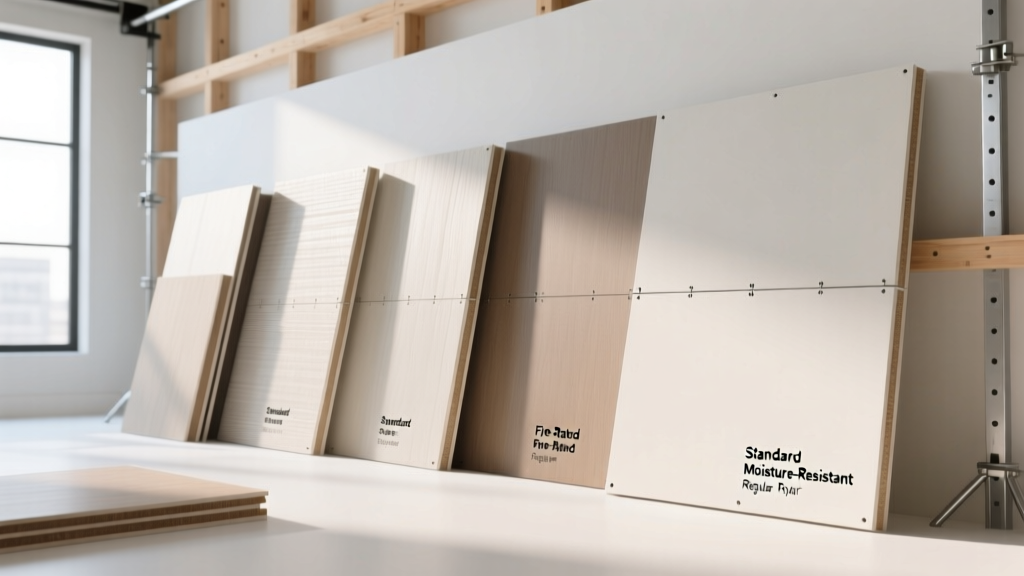
To accurately estimate project costs, you must first define gypsum board at a chemical and structural level. Gypsum board is a panel product consisting of a noncombustible core primarily composed of calcium sulfate dihydrate (gypsum), with or without additives, surfaced with paper or glass mat facers. The baseline manufacturing standard is governed by ASTM C1396, which dictates the physical properties, dimensions, and tolerances for all gypsum panel products.
The cost of the raw material is heavily influenced by the facer type and core density. Standard paper-faced boards utilize recycled paper for the back liner and smooth, treated paper for the face. Upgrading to fiberglass mats (for moisture and mold resistance) or adding high-density core formulations (for impact and fire resistance) increases the base material cost by 30% to 120%.
How to Define Gypsum Board Grades by Application
Contractors and estimators define gypsum board grades based on the specific performance requirements of the building environment. Selecting the wrong grade leads to either code violations or unnecessary budget bloat. Below is a breakdown of standard grades and their current material costs.
| Board Type | Core / Facer Additives | Primary Application | Material Cost (4x8 Sheet) | Cost per Sq.Ft. |
|---|---|---|---|---|
| Standard (Regular) | Standard gypsum, paper facers | Interior walls, ceilings, non-rated partitions | $12.50 - $15.00 | $0.39 - $0.47 |
| Fire-Rated (Type X) | Glass fibers in core, paper facers | Firewalls, stairwells, shaft enclosures (1-hour rating) | $16.00 - $21.00 | $0.50 - $0.66 |
| Moisture-Resistant (MR) | Silicone/wax core additives, green paper | Bathroom walls, kitchen backsplashes (intermittent moisture) | $17.00 - $22.00 | $0.53 - $0.69 |
| Glass-Mat (e.g., DensGlass) | Silicone core, fiberglass mat facers | Exterior sheathing, high-moisture commercial showers | $28.00 - $36.00 | $0.88 - $1.13 |
| Abuse-Resistant | High-density core, heavy-duty face paper | Corridors, hospitals, schools (impact resistance) | $24.00 - $30.00 | $0.75 - $0.94 |
Standard vs. Fire-Rated (Type X) Cost Variance
The transition from standard 1/2-inch board to 5/8-inch Type X represents the most common cost threshold in commercial construction. Type X contains minimum 1% glass fibers by weight, which hold the calcined gypsum core together as it dehydrates under extreme heat. While the material cost jumps by roughly 40%, the real expense lies in labor: 5/8-inch Type X weighs approximately 2.2 lbs per square foot (70 lbs per 4x8 sheet) compared to 1.6 lbs per square foot for standard 1/2-inch board. This 37% weight increase slows hanging speeds by an estimated 15-20%, directly increasing labor costs.
Do not substitute two layers of 1/2-inch standard board for one layer of 5/8-inch Type X to achieve a fire rating. Assemblies are tested and listed by Underwriters Laboratories (UL) and Gypsum Association (GA). Using non-rated board in a rated assembly voids the fire certification and will result in failed municipal inspections, requiring complete demolition and rebuild.
Decoding GA-214 Finish Levels and Labor Costs
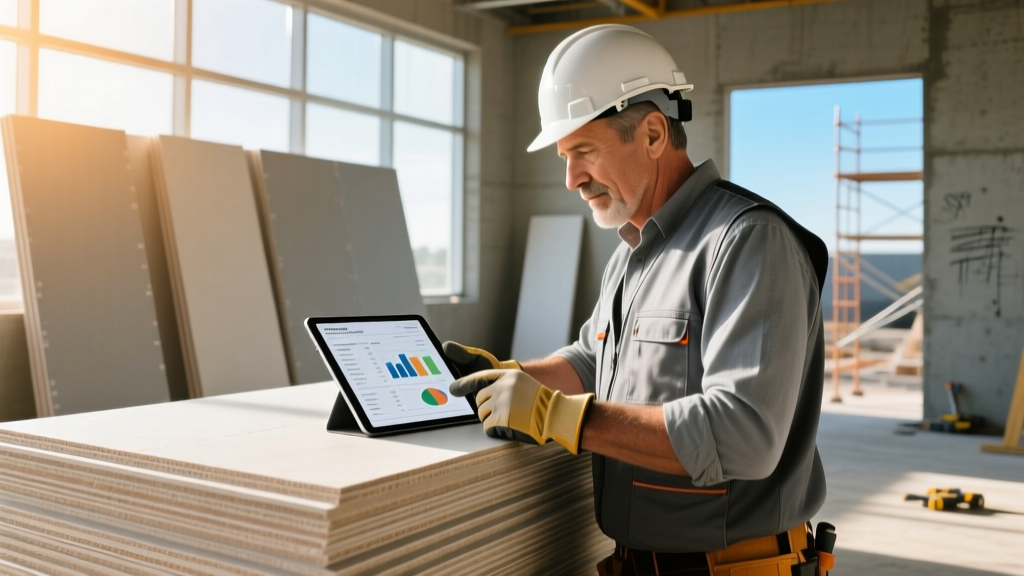
Defining gypsum board is only half the equation; defining the finish level dictates the final installed cost. The Gypsum Association standard GA-214 outlines six levels of finish. Material costs remain static across these levels, but labor and joint compound costs scale dramatically.
- Level 0 & 1: Bare board or tape embedded only. Used in concealed spaces (plenums, attics). Labor add: $0.00 - $0.30/sq.ft.
- Level 2: Tape and one coat over joints. Used in utility areas or as a substrate for tile. Labor add: $0.50 - $0.75/sq.ft.
- Level 3: Tape and two coats. Used where heavy textures will be applied. Labor add: $0.85 - $1.10/sq.ft.
- Level 4: Tape and three coats. The standard for residential and commercial walls with flat paint. Labor add: $1.40 - $1.80/sq.ft.
- Level 5: Level 4 plus a full skim coat of joint compound over the entire surface. Required for gloss/semi-gloss paints or critical lighting (e.g., skylights, wall-wash LED fixtures). Labor add: $2.20 - $3.00/sq.ft.
Specifying a Level 5 finish instead of Level 4 increases the total installed drywall cost (material + labor) by roughly 35% to 45%. Always cross-reference the architectural lighting plan before agreeing to a Level 5 bid; if wall-wash lighting is present, Level 5 is mandatory to prevent joint shadowing.
Hidden Cost Drivers: Thickness, Edges, and Waste
Beyond grade and finish level, estimators must account for dimensional specifications and accessory costs that frequently cause budget overruns.
Thickness and Sound Transmission (STC)
While 1/2-inch is the residential standard, commercial partitions requiring specific Sound Transmission Class (STC) ratings often mandate 5/8-inch board or specialized acoustic boards (e.g., USG Quiet Rock). Acoustic gypsum board features a viscoelastic polymer core that dampens sound waves. Expect to pay $35.00 to $55.00 per 4x8 sheet for acoustic variants. Alternatively, achieving similar STC ratings using standard 5/8-inch board on resilient channels adds $0.60 to $0.90 per square foot in material and specialized labor.
Edge Profiles
Standard gypsum board features a tapered edge to accommodate joint compound. However, square-edge board is required when finishing with veneer plaster systems or when butting against specific reveal trims. Square-edge boards are often specialty order items in many markets, carrying a 10-15% premium and longer lead times.
Waste Factor Calibration: Standard rectangular rooms require a 10% waste factor. However, complex commercial layouts with numerous penetrations (HVAC, electrical, plumbing), curved walls, or staggered stud framing require a 15% to 18% waste factor. Calculating waste strictly on net square footage will guarantee a material shortage and an emergency delivery fee ($150-$300 per truck roll).
Actionable Framework: Specifying and Budgeting
To finalize your gypsum board budget, apply this sequential framework to your takeoffs:
- Map Codes to Grades: Overlay the life-safety plan on your floor plan. Highlight all 1-hour and 2-hour fire-rated assemblies. Assign 5/8-inch Type X (or double-layer 1/2-inch Type X for 2-hour) strictly to these zones.
- Map Moisture to Facers: Assign MR (green board) to residential wet areas. Assign Glass-Mat panels to commercial wet areas, exterior soffits, and tile backing in public showers.
- Calculate Net vs. Gross: Measure gross wall area, subtract openings larger than 32 sq.ft., then apply the appropriate waste factor (10% standard, 15% complex).
- Apply Finish Multipliers: Determine the finish level per room based on the lighting and paint specifications. Apply the corresponding labor rate to the gross square footage (finishers charge on gross area, not net, due to the complexity of cutting around openings).
- Include Accessories: Budget $0.15 to $0.25 per linear foot for corner bead, trim, and joint tape, and add 1.5 buckets of joint compound per 1,000 sq.ft. for Level 4 finishes.
By strictly defining the gypsum board specifications against the architectural requirements rather than defaulting to generic 'drywall' allowances, estimators can eliminate change orders and protect project margins.
Written by
Marcus ChenMarcus Chen is a licensed structural engineer (PE) and building materials analyst with over 12 years of experience across residential, commercial, and industrial construction. He holds a Master of Science in Civil Engineering from UC Berkeley and spent six years at Thornton Tomasetti before transitioning to independent consulting and technical writing. Marcus specializes in material selection for seismic-prone regions, concrete reinforcement strategies, and lifecycle cost analysis. His work has been cited by the American Concrete Institute (ACI) and the Structural Engineers Association of California (SEAOC). When he is not on a job site or at his desk, you will find him hiking the Sierra Nevada or restoring a 1920s craftsman bungalow in Oakland, CA.
More from Marcus Chen
View all
Construction Cost
How Much Did the Eiffel Tower Cost to Build?
How much did the Eiffel Tower cost to build in 1889? We adjust for inflation and compare its budget to modern skyscraper construction.
Aug 4, 2026

Fire Resistance
What Is a Fire Resistant Material? Testing & Certification Guide
Discover what is a fire resistant material through ASTM and UL testing. Learn how fire ratings, certifications, and assemblies work in construction.
Aug 4, 2026

Construction Cost
How Much Did the Burj Khalifa Cost to Build?
How much did the Burj Khalifa cost to build? We break down the $1.5B project and extract 5 money-saving strategies for your next build.
Jul 30, 2026