Toggle Bolts for Sheetrock: Load Specs, Ratings, and Failure Modes
Master toggle bolts for sheetrock with exact performance ratings, shear vs. tensile load specs, and 1/2-inch drywall limits.
The Mechanics of Gypsum Core Compression
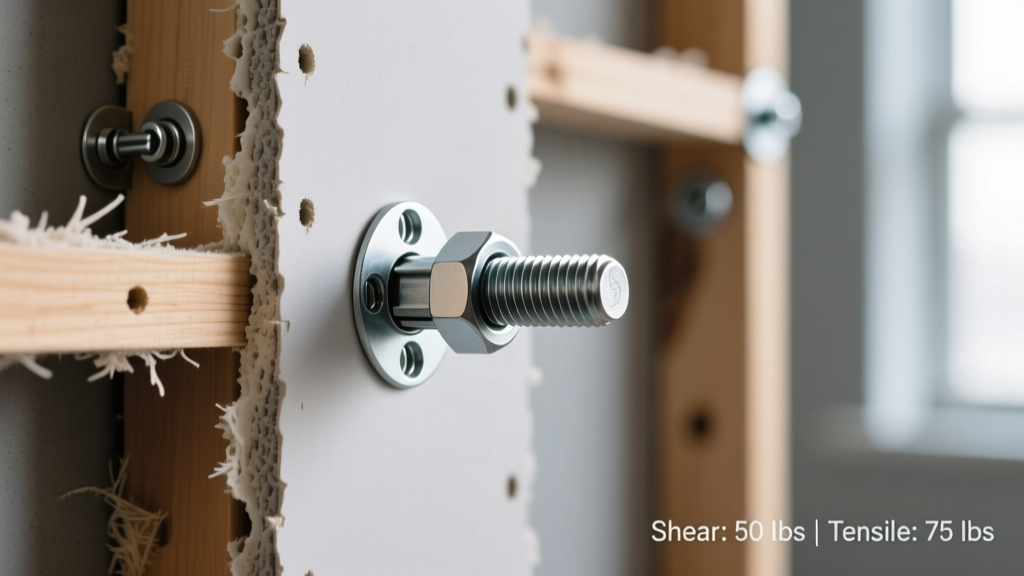
Toggle bolts for sheetrock do not rely on thread friction or core expansion to hold weight. Instead, they function as mechanical clamps. The toggle mechanism passes through the drywall and springs open against the back paper face of the gypsum panel. When the bolt is tightened, the fixture is pulled against the front paper face, while the toggle pulls against the back paper face. The gypsum core is effectively trapped in a state of localized compression.
The primary failure point in this system is rarely the steel bolt itself snapping. Instead, failure occurs when the compressive force exceeds the structural integrity of the gypsum core or the tensile strength of the back paper. Standard gypsum board has a compressive strength ranging from 350 to 500 psi. If the bolt head or washer bearing against the front face is too narrow, it will punch through the front paper and crush the core, resulting in catastrophic pull-out. According to USG Installation Guidelines, distributing this clamping force evenly is the single most critical factor in heavy-load drywall anchoring.
Tensile (Pull-Out) vs. Shear (Downward) Strength
Engineering specs for toggle bolts differentiate strictly between tensile and shear loads. Tensile load measures the force required to pull the bolt straight out of the wall. Shear load measures the downward force applied parallel to the wall face. Because the toggle rests flat against the unbroken back paper of the drywall, shear strength is typically 2.5 to 3 times higher than tensile strength. A shelf bracket pushing straight down utilizes shear strength; a ceiling-mounted plant hanger utilizes tensile strength.
Performance Matrix: Toggle Bolt Specifications
The following data reflects Safe Working Loads (SWL) utilizing the 4:1 safety ratio in standard, dry-condition gypsum board. Strap toggles (such as the SNAPTOGGLE system) consistently outperform traditional wing toggles because the metal strap distributes the load across a wider surface area on the back paper, reducing localized core crushing.
| Bolt Diameter | Toggle Type | Required Hole Size | Max Shear SWL (1/2") | Max Tensile SWL (1/2") | Max Tensile SWL (5/8") |
|---|---|---|---|---|---|
| 1/8" | Traditional Wing | 3/8" | 30 lbs | 12 lbs | 15 lbs |
| 3/16" | Traditional Wing | 1/2" | 50 lbs | 22 lbs | 28 lbs |
| 1/4" | Metal Strap | 1/2" | 250 lbs | 85 lbs | 105 lbs |
| 3/8" | Metal Strap | 5/8" | 400 lbs | 150 lbs | 185 lbs |
Gypsum Board Type Compatibility & Edge Cases
Not all drywall is manufactured identically, and the core composition directly impacts toggle bolt performance. The Gypsum Association outlines distinct physical properties for specialized boards that alter fastener behavior.
Type X (Fire-Rated) Gypsum Board
Type X board contains glass fibers integrated into the gypsum core to maintain structural integrity during a fire. These fibers slightly increase the core's resistance to crumbling under the compressive load of a toggle bolt. While the ultimate tensile strength increases by roughly 8-12% compared to standard board, the back paper remains the limiting factor. Do not increase your Safe Working Load expectations simply because you are anchoring into Type X.
Moisture-Resistant (Green/Purple) Board
Moisture-resistant drywall features a wax or silicone-treated core and water-repellent face paper. This treatment makes the paper surface slightly more slippery. When installing toggle bolts in green board, traditional wing toggles are prone to spinning endlessly without tightening, as the wings slide against the treated back paper. Metal strap toggles are mandatory here; the teeth on the strap channel bite into the paper, preventing rotation during the final torque phase.
Dynamic vs. Static Loading Framework
When selecting toggle bolts for sheetrock, you must classify the fixture's load type. Static loads remain entirely stationary (e.g., a framed mirror, a fixed shelving bracket). Dynamic loads involve movement, vibration, or shifting leverage (e.g., an articulating TV mount, a heavy door stop, or grab bars).
- Static Loads: Can be safely mounted using toggle bolts calculated at the standard 4:1 safety ratio. A 1/4" strap toggle is sufficient for a 60 lb mirror.
- Dynamic/Pull-Away Loads: Articulating TV mounts create massive leverage multipliers when extended away from the wall. A 50 lb TV extended 20 inches from the wall generates over 150 lbs of tensile pull on the top fasteners. Toggle bolts are strictly prohibited for articulating mounts unless backed by structural blocking. The repetitive dynamic stress will eventually fatigue the back paper of the drywall, leading to delayed, catastrophic failure.
Installation Specifications & Torque Limits
Proper installation dictates the actual performance of the anchor. Follow these precise technical steps to avoid compromising the gypsum core.
- Drill Bit Selection: Use a sharp brad-point or spur drill bit, not a standard twist bit. Twist bits tend to wander in drywall, creating oversized, oval-shaped holes. If a 1/2" hole becomes 9/16", the toggle bracket will tilt under load, concentrating force on a single edge and cutting through the back paper.
- Clearance Verification: Insert a wire hanger into the hole to verify there are no plumbing lines, electrical boxes, or fire-blocking within 3 inches behind the drywall.
- Toggle Insertion: For strap toggles, zip the strap tight against the back of the drywall. Do not overtighten the strap mechanism before the bolt is threaded, or you risk snapping the plastic retention collar.
- Torque Application: Thread the bolt by hand until snug. Use a drill on a low-torque clutch setting or a hand screwdriver for the final 3-4 turns. Do not exceed 15 inch-pounds of torque on a 1/4" bolt. Overtightening will crush the front gypsum core, creating a void that allows the bolt to slowly work loose over time.
When Toggle Bolts Fail: Proximity and Moisture Degradation
Even perfectly installed toggle bolts will fail if environmental or spatial parameters are ignored. According to Fine Homebuilding's Fastener Guide, edge proximity is a leading cause of drywall anchor blowouts.
Furthermore, standard zinc-plated toggle bolts will oxidize in high-humidity environments like bathrooms. As the bolt rusts, the rust expands, fracturing the surrounding gypsum core and degrading the holding power. For any installation in moisture-resistant board or high-humidity zones, specify 18-8 stainless steel toggle bolts to prevent internal core degradation.
Expert Decision Framework: Toggle Bolts vs. Wood Blocking
While toggle bolts for sheetrock offer exceptional holding power for retrofits, they are not a universal substitute for structural framing. Use this framework to make the final specification decision:
- Choose Toggle Bolts When: The fixture is a static load under 85 lbs (tensile) or 250 lbs (shear), the wall is already finished and painted, and the fixture footprint is wide enough to distribute the load across multiple anchors.
- Choose Wood Blocking When: Installing grab bars (which must withstand 250+ lbs of dynamic human weight), articulating TV arms, heavy cabinetry, or any fixture subject to repetitive vibration. Cutting the drywall, installing 2x4 blocking between studs, and patching the wall is the only code-compliant method for life-safety and high-dynamic loads.