Sound Absorbing Gypsum Board Costs: 2026 Pricing and ROI Breakdown
Analyze 2026 costs for sound absorbing gypsum board. Compare material, labor, and ROI against standard drywall for residential and commercial projects.

The True Cost of Sound Absorbing Gypsum Board in 2026
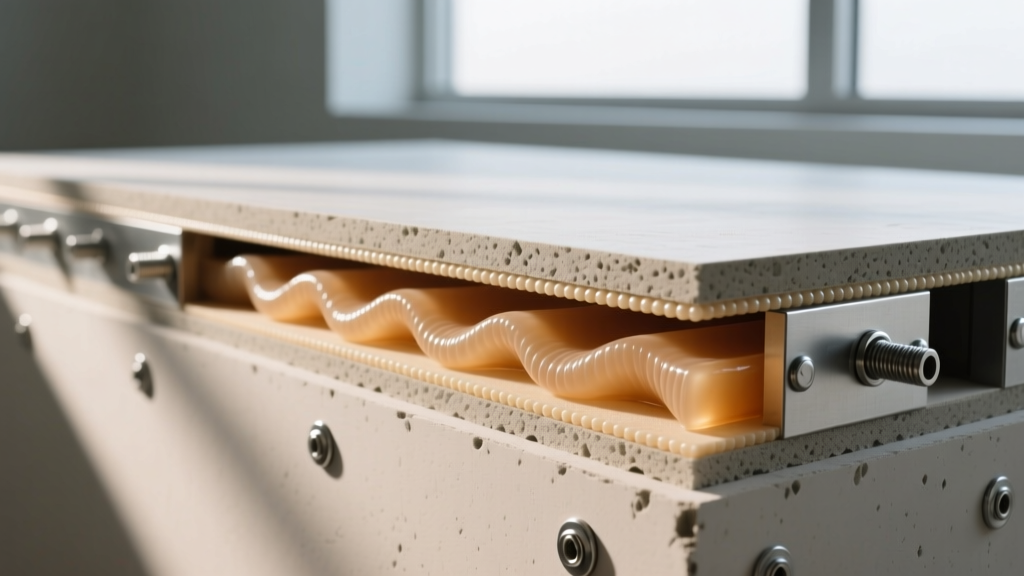
Specifying acoustic treatments for walls and ceilings requires a precise understanding of material and labor differentials. Standard 5/8-inch Type X gypsum board provides baseline fire resistance and structural rigidity, but it fails to mitigate low-frequency noise or high-impact vibrations. Sound absorbing gypsum board—engineered with viscoelastic constrained-layer dampening or high-density acoustic cores—commands a significant premium. In 2026, the material cost for specialized acoustic drywall ranges from 200% to 500% higher than standard alternatives. However, evaluating this cost solely on a per-sheet basis is a critical estimating error. A comprehensive cost analysis must factor in installation labor, space-saving benefits, auxiliary acoustic materials, and the long-term return on investment (ROI) in multi-family and commercial real estate.
Material Pricing Matrix: Standard vs. Acoustic Gypsum
The market for sound absorbing gypsum board is segmented into three primary tiers based on the manufacturing technology used to achieve specific Sound Transmission Class (STC) ratings. The pricing below reflects 2026 wholesale distributor averages for 4x8-foot sheets.
| Product Category | Core Technology | Example Models | Thickness | Cost per 4x8 Sheet | Cost per Sq. Ft. |
|---|---|---|---|---|---|
| Standard Type X | Dense gypsum core | USG Sheetrock, GP ToughRock | 5/8" | $14.00 - $18.00 | $0.44 - $0.56 |
| Mid-Tier Acoustic | High-density fiberglass/aggregate core | National Gypsum SoundBreak XP | 5/8" | $38.00 - $48.00 | $1.18 - $1.50 |
| Premium Constrained-Layer | Viscoelastic polymer sandwiched between gypsum | QuietRock 510/530, CertainTeed SilentFX | 1/2" to 5/8" | $65.00 - $95.00 | $2.03 - $2.96 |
While the premium constrained-layer boards represent the highest material cost, they often achieve an STC rating of 50 to 60+ on a single layer over standard wood or metal studs. Achieving an equivalent STC rating with standard drywall requires double-layering, resilient channels, and specialized damping compounds, which alters the total cost equation.
Labor Premiums and Installation Nuances
Installing sound absorbing gypsum board is not a direct swap for standard drywall. The physical properties of acoustic boards dictate specific installation protocols that increase labor time and cost.
Cutting and Scoring Limitations
Standard gypsum board is easily scored with a utility knife and snapped. Constrained-layer sound absorbing gypsum board features a central polymer core that does not snap cleanly and gums up standard drywall blades. Installers must use fine-toothed drywall saws, specialized routers, or score both the front and back paper faces deeply before snapping. This increases cutting time by approximately 15% to 20% per sheet. Expect labor rates for hanging acoustic board to range from $2.25 to $3.50 per square foot, compared to $1.50 to $2.00 for standard board.
Mandatory Acoustic Sealant
To prevent sound flanking at the perimeters, acoustic sealant must be applied continuously at the top and bottom tracks, as well as at all vertical corner joints. A standard 28-ounce tube of acoustic sealant costs between $8.00 and $12.00 in 2026 and covers approximately 100 linear feet (assuming a 1/4-inch bead). For a 1,000-square-foot wall area, budget an additional $150 to $200 strictly for sealant material and the labor to apply it.
Spending $3.00 per square foot on premium sound absorbing gypsum board is financially wasted if flanking paths are ignored. Sound behaves like water; it will exploit the weakest point in the assembly. You must budget for:
- Acoustic Putty Pads: Required behind every electrical outlet and switch box ($4.00 - $6.00 per pad).
- Isolation Clips and Hat Channel: If decoupling is required for low-frequency bass mitigation, budget an additional $1.80 - $2.50 per square foot for hardware.
- HVAC Acoustic Lining: Duct boots penetrating the acoustic wall must be wrapped or lined to prevent airborne noise transfer.
Decision Framework: Space vs. Budget Optimization
General contractors and architects frequently face a value-engineering decision: use cheaper standard board in a complex, multi-layer assembly, or use expensive sound absorbing gypsum board in a simple, single-layer assembly. The decision hinges on spatial constraints and labor availability.
Scenario A: The Space-Constrained Urban Retrofit
In high-density urban multi-family projects, maximizing leasable square footage is paramount. A double-layer standard drywall assembly with Green Glue and resilient channel consumes roughly 2.5 inches of floor space per wall. By specifying a 5/8-inch premium constrained-layer sound absorbing gypsum board, you achieve the same STC 55+ rating while consuming only 5/8 of an inch. Financial Impact: Saving 1.8 inches of depth across a 50-foot party wall recovers 7.5 square feet of leasable floor space. At $40 per square foot in annual urban rent, this spatial recovery pays for the material premium in under three years.
Scenario B: The Budget-Driven Suburban Build
For suburban single-family homes or budget hotels where wall thickness is not a constraint, the high material cost of constrained-layer boards is difficult to justify. Optimal Strategy: Use two layers of standard 5/8-inch Type X gypsum board with a viscoelastic damping compound (like Green Glue) sandwiched between them. The material cost is roughly $1.20 per square foot (two sheets + damping compound), and while labor is higher due to hanging two layers, the total installed cost often undercuts single-layer premium acoustic board by 15% to 20%.
ROI in Multi-Family and Commercial Sectors
The justification for sound absorbing gypsum board extends far beyond initial construction costs. In the commercial and multi-family residential sectors, acoustic performance directly correlates with revenue retention and asset valuation.
According to industry data tracked by the Gypsum Association, buildings that meet or exceed enhanced acoustic standards (such as IBC Section 1206 requirements for STC 50) experience significantly lower tenant turnover. In multi-family housing, noise complaints are consistently ranked among the top three reasons for lease non-renewal. The cost of turning over a single apartment unit—factoring in vacancy loss, marketing, and minor repairs—averages $2,500 to $4,000. Upgrading party walls with sound absorbing gypsum board during initial construction or major rehabilitation costs approximately $800 to $1,200 per unit. Preventing just one turnover over a five-year hold period yields a net positive ROI.
Furthermore, in commercial office environments, specialized acoustic boards are increasingly utilized in executive boardrooms, server rooms, and healthcare facilities to ensure HIPAA compliance regarding speech privacy. In these scenarios, the cost of the gypsum board is negligible compared to the regulatory fines or corporate liabilities associated with acoustic breaches.
Acoustic Testing Standards and Code Compliance
When evaluating product data sheets from manufacturers like QuietRock or National Gypsum, it is vital to understand the testing methodologies behind the advertised STC ratings. STC (Sound Transmission Class) measures the reduction of airborne sound (like speech or television noise) across a frequency range of 125 Hz to 4000 Hz, tested per ASTM E90 standards.
However, STC is a poor metric for evaluating low-frequency impact noise, such as footfalls, bass from home theater systems, or mechanical vibrations. For these scenarios, specifiers must look at the OITC (Outdoor-Indoor Transmission Class) rating, which measures lower frequencies down to 80 Hz. Many mid-tier high-density acoustic boards perform exceptionally well in STC testing but show marginal gains in OITC. If your project involves mitigating low-frequency noise (e.g., a wall adjacent to an elevator shaft or a gym), you must specify constrained-layer sound absorbing gypsum board or incorporate decoupling isolation clips, regardless of the base STC rating of the board.
Final Estimating Checklist for 2026
- Verify the exact STC and OITC requirements in the local building code (IBC Chapter 12 or local amendments).
- Calculate the total assembly cost (board + sealant + fasteners + putty pads), not just the per-sheet drywall cost.
- Consult with your drywall subcontractor regarding their experience cutting and hanging constrained-layer polymers to avoid unexpected change orders for blade wear and labor overages.
- Factor in the value of recovered floor space when comparing single-layer acoustic board against multi-layer standard assemblies.
Written by
Priya KapoorPriya Kapoor is a real estate market analyst and construction economics researcher with expertise in housing affordability, development feasibility, and infrastructure investment. She holds a Master of Regional Planning from Cornell University and previously worked as a senior analyst at CBRE's Investment Properties group, where she modeled returns for $4B in mixed-use development pipelines. Priya now runs an independent research practice advising developers, municipalities, and REITs on construction cost forecasting and market timing. She publishes the quarterly "BuildMat Market Pulse" report tracking material price indices across 12 commodity categories. Based in Austin, TX, Priya serves on the board of Habitat for Humanity Austin and is a marathon runner.
More from Priya Kapoor
View all
Construction Cost
Cost to Build a 1600 Sq Ft Home in 2026: Full Breakdown
Accurate 2026 cost to build a 1600 sq ft home—material, labor, and regional pricing breakdowns included. Plan your budget with real-time estimates.
Aug 11, 2026

Wood & Lumber
Name the Types of Wood for Pressure Treatment and Preservation
Learn how to name the types of wood best suited for pressure treatment. Compare species treatability, chemical retention levels, and 2026 preservation costs.
Aug 4, 2026

Stone & Masonry
Stone Veneer Suppliers Lindenhurst: 2026 Cost Analysis
Analyze 2026 stone veneer costs in Lindenhurst, NY. Compare local supplier pricing, delivery fees, and Suffolk County installation labor rates.
Aug 4, 2026