Troubleshooting Poor Gypsum Board Sound Absorption in Existing Walls
Diagnose and fix poor gypsum board sound absorption. Learn to identify flanking paths, repair acoustic seals, and upgrade STC ratings without full demolition.

The Anatomy of Acoustic Failure in Drywall Assemblies
When facility managers or homeowners report inadequate gypsum board sound absorption, the root cause is rarely the gypsum core itself. Standard 1/2-inch regular gypsum board yields a baseline Sound Transmission Class (STC) of roughly 33. While this is sufficient for basic visual privacy in non-critical interior partitions, it falls drastically short of the STC 50 minimum mandated by the International Building Code (IBC Section 1206) for dwelling unit separations. Acoustic failure in existing drywall assemblies almost always stems from three specific deficiencies: insufficient mass, rigid structural coupling, and unsealed flanking paths.
Diagnosing the STC Deficit: Airborne vs. Structure-Borne
Before initiating repairs, you must categorize the noise complaint. Gypsum board primarily mitigates airborne noise (voices, television, traffic). If the complaint involves impact noise (footsteps, plumbing vibrations, door slamming), the issue is structure-borne, and simply adding mass to the drywall surface will yield negligible results. For structure-borne noise, the repair protocol must involve decoupling the drywall from the framing using resilient channels or isolation clips. However, for airborne noise leaks, troubleshooting the existing gypsum board envelope is highly effective and significantly less invasive.
Troubleshooting Matrix: Identifying and Sealing Sound Leaks
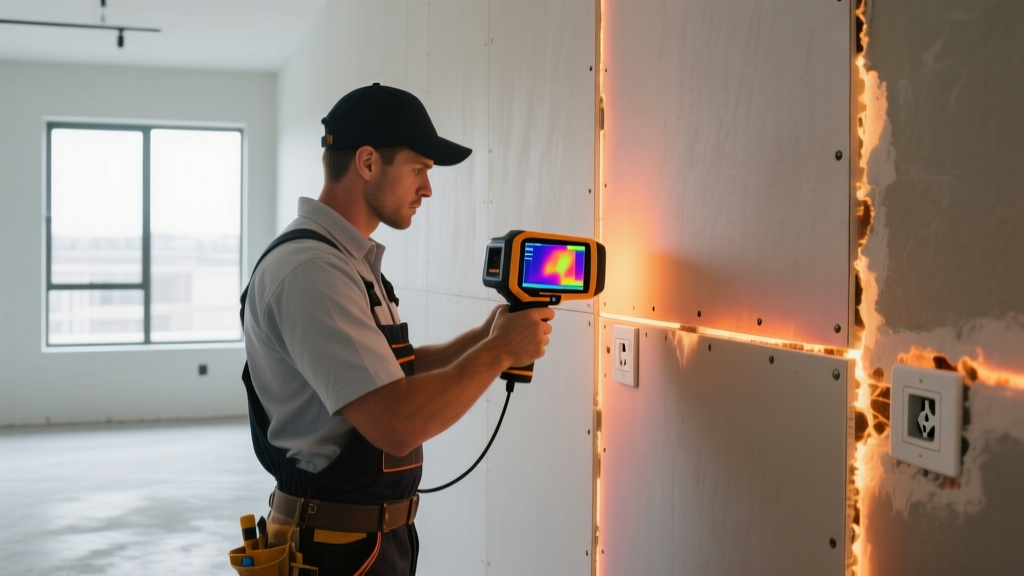
Acoustic energy behaves like water; it will exploit the path of least resistance. A gap comprising just 1% of a wall's total surface area can reduce the assembly's overall STC rating by up to 50%. Use the following diagnostic matrix to pinpoint the exact failure mode in your existing drywall partitions.
| Symptom | Frequency Range | Root Cause | Repair Protocol |
|---|---|---|---|
| Clear voice transmission between rooms | Mid-to-High (500Hz - 2000Hz) | Back-to-back electrical boxes on shared stud cavities | Offset electrical boxes to separate studs; install acoustic putty pads (e.g., Soundproofing America Putty Pads) over existing boxes. |
| Low-frequency hum or bass bleed | Low (63Hz - 250Hz) | Rigid drywall-to-framing connection; lack of damping compound | Apply constrained layer damping (Green Glue) and overlay with a second layer of 5/8-inch Type X gypsum board. |
| Sound traveling over the wall partition | Broadband | Unsealed top track or perimeter flanking paths | Inject non-hardening acoustical sealant at the top plate, bottom track, and all intersecting wall joints. |
| Noise bypassing wall entirely | Broadband | Shared HVAC supply/return vents or unsealed ceiling plenums | Install acoustic duct liners, add mass-loaded vinyl (MLV) wraps to ductwork, and seal ceiling plenum penetrations. |
Repairing Compromised Acoustic Seals and Penetrations
The most common reason a theoretically soundproof wall fails in practice is the degradation of acoustic seals. Over time, building settlement, HVAC vibration, and thermal expansion cause standard caulking to crack and detach from the gypsum paper face. According to the Gypsum Association Sound Control Manual (GA-600), all perimeter joints, penetrations, and intersections must be sealed with a non-skinning, non-hardening acoustical sealant.
Addressing Plumbing and Electrical Penetrations
Where plumbing lines or electrical conduit penetrate the gypsum board, the annular space must be sealed. For small gaps (under 1/4 inch), inject acoustical sealant. For larger penetrations, such as HVAC duct sleeves or main plumbing stacks, use intumescent firestop pillows or acoustic mineral wool packed tightly into the cavity, followed by a 1/2-inch bead of acoustical sealant over the gypsum interface. This dual-layer approach satisfies both fire-rating continuity and acoustic isolation requirements.
Upgrading Existing Gypsum Board Without Full Demolition
When sealing flanking paths does not achieve the target STC rating, you must increase the mass or damping of the wall assembly. Full demolition of the existing drywall is rarely necessary. Modern retrofit methodologies allow contractors to upgrade HUD-compliant noise control assemblies directly over the existing surface, provided the loss of 5/8-inch to 1-inch of floor space is acceptable.
Decoupling vs. Mass-Loading: Which Retrofit Works?
The decision between adding mass or decoupling depends on the specific frequency of the offending noise and the structural capacity of the existing framing.
- Constrained Layer Damping (Green Glue): This viscoelastic compound converts acoustic kinetic energy into low-grade heat. By sandwiching two tubes of Green Glue Noiseproofing Compound between the existing drywall and a new layer of 5/8-inch Type X gypsum board, you can increase the assembly's STC by 10 to 15 points. Cost: Approximately $25 per tube (covers ~40 sq. ft. per two tubes), making it highly cost-effective at roughly $1.25 per square foot for the compound.
- Pre-Damped Acoustic Gypsum Board: Products like QuietRock 545 or CertainTeed SilentFX feature a viscoelastic polymer core factory-laminated between two layers of gypsum. A single layer of QuietRock 545 installed over existing wood studs can achieve an STC of 54. Cost: $80 to $95 per 4x8 sheet. This is the fastest installation method but requires taping and finishing a specialized face paper.
- Resilient Channel Decoupling: If the existing drywall is heavily damaged, removing it and installing RC-1 resilient channels perpendicular to the studs before hanging new 5/8-inch drywall breaks the rigid mechanical connection. This is highly effective for low-frequency structure-borne noise but requires full demolition of the existing gypsum layer.
Cost and Performance Comparison: Gypsum Retrofit Options
Standard 1/2" Gypsum (Baseline): STC 33 | Material Cost: ~$12 / sheet
Standard 5/8" Type X Gypsum: STC 35 | Material Cost: ~$16 / sheet
5/8" Type X + Green Glue + Existing Wall: STC 48-52 | Material Cost: ~$1.85 / sq. ft. (compound + new board)
QuietRock 545 (Single Layer Overlay): STC 54+ | Material Cost: ~$2.65 / sq. ft.
Validating the Repair: Post-Installation Acoustic Testing
Troubleshooting and repairing gypsum board sound absorption is only verifiable through standardized testing. While laboratory testing via ASTM E90 provides the official STC rating for manufactured assemblies, field conditions require ASTM E336 testing protocols. Hiring a certified acoustic consultant to perform an ASTM E336 test typically costs between $1,500 and $3,000 per day.
For contractors and facility managers seeking a preliminary validation before final handover, a localized field test can be conducted using a calibrated Class 1 Sound Pressure Level (SPL) meter and a pink noise generator. Place the omnidirectional speaker in the source room, generating 90 dB of pink noise. Measure the SPL in the receiving room at three distinct locations, at least 3 feet away from any wall surfaces and 5 feet above the floor. The difference between the source room average and the receiving room average (adjusted for the receiving room's reverberation time) provides a reliable approximation of the field STC (FSTC). If the FSTC falls below 45 in multi-family residential applications, re-inspect the perimeter seals and electrical penetrations using the troubleshooting matrix above, as hidden flanking paths are almost certainly compromising the assembly.
Written by
James ThorntonJames Thornton is a construction industry veteran with 25 years of hands-on experience in wood framing, lumber grading, and residential building codes. He started as a framing carpenter in rural Oregon, earned his ICC Residential Building Inspector certification, and eventually became a senior plan reviewer for the City of Portland Bureau of Development Services. James holds a B.S. in Wood Science & Technology from Oregon State University and is a certified lumber grader through the West Coast Lumber Inspection Bureau (WCLIB). He has inspected over 3,000 residential construction sites and authored the city's internal guide on advanced framing techniques (2x6 at 24" O.C.). James lives in Bend, OR, where he builds custom timber-frame cabins and competes in lumberjack sports.
More from James Thornton
View all
Insulation
Best Home Insulation Materials: Complete 2026 Guide
Compare top home insulation materials for 2026. Find R-values, installed costs per square foot, and best uses for fiberglass, spray foam, and mineral wool.
Aug 4, 2026

Sustainable Building
Certify Your Green Building Material for LEED and WELL
Step-by-step guide to certifying a green building material for LEED v5 and WELL v2. Master EPDs, HPDs, and VOC limits for 2026 project specifications.
Aug 4, 2026

Stone & Masonry
Veneer Stacked Stone Panels: Interior Design & Style Showcase
Discover how veneer stacked stone panels transform interiors. Explore modern design profiles, material pairings, and technical installation specs.
Aug 4, 2026