Utility Knife for Cutting Drywall: Blade Lifespan & Durability
Analyze the durability and lifespan of utility knife blades for cutting drywall. Learn how blade materials and gypsum abrasion affect cut quality.
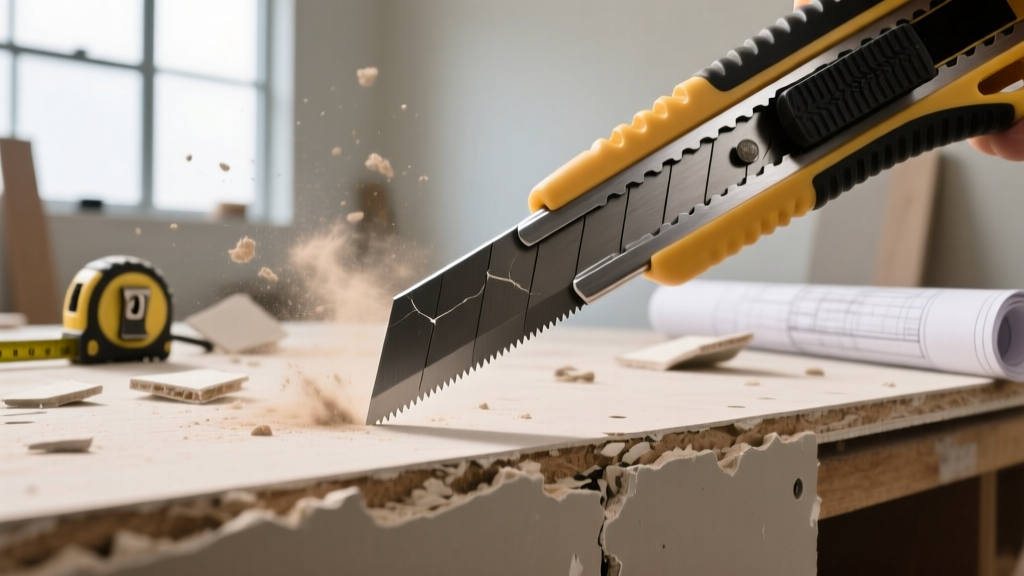
The Hidden Cost of Dull Blades in Gypsum Board Fabrication
When professionals select a utility knife for cutting drywall, the focus is often on the ergonomics of the handle or the auto-locking mechanism. However, the true bottleneck in drywall fabrication is the metallurgical durability of the blade itself. A degraded blade does not merely slow down the cutting process; it fundamentally compromises the edge integrity of the gypsum board, leading to increased material waste and exponentially higher finishing labor costs. In 2026, with labor rates for Level 4 and Level 5 drywall finishes continuing to climb, understanding the exact lifespan and failure modes of utility knife blades is a critical component of job-site efficiency.
The Gypsum Association emphasizes that proper scoring and snapping techniques are foundational to achieving tight, seamless joints. When a blade loses its micro-edge, it transitions from slicing the paper facer to compressing and tearing it. This results in ragged edges that require heavy pre-filling with joint compound, negating any time saved during the initial cutting phase.
How Gypsum Core Abrasion Degrades Blade Edges
It is a common misconception that gypsum (calcium sulfate dihydrate) is too soft to dull steel. While pure gypsum ranks at a mere 2 on the Mohs hardness scale, commercial drywall panels contain crystalline impurities, including microscopic silica and uncalcined calcium carbonate, which act as an abrasive grinding compound. Furthermore, the paper facers on modern moisture-resistant and mold-resistant boards are denser and more heavily sized than standard white paper, accelerating edge rolling on standard carbon steel blades.
Standard high-carbon steel blades typically fail via "edge rolling"—the microscopic folding of the apex under lateral pressure. In contrast, harder stainless or carbide-tipped blades are prone to "micro-chipping" when subjected to the torsional stress of snapping the gypsum core. Always inspect the blade edge under direct light; a dull rolled edge reflects light, while a chipped edge will show visible micro-fractures.
Blade Material Durability Matrix
Not all 18mm snap-off blades are created equal. The market in 2026 offers several metallurgical options, each with distinct hardness ratings (measured in Rockwell C scale, HRC) and lifespans when subjected to continuous drywall scoring.
| Blade Material | Hardness (HRC) | Expected Lifespan (Linear Ft) | Primary Failure Mode | Avg. Cost per Blade (2026) |
|---|---|---|---|---|
| Standard SK5 Carbon Steel | 58 - 60 | 35 - 50 | Edge Rolling | $0.25 - $0.40 |
| Stainless Steel (SUS420) | 52 - 54 | 20 - 30 | Rapid Edge Rolling | $0.50 - $0.75 |
| Titanium Nitride (TiN) Coated | 62 - 65 (Edge) | 90 - 130 | Coating Delamination | $0.85 - $1.20 |
| Tungsten Carbide Tipped | 70 - 75 | 300+ | Brittle Snapping / Chipping | $3.50 - $5.00 |
As the data illustrates, while Tungsten Carbide offers the highest theoretical lifespan, its brittleness makes it hazardous for the "score and snap" method if the installer applies uneven lateral torque. For general drywall fabrication, Titanium Nitride (TiN) coated blades offer the optimal balance of edge retention and structural flexibility.
Quantifying Blade Lifespan: The Degradation Curve
To maintain optimal cut quality, installers must understand the linear degradation curve of their chosen blade. The lifespan metrics above assume a standard 5/8-inch Type X gypsum board. When cutting denser materials like glass-mat gypsum or cementitious backer boards, these lifespans are reduced by approximately 40%.
- Phase 1: The Razor Apex (0-20 Linear Feet): The blade slices cleanly through both the front and back paper facers with minimal downward pressure (approx. 4-6 lbs of force). The gypsum core snaps cleanly along the score line with zero edge crumbling.
- Phase 2: Micro-Rolling (20-40 Linear Feet): The extreme apex of the blade begins to fold. Downward pressure must increase to 8-10 lbs. The back paper facer may require a secondary pass to sever completely. Edge crumbling increases by 15%.
- Phase 3: Compression Tearing (40+ Linear Feet): The blade no longer cuts; it compresses the paper fibers. The gypsum core fractures unpredictably, often diverging 1/4-inch or more from the intended score line. This phase demands immediate blade snapping or replacement.
Impact of Blade Wear on Drywall Edge Integrity
The correlation between utility knife blade durability and the final aesthetic quality of a drywall installation is direct and unforgiving. According to finishing guidelines published by USG (United States Gypsum), the integrity of the tapered edge is paramount for hiding joints. However, when installers must cut boards to fit around windows, doors, or electrical boxes, they are creating "butt joints" or non-tapered edges.
"A dull utility knife blade crushes the paper facer into the gypsum core rather than severing it. When moisture from joint compound is later applied, these crushed paper fibers swell and bubble, creating 'paper peeling' or 'blistering' that cannot be fixed by sanding alone. The only remedy is cutting out the blister, re-taping, and re-mudding, which destroys production schedules."
Furthermore, a dull blade increases the generation of fine gypsum dust. While scoring drywall inherently produces some particulate matter, a degraded blade pulverizes the calcium sulfate core rather than parting it, increasing airborne dust levels and creating a more hazardous breathing environment on the job site.
Maximizing Utility Knife Lifespan on the Job Site
Extending the functional life of your utility knife for cutting drywall requires strict adherence to tool maintenance protocols. The following step-by-step framework ensures maximum edge retention and job-site safety.
- Implement the "Two-Score" Rule: Never attempt to cut through the front paper, the core, and the back paper in a single, heavy-handed pass. Score the front paper deeply, snap the core, and then use the knife exclusively to slice the back paper. This reduces lateral stress on the blade edge by 60%.
- Snap at the First Sign of Light Reflection: Hold the blade under a bright work light. If the very edge of the blade reflects a continuous line of light, the edge has rolled. Snap off the segment immediately using the built-in snipper on the knife handle.
- Avoid Prying and Leveraging: Never use the extended blade of a utility knife to pry apart snapped drywall sections or scrape away dried joint compound. The 18mm blade segments are designed for tensile scoring, not lateral prying; doing so will snap the blade at the score line, creating a severe laceration hazard.
- Store in Low-Humidity Environments: Even high-carbon steel blades will develop micro-rust when left in the humid environment of a newly taped and mudded drywall room. Store spare blades in sealed, desiccant-lined pouches.
When cutting drywall for inside corners, use a fresh blade to bevel the edge at a 45-degree angle. A dull blade will tear the paper during beveling, leaving a fuzzy edge that prevents the corner tape from seating flatly. A sharp TiN-coated blade will create a clean, recessed channel for the joint compound.
Safety Considerations and OSHA Compliance
Blade durability is inextricably linked to job-site safety. As blades dull, installers naturally compensate by applying excessive downward force. When the blade finally breaks through the dense paper facer or slips off the metal straightedge, this excess kinetic energy frequently results in severe lacerations to the non-dominant hand or leg. The Occupational Safety and Health Administration (OSHA) mandates that hand tools be maintained in a safe, functional condition. Using a heavily degraded utility knife blade that requires excessive force to operate violates basic hand-tool safety principles and increases the statistical probability of recordable workplace injuries.
Frequently Asked Questions
Can I sharpen a drywall utility knife blade instead of snapping it?
No. Utility knife blades are hardened and tempered to specific metallurgical standards. Attempting to sharpen an 18mm snap-off blade with a standard whetstone or file will remove the tempered edge, leaving soft steel that will roll over immediately upon contact with the gypsum core. Always snap to a fresh, factory-honed segment.
Does cutting moisture-resistant (green/purple) drywall dull blades faster?
Yes. Moisture-resistant and mold-resistant gypsum boards utilize heavier, more chemically treated paper facers, and sometimes incorporate fiberglass mesh within the core. These additives increase the abrasiveness of the material, typically reducing the lifespan of a standard carbon steel blade by 20% to 30% compared to standard white board.
What is the best utility knife handle for drywall scoring?
For drywall fabrication, a heavy-duty, all-metal 18mm snap-off knife with an auto-locking mechanism and a built-in blade snapper is ideal. The metal body provides the necessary rigidity to prevent flexing during deep scoring, ensuring the score line remains perfectly straight, which is critical for a clean core snap.