Gypsum Board for Walls vs. Plaster and Wood: Material Comparison
Compare gypsum board for walls against plaster, wood, and fiber cement. Explore 2026 costs, STC acoustics, and installation failure modes.

The Core Debate: Gypsum Board for Walls vs. Traditional Alternatives
Selecting the right interior wall cladding dictates the acoustic performance, fire safety, and long-term maintenance of a building. While gypsum board for walls (commonly known as drywall) commands over 90% of the residential and commercial market due to its speed of installation and cost-efficiency, alternative materials like veneer plaster, solid wood paneling, and fiber cement offer distinct advantages in specific architectural and environmental contexts. This guide provides a technical, side-by-side evaluation of these materials, focusing on real-world installed costs, acoustic transmission classes (STC), and specific failure modes to help contractors and homeowners make an evidence-based decision.
Quick Decision Framework
- Choose Gypsum Board (Standard/Type X): For standard residential and commercial partitions where budget, speed, and predictable fire ratings (1-hour to 2-hour assemblies) are the primary drivers.
- Choose Veneer Plaster: For high-end residential or historical restorations requiring superior impact resistance, seamless monolithic aesthetics, and enhanced acoustic mass.
- Choose Wood/MDF Paneling: For aesthetic accent walls, biophilic design elements, or spaces where thermal warmth and visual texture outweigh acoustic and fire-performance requirements.
- Choose Fiber Cement Board: For high-moisture environments, commercial wet areas, or exterior-adjacent interior walls where mold resistance and extreme impact durability are mandatory.
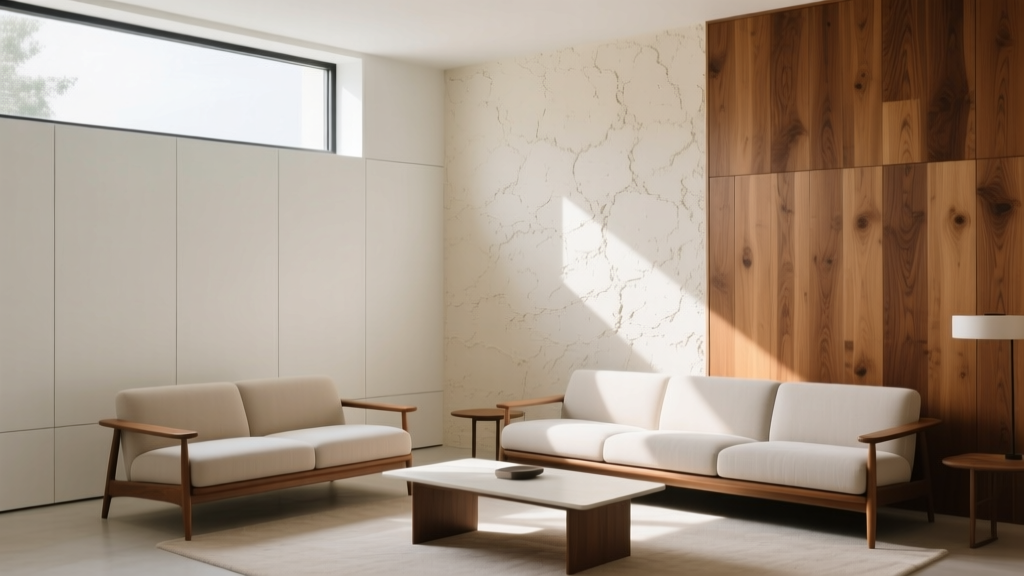
Material Breakdown: Specifications and Real-World Performance
1. Standard and Fire-Rated Gypsum Board
Modern gypsum board consists of a non-combustible calcium sulfate dihydrate core encased in paper or fiberglass mats. The industry standard for interior walls is 1/2-inch regular board, such as USG Sheetrock UltraLight Panels, which weigh approximately 41 lbs per 4x8 sheet (30% lighter than legacy boards, reducing installer fatigue and truss load). For fire-rated assemblies, 5/8-inch Type X board is required; the added thickness and embedded glass fibers allow it to withstand standard ASTM E119 fire hose stream tests, typically achieving a 1-hour fire rating on a single-layer wood stud assembly.
Installation relies on a precise fastening schedule: coarse-thread Type W screws spaced at 16 inches on center (O.C.) for wall studs, and 12 inches O.C. for ceiling joists. Joints are finished with paper tape and all-purpose or setting-type joint compound.
2. Veneer Plaster Systems
Veneer plaster is a two-coat system applied over a specialized gypsum base (blue board), such as USG Imperial Veneer Finish. Unlike drywall, which relies on paper tape for joint integrity, plaster creates a continuous, monolithic surface. The base coat (scratch/brown) provides structural bonding and impact resistance, while the finish coat (often diamond or Imperial veneer) provides a hard, troweled surface. Plaster walls boast significantly higher surface hardness, resisting denting from furniture and doorknobs far better than paper-faced drywall.
3. Wood Paneling and Engineered MDF
Wood cladding ranges from solid tongue-and-groove pine or oak to engineered Medium Density Fiberboard (MDF) shiplap. Solid wood offers natural thermal insulation and acoustic diffusion but is highly susceptible to seasonal hygroscopic expansion. MDF alternatives (like UFP-Edge shiplap) are dimensionally stable and cost-effective but lack the fire resistance of mineral-based products and will swell irreparably if exposed to liquid water.
4. Fiber Cement Board
Products like James Hardie HardieBacker or Allura Fiber Cement panels are composed of Portland cement, silica sand, and cellulose fibers. While primarily used as tile backer boards, they are increasingly specified as exposed interior wall cladding in industrial-style commercial spaces or high-humidity residential zones. They are impervious to mold and water damage but require specialized carbide-tipped scoring tools or diamond blades for cutting, generating significant silica dust during fabrication.
Head-to-Head Comparison Matrix
| Material | Material Cost (per sq. ft.) | Installed Cost (per sq. ft.) | Acoustic Rating (STC) | Fire Rating (Standard Assembly) | Moisture Tolerance |
|---|---|---|---|---|---|
| 1/2" Standard Gypsum | $0.45 - $0.65 | $1.85 - $2.60 | 33 - 35 | None (Combustible facing) | Low (Requires MR board for damp areas) |
| 5/8" Type X Gypsum | $0.70 - $0.95 | $2.20 - $3.10 | 35 - 38 | 1-Hour (Single layer, wood studs) | Low |
| Veneer Plaster (2-coat) | $1.20 - $1.80 (incl. base) | $5.50 - $8.50 | 40 - 45 | 1-Hour (with specific base) | Low to Moderate |
| Solid Wood (T&G Oak) | $6.00 - $12.00 | $11.00 - $18.00 | 30 - 34 | None (High surface flame spread) | Moderate (Prone to warping) |
| Fiber Cement (1/4" panel) | $2.50 - $4.00 | $6.50 - $9.50 | 38 - 42 | Non-combustible core | High (Impervious to rot) |
Cost Analysis: The Labor-to-Material Ratio
When evaluating wall systems, material cost is often a fraction of the total project expense. Gypsum board for walls is heavily favored in production building because the labor-to-material ratio is highly optimized. A standard drywall installation (hanging, taping, mudding, sanding) costs between $1.85 and $2.60 per square foot installed. The material accounts for roughly 25% of this total, while skilled finishing labor accounts for the rest.
Conversely, veneer plaster is intensely labor-driven. The material cost is relatively low, but the application requires highly specialized plasterers—a trade facing severe labor shortages in 2026. Consequently, installed plaster costs frequently exceed $7.00 per square foot, making it a premium upgrade reserved for custom builds. Wood paneling sits in the middle; while the material is expensive, the installation (blind-nailing to studs or furring strips) is faster than multi-day drywall mudding and sanding cycles.
Critical Installation Pitfalls & Failure Modes
- Gypsum Board Truss Uplift: In cold climates, roof trusses can arch upward in winter, pulling the ceiling drywall away from the top wall plates. Fix: Use drywall clips at the top plate and avoid fastening the ceiling board within 16 inches of the wall intersection to allow for flex.
- Plaster Delamination: Veneer plaster will fail to bond if the blue board surface is dusty or if the ambient temperature drops below 55°F (13°C) during the curing phase. Fix: Apply a bonding agent (e.g., USG Plaster Bonder) and strictly maintain HVAC climate control during application.
- Wood Gapping: Solid wood installed during high-humidity summer months will shrink and reveal gaps in winter. Fix: Acclimate solid wood in the installation space for a minimum of 72 hours at 65-70°F and 30-50% relative humidity before fastening.
Acoustic and Environmental Considerations
Acoustic performance in wall assemblies is governed by the Mass Law and mechanical decoupling. Standard 1/2-inch gypsum board weighs approximately 1.6 lbs per square foot (psf). A standard partition (1/2-inch drywall on both sides of wood studs with R-13 fiberglass batts) achieves an STC (Sound Transmission Class) rating of roughly 35, which blocks normal speech but allows loud music or shouting to pass through. According to the Pacific Northwest National Laboratory's Building America guidelines, improving this requires either adding mass or decoupling the structure.
Veneer plaster naturally adds mass (upwards of 2.5 psf), pushing baseline STC ratings into the low 40s without altering the stud cavity. To make gypsum board match plaster's acoustic performance, contractors must utilize resilient channels, staggered studs, or specialized acoustic sealants at the perimeter, which adds roughly $0.80 to $1.20 per square foot to the drywall installation cost.
From an environmental standpoint, the Gypsum Association notes that modern gypsum board is highly recyclable, with many manufacturers incorporating up to 95% post-consumer and post-industrial recycled gypsum into their cores. However, paper-faced drywall is a known food source for mold if left exposed to chronic moisture. In bathrooms or basements, specifiers must upgrade to glass-mat gypsum panels (like Georgia-Pacific DensArmor Plus), which replace the paper facing with fiberglass, entirely eliminating the organic material mold requires to grow.
Final Verdict: Selecting the Right Wall System
There is no universal 'best' material; the correct choice depends entirely on the performance requirements of the specific space. Gypsum board for walls remains the undisputed champion for 90% of interior partitions due to its unmatched balance of fire safety, cost-efficiency, and installation speed. It is the default for a reason. However, when a project demands the monolithic luxury and acoustic mass of veneer plaster, the biophilic warmth of wood paneling, or the indestructible moisture resistance of fiber cement, these alternatives justify their premium costs and specialized installation requirements. Always align the material choice with the specific acoustic, hygroscopic, and fire-code demands of the local building jurisdiction.
Written by
Priya KapoorPriya Kapoor is a real estate market analyst and construction economics researcher with expertise in housing affordability, development feasibility, and infrastructure investment. She holds a Master of Regional Planning from Cornell University and previously worked as a senior analyst at CBRE's Investment Properties group, where she modeled returns for $4B in mixed-use development pipelines. Priya now runs an independent research practice advising developers, municipalities, and REITs on construction cost forecasting and market timing. She publishes the quarterly "BuildMat Market Pulse" report tracking material price indices across 12 commodity categories. Based in Austin, TX, Priya serves on the board of Habitat for Humanity Austin and is a marathon runner.
More from Priya Kapoor
View all
Construction Cost
Cost to Build a 1600 Sq Ft Home in 2026: Full Breakdown
Accurate 2026 cost to build a 1600 sq ft home—material, labor, and regional pricing breakdowns included. Plan your budget with real-time estimates.
Aug 11, 2026

Wood & Lumber
Name the Types of Wood for Pressure Treatment and Preservation
Learn how to name the types of wood best suited for pressure treatment. Compare species treatability, chemical retention levels, and 2026 preservation costs.
Aug 4, 2026

Stone & Masonry
Stone Veneer Suppliers Lindenhurst: 2026 Cost Analysis
Analyze 2026 stone veneer costs in Lindenhurst, NY. Compare local supplier pricing, delivery fees, and Suffolk County installation labor rates.
Aug 4, 2026