Wet Gypsum Board Cost Analysis: Remediation, Repair, and Replacement
Comprehensive 2026 cost analysis for wet gypsum board. Compare repair vs. replacement costs, material upgrades, and hidden remediation expenses.

The Financial Reality of Wet Gypsum Board
When gypsum board is exposed to moisture, the clock starts ticking immediately. The porous gypsum core and the cellulose paper facing create an ideal environment for microbial growth and structural degradation, often within 48 hours of initial exposure. From a construction and property management perspective, wet gypsum board is not just a physical problem; it is a compounding financial liability. Delaying remediation by even 24 hours can shift a project from a simple drying protocol to a full-scale demolition and mold abatement contract, increasing overall costs by 300% to 500%.
This 2026 cost analysis breaks down the exact financial implications of dealing with water-damaged drywall. We evaluate the triage decision matrix, itemize current market rates for remediation and replacement, and analyze the long-term ROI of upgrading to moisture-resistant gypsum products in high-risk zones.
The Triage Framework: Dry, Repair, or Replace?
Before calculating costs, contractors and adjusters must categorize the water exposure. The Institute of Inspection, Cleaning and Restoration Certification (IICRC) S500 standard dictates the protocol based on water category and exposure time. According to the EPA guidelines on mold cleanup, porous materials like standard drywall that have been wet for more than 48 hours generally cannot be adequately cleaned and must be discarded.
Decision Matrix: When to Replace
- Category 1 (Clean Water) + Less than 24 Hours: Dry in place using commercial dehumidifiers and air movers. Cost impact is minimal.
- Category 1 (Clean Water) + Over 48 Hours: Core saturation is likely. Cut and replace 12 inches above the highest visible water line to align with standard 4-foot sheet dimensions.
- Category 2 (Gray Water - Appliance Leaks): Contains chemical or biological contaminants. Full replacement of all saturated panels is required.
- Category 3 (Black Water - Sewage/Flooding): Highly contaminated. Mandatory full removal, hazardous disposal, and antimicrobial framing treatment.
Itemized Cost Breakdown: Remediation to Repaint
The costs below reflect 2026 national averages for residential and light commercial projects. Prices fluctuate based on regional labor rates, site accessibility, and the extent of the damage. This breakdown assumes a standard 10x12 foot room (approx. 320 square feet of wall area) where the bottom 2 feet of drywall has been compromised by a Category 2 water leak.
| Project Phase | Unit Cost (2026) | Estimated Total (64 sq ft) |
|---|---|---|
| Demolition & Haul Away | $1.75 - $2.50 / sq ft | $112 - $160 |
| Framing Drying & Antimicrobial Treatment | $2.00 - $3.50 / linear ft | $80 - $140 |
| Material (Moisture-Resistant Gypsum) | $0.75 - $1.40 / sq ft | $48 - $90 |
| Installation & Level 4 Finishing | $2.50 - $4.00 / sq ft | $160 - $256 |
| Primer & Paint (2 Coats) | $1.25 - $2.00 / sq ft | $80 - $128 |
| Total Estimated Project Cost | $7.50 - $13.40 / sq ft | $480 - $774 |
Note: If Category 3 water or active mold colonization is present, professional mold remediation must precede reconstruction. Remediation adds an average of $15.00 to $30.00 per square foot, requiring negative air pressure containment and HEPA vacuuming, as detailed by the CDC's post-flood cleanup protocols.
Material Upgrade ROI: Standard vs. Moisture-Resistant Gypsum
When replacing wet gypsum board, particularly in high-risk areas like bathrooms, utility rooms, or below-grade spaces, reverting to standard white board is a false economy. Upgrading to moisture-resistant (MR) or glass-mat gypsum panels prevents future catastrophic failures. Here is how the primary 2026 market options compare:
1. Standard Gypsum Board (White)
- Material Cost: $0.45 - $0.55 per sq ft.
- Composition: Standard gypsum core with untreated cellulose paper.
- Verdict: Never use in wet areas. The paper facing acts as a wick, drawing moisture into the core, leading to sagging and mold growth within days of a minor leak.
2. Moisture-Resistant / Mold-Resistant (Green/Purple Board)
- Material Cost: $0.75 - $0.95 per sq ft.
- Top Products: USG Sheetrock Mold Tough, National Gypsum Gold Bond XP.
- Composition: Silicone-treated gypsum core with moisture- and mold-resistant treated paper facings.
- Verdict: Excellent for general bathroom walls and kitchen backsplashes. Provides a 24-48 hour buffer against incidental moisture, but will still fail under sustained flooding or direct shower spray.
3. Glass Mat Gypsum Panels
- Material Cost: $1.35 - $1.60 per sq ft.
- Top Products: Georgia-Pacific DensArmor Plus, CertainTeed M2Tech.
- Composition: Inorganic fiberglass mat facing on both sides of a moisture-resistant core. Contains no cellulose.
- Verdict: The ultimate defense. Because it lacks paper, it removes the primary food source for mold. Highly recommended for shower surrounds (when paired with a liquid waterproofing membrane), basement walls, and commercial wet areas. The 200% material premium pays for itself after a single avoided remediation event.
Hidden Cost Traps in Wet Drywall Projects
Budgets frequently blow past initial estimates because estimators focus solely on the drywall square footage. A comprehensive cost analysis must account for the collateral damage caused by wet gypsum board:
- Insulation Replacement: Fiberglass batt insulation trapped behind wet drywall acts as a sponge. It cannot be effectively dried in place. Budget an additional $1.50 to $2.50 per square foot of wall cavity to remove and replace wet insulation.
- Baseboard and Trim Salvage: MDF baseboards swell and disintegrate when exposed to water. Even solid wood trim may warp. Factor in $3.00 to $6.00 per linear foot for careful removal, drying, and reinstallation, or full replacement if MDF was used.
- Electrical Component Drying: Outlets and switches located in the flood zone must be inspected. While the devices themselves are inexpensive to replace ($5-$15 each), the labor to safely disconnect, dry the junction boxes, and reinstall adds $85 to $125 per hour in licensed electrician fees.
- Texture Matching: If the existing walls feature heavy knockdown, orange peel, or skip-trowel textures, blending the new patch into the old wall requires a Level 5 finish and specialized texture equipment. Add $1.50 to $3.00 per square foot for professional texture matching.
Strategic Execution: The 12-Inch Rule
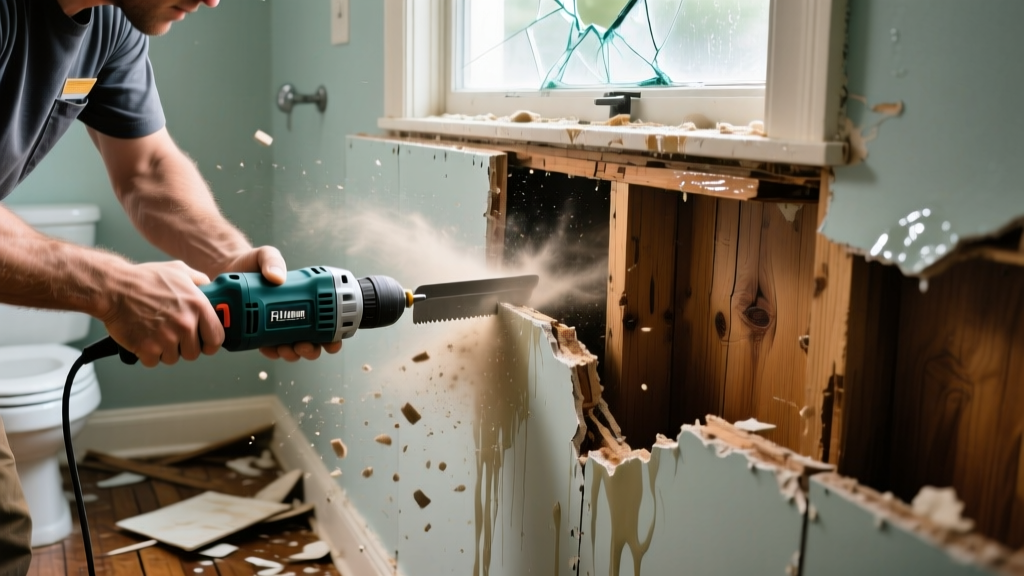
When cutting out wet gypsum board, never cut exactly at the water line. Capillary action draws water upward through the gypsum core far beyond the visible staining. The industry standard is to measure the highest point of visible moisture and cut exactly 12 inches above that line.
This 12-inch buffer serves two critical financial purposes: First, it ensures you are anchoring the new drywall to framing that is verifiably dry and structurally sound. Second, it aligns the cut with standard 4-foot panel dimensions. If you cut at an arbitrary height (e.g., 26 inches), you will waste material and create awkward, off-creased butt joints that require extensive mudding, increasing your Level 4 finishing labor costs by up to 20%.
Frequently Asked Questions
Can I just paint over a water stain on drywall?
No. Painting over a water stain without addressing the moisture traps water inside the wall cavity, guaranteeing mold growth and core degradation. If the board is structurally sound and completely dry (verified with a pin-type moisture meter reading below 1%), you must seal the stain with an oil-based or shellac-based primer (like Zinsser B-I-N) before applying latex paint. Water-based primers will allow the stain to bleed through.
Does homeowners insurance cover wet gypsum board replacement?
Insurance typically covers sudden and accidental water damage (e.g., a burst supply line or a failed washing machine hose). However, it almost universally excludes damage resulting from long-term neglect, unresolved slow leaks, or groundwater seepage. If the wet drywall is the result of a shower pan that has been leaking for six months, the claim will likely be denied as a maintenance issue.
How long does it take for wet drywall to dry out completely?
Under ideal conditions with commercial-grade LGR (Low Grain Refrigerant) dehumidifiers and high-velocity air movers, a mildly wet drywall panel can dry in 3 to 5 days. However, if the wall cavity is insulated or if the water was contaminated, drying is not a viable option, and replacement is required to meet health and safety standards.
Written by
Priya KapoorPriya Kapoor is a real estate market analyst and construction economics researcher with expertise in housing affordability, development feasibility, and infrastructure investment. She holds a Master of Regional Planning from Cornell University and previously worked as a senior analyst at CBRE's Investment Properties group, where she modeled returns for $4B in mixed-use development pipelines. Priya now runs an independent research practice advising developers, municipalities, and REITs on construction cost forecasting and market timing. She publishes the quarterly "BuildMat Market Pulse" report tracking material price indices across 12 commodity categories. Based in Austin, TX, Priya serves on the board of Habitat for Humanity Austin and is a marathon runner.
More from Priya Kapoor
View all
Construction Cost
Cost to Build a 1600 Sq Ft Home in 2026: Full Breakdown
Accurate 2026 cost to build a 1600 sq ft home—material, labor, and regional pricing breakdowns included. Plan your budget with real-time estimates.
Aug 11, 2026

Wood & Lumber
Name the Types of Wood for Pressure Treatment and Preservation
Learn how to name the types of wood best suited for pressure treatment. Compare species treatability, chemical retention levels, and 2026 preservation costs.
Aug 4, 2026

Stone & Masonry
Stone Veneer Suppliers Lindenhurst: 2026 Cost Analysis
Analyze 2026 stone veneer costs in Lindenhurst, NY. Compare local supplier pricing, delivery fees, and Suffolk County installation labor rates.
Aug 4, 2026