Wall Anchors for Drywall: Durability and Lifespan Analysis
Analyze the durability and lifespan of wall anchors for drywall. Compare plastic, threaded, and toggle bolts for long-term load retention.
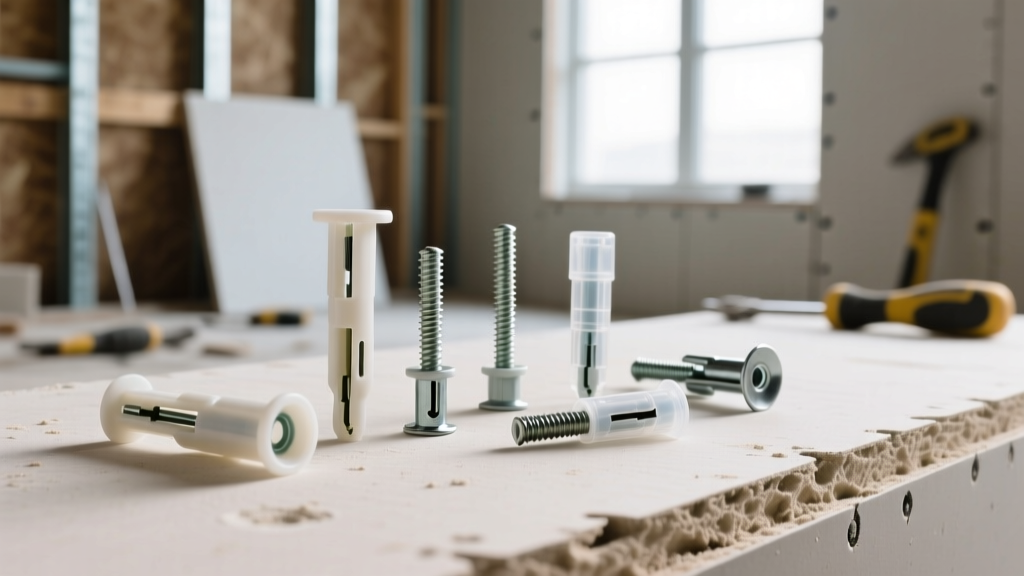
The Physics of Gypsum Degradation and Anchor Creep
Gypsum board is fundamentally a sandwich of paper facing encasing a core of calcium sulfate dihydrate. While this crystalline structure provides excellent fire resistance and dimensional stability for broad surface loads, it is inherently hostile to concentrated point loads. When evaluating wall anchors for drywall, the primary enemy of long-term durability is not the anchor itself, but a phenomenon known as 'creep' within the gypsum core.
Creep occurs when a constant static load causes the microscopic crystals in the gypsum core to slowly fracture and compress over time. Unlike wood, which has interlocking grain structures that resist long-term deformation, or concrete, which cures into a rigid matrix, gypsum is relatively brittle. An anchor that holds 50 pounds on day one may experience a 20% reduction in pull-out strength by year three if the load remains constant and approaches the anchor's maximum rated capacity. Understanding this material limitation is critical for specifying the correct wall anchors for drywall in both residential and commercial applications.
Comparative Lifespan Matrix: Anchor Types Under Static Load
The lifespan of an anchor is directly correlated to how it distributes force across the gypsum core and the backside of the panel. Expansion anchors concentrate stress at the insertion point, while toggle mechanisms distribute stress across a wide surface area behind the board. Below is a durability matrix based on 1/2-inch standard gypsum board under continuous static loading at 75% of the manufacturer's maximum rated capacity.
| Anchor Category | Specific Product Example | Max Pull-Out (1/2 in.) | Expected Lifespan (at 75% load) | Primary Failure Mode |
|---|---|---|---|---|
| Plastic Expansion | #8-10 Ribbed Plastic Anchor | 15 lbs | 1 - 3 Years | Core crushing and gradual pull-out |
| Self-Drilling Threaded | E-Z Ancor Twist-N-Lock (50 lb) | 50 lbs | 5 - 8 Years | Thread stripping in humid conditions |
| Hollow Wall (Molly) | #10-24 Zinc Plated Molly Bolt | 55 lbs | 12 - 15 Years | Paper facing delamination under shear |
| Strap Toggle | Toggler Snaptoggle (1/4-20) | 265 lbs | 20+ Years (Permanent) | Complete panel failure (board breaks before anchor) |
| Wing Toggle | 1/4 in. Spring Toggle Bolt | 100 lbs | 15 - 20 Years | Wing fatigue and bolt corrosion |
Dynamic vs. Static Loading: Why Anchors Fail Prematurely
Manufacturers rate wall anchors for drywall based on static pull-out strength. However, real-world applications rarely involve purely static loads. Dynamic loads—introduced by vibration, impact, or repetitive movement—accelerate gypsum degradation exponentially. For example, a wall-mounted television on an articulating arm creates a dynamic lever effect. Every time the arm is extended, the shear force on the top anchors and the pull-out force on the bottom anchors multiply.
According to structural testing guidelines outlined by the Gypsum Association's GA-216 standard, fasteners and anchors must be selected based on the specific load characteristics of the attachment. When dynamic forces are present, the effective load capacity of the gypsum board should be derated by at least 40% to account for accelerated core fatigue.
Core Density Variables: Standard vs. 5/8-inch Type X
The lifespan and holding power of wall anchors for drywall change significantly when upgrading from standard 1/2-inch board to 5/8-inch Type X fire-rated board. Type X gypsum board is manufactured with a denser core and incorporates glass fibers to prevent the board from crumbling during a fire. This increased density and fibrous reinforcement directly impact anchor performance.
When installing anchors into 5/8-inch Type X board, you can expect a 30% to 45% increase in pull-out strength compared to standard 1/2-inch regular board. The glass fibers act as a micro-rebar, resisting the propagation of micro-fractures that cause creep. For commercial projects requiring long-term durability of heavy wall-mounted fixtures, specifying Type X board and utilizing hollow-wall molly bolts or strap toggles provides a highly reliable, code-compliant mounting solution that will easily outlast the building's interior finish lifecycle.
Environmental Factors: Moisture and Thermal Cycling
Gypsum is hygroscopic; it readily absorbs and releases ambient moisture. In environments with high humidity fluctuations—such as bathrooms, kitchens, or unconditioned commercial spaces—the gypsum core undergoes continuous expansion and contraction. This thermal and moisture cycling weakens the mechanical bite of threaded and expansion anchors.
'The long-term performance of mechanical fasteners in gypsum panel products is highly dependent on the environmental moisture content. Prolonged exposure to elevated humidity levels can reduce the structural integrity of the gypsum core, necessitating the use of moisture-resistant panels and corrosion-resistant fasteners.' — Building Science Corporation, BSD-102
Upgrading to Moisture-Resistant Gypsum (Type MR)
If anchors must be installed in high-humidity zones, the substrate should be upgraded to Moisture-Resistant (Type MR) or fiberglass-faced gypsum board (such as USG's Securock). Type MR boards feature a wax or silicone-treated core that repels liquid water, maintaining core density and preserving the anchor's lifespan. When pairing Type MR board with stainless steel or zinc-plated strap toggles, you eliminate both core degradation and anchor corrosion, ensuring a lifespan that matches the wall assembly itself.
Installation Torque and Core Compaction
A frequent cause of premature anchor failure is improper installation, specifically over-torquing during the setting phase. When a contractor uses a high-speed impact driver to set a threaded drywall anchor or tighten a molly bolt, the rotational force generates friction heat and pulverizes the immediate gypsum core. This creates a 'blown-out' hole where the anchor spins freely, permanently destroying the board's local compressive strength.
Real-World Failure Modes and Diagnostic Checklist
Identifying a failing anchor before it drops a heavy fixture requires understanding the visual and tactile symptoms of gypsum degradation. Facility managers and homeowners should conduct annual inspections of heavy wall-mounted items using the following diagnostic checklist:
- Radial Paper Cracking: Look for hairline fractures radiating outward from the anchor head. This indicates the paper facing is delaminating from the core, a primary precursor to pull-out failure.
- Fixture Deflection (The 'Nod'): If a shelf or cabinet sags slightly when weight is applied but returns to level when unloaded, the gypsum core is experiencing elastic deformation and active creep. Immediate load reduction or anchor upgrading is required.
- Visible Core Dusting: If you notice fine white gypsum dust accumulating on the top edge of a mounted fixture or on the floor below, the anchor is slowly grinding through the core due to vibration or dynamic movement.
- Anchor Head Protrusion: If the flange of a plastic or threaded anchor is sitting 1/16th of an inch proud of the wall surface, the anchor has already begun to migrate outward. Do not attempt to hammer it back in; this will only further crush the compromised core.
Selecting the correct wall anchors for drywall is not merely a matter of matching a weight rating on a package. It requires a comprehensive analysis of the gypsum substrate's physical properties, the environmental conditions of the space, and the precise nature of the load being applied. By prioritizing load distribution mechanisms like strap toggles over localized expansion anchors, and by respecting the torque limitations of the calcium sulfate core, builders and facility managers can achieve mounting solutions that remain secure for decades. For further technical specifications on substrate preparation and fastener compatibility, professionals should consult the USG Technical Data resources to ensure compliance with current building standards.