Green Gypsum Board Selection Guide: Specs, Costs & Best Uses
Compare green gypsum board options for high-humidity areas. Explore ASTM specs, top product models, pricing, and critical installation rules.

Beyond the Green Paper: Understanding Moisture-Resistant Core Chemistry
Green gypsum board, universally recognized by its green-tinted paper facing, is engineered specifically for high-humidity environments where standard white drywall would rapidly degrade. The moisture resistance is not merely cosmetic; it is achieved through a dual-action chemical treatment during the manufacturing process. First, the gypsum core is formulated with hydrophobic additives, typically siloxane or wax emulsions, which reduce the capillary action that draws water into the porous gypsum matrix. Second, the heavy paper facers are treated with water-repellent sizing agents and often incorporate biocides to inhibit mold spore germination.
Under ASTM C1396 (Standard Specification for Gypsum Board), water-resistant gypsum backing board must pass rigorous absorption testing. To qualify, the board must exhibit a maximum water absorption of 5% by weight when submerged, and a surface water absorption limit of 1.5 grams. Standard white gypsum board routinely absorbs 15% to 25% under identical conditions, leading to core softening, paper delamination, and structural failure.
The Waterproofing Misconception: Where Green Board Fails
The most frequent and costly error in residential and commercial construction is treating moisture-resistant green gypsum board as a waterproofing membrane. It is designed to withstand high ambient humidity and occasional surface condensation, not continuous liquid water exposure or hydrostatic pressure.
Material Comparison Matrix: Green Board vs. Alternatives
Selecting the right substrate requires matching the material's physical properties to the specific moisture profile of the room. Use this matrix to determine when green board is sufficient and when an upgrade is mandatory.
| Material Type | Facing Material | Core Treatment | Ideal Application | Direct Shower Safe? |
|---|---|---|---|---|
| Standard Green Board (Paper-faced) | Treated Green Paper | Siloxane/Wax | Bathroom ceilings, kitchen backsplashes, laundry rooms | No (Requires Membrane) |
| Fiberglass-Faced MR Board | Woven Fiberglass Mat | Siloxane/Wax | Commercial bathrooms, high-humidity basements | Yes (With Membrane) |
| Cement Backer Board | Fiberglass Mesh | Portland Cement | Shower pans, tub surrounds, wet room floors | Yes |
| Extruded Polystyrene Foam Board | Reinforced Cementitious | Closed-Cell Foam | Custom shower niches, steam rooms, curved walls | Yes |
Top Industry Product Lines and Specifications
When specifying green gypsum board for a project, contractors and architects generally choose between traditional paper-faced options and advanced fiberglass-mat alternatives. Fiberglass-mat boards eliminate the organic paper facing entirely, removing the primary food source for mold.
1. USG Sheetrock Mold Tough Gypsum Panels
This is the industry-standard paper-faced green board. It features a 100% recycled, moisture- and mold-resistant green face paper and a water-repellent core. It is available in 1/2-inch and 5/8-inch (Type X fire-rated) thicknesses. The 1/2-inch panels weigh approximately 1.6 lbs per square foot, making them manageable for ceiling installations in humid environments like indoor pool enclosures or commercial locker rooms.
2. Georgia-Pacific DensArmor Plus
DensArmor Plus represents the fiberglass-mat evolution of green board. Instead of green paper, it utilizes a heavy-duty fiberglass mat on both sides. While it doesn't have the traditional 'green paper' look (it has a pale yellow/tan mat), it serves the exact same specification category and outperforms paper-faced boards in prolonged high-humidity scenarios. It scores a perfect 10 on the ASTM D3273 mold resistance test.
3. CertainTeed M2Tech Moisture & Mold Resistant
CertainTeed's M2Tech line utilizes a specialized green face paper and a proprietary mold-resistant core treatment. A distinct advantage of M2Tech is its enhanced edge profile, which resists crushing during fastening and provides a slightly more rigid taping flange compared to standard tapered edges, reducing the risk of joint telegraphing in humid conditions where wood framing expands and contracts.
Project Cost Breakdown: Material and Labor Estimates
Budgeting for moisture-resistant drywall requires factoring in both the material premium and the specialized finishing labor. Taping and mudding green board requires setting-type joint compounds in the wettest areas to prevent joint degradation.
| Component | Standard White Board (1/2'') | Green MR Board (1/2'') | Fiberglass-Mat MR (1/2'') |
|---|---|---|---|
| Material Cost (per 4x8 sheet) | $14.00 - $17.00 | $22.00 - $26.00 | $28.00 - $34.00 |
| Material Cost (per sq. ft.) | $0.45 - $0.55 | $0.70 - $0.85 | $0.90 - $1.10 |
| Installation Labor (per sq. ft.) | $0.50 - $0.70 | $0.55 - $0.75 | $0.60 - $0.85 |
| Finishing/Taping (per sq. ft.) | $0.40 - $0.60 | $0.50 - $0.75 | $0.65 - $0.90 |
| Total Installed Cost (per sq. ft.) | $1.35 - $1.85 | $1.75 - $2.35 | $2.15 - $2.85 |
Note: Pricing reflects national averages for 2026. Regional labor rates and supply chain variables may cause fluctuations of up to 15%. Fiberglass-mat boards require specialized cutting tools (hook-blade knives or shears) as scoring and snapping creates excessive airborne glass fibers.
Critical Installation Protocols for High-Humidity Zones
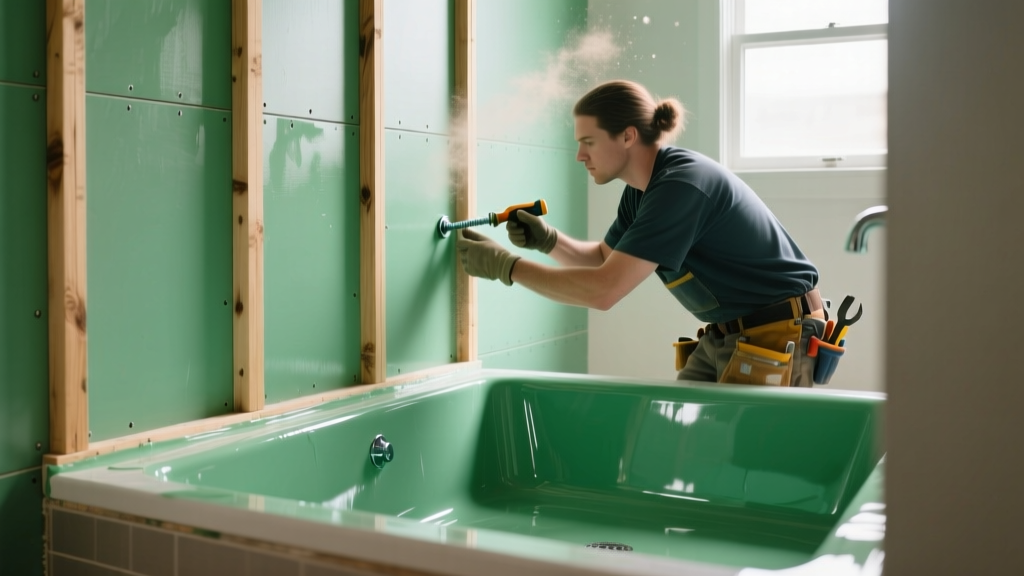
Adhering to the Gypsum Association Application and Finishing Manual is non-negotiable when working in moisture-prone areas. Improper fastening or finishing compromises the board's integrated defenses.
- Fastener Spacing: For 1/2-inch green board on walls, space screws a maximum of 12 inches on center. For ceilings, reduce spacing to 8 inches on center to prevent sagging, which is exacerbated by the added weight of ambient moisture absorption.
- Fastener Type: Use only corrosion-resistant, epoxy-coated, or galvanized drywall screws. Standard phosphate-coated black drywall screws will rust rapidly in high-humidity environments, bleeding through the primer and paint.
- Joint Compound Selection: Do not use standard air-drying pre-mixed joint compound (often called 'mud in a bucket') for the tape coat in wet areas. Use a setting-type compound (e.g., Durabond 90 or Easy Sand 45) for the first two coats. Setting compounds undergo a chemical crystallization process that is highly resistant to moisture re-emulsification.
- Primer Requirements: Green board must be sealed with an alkali-resistant, moisture-blocking primer (such as Zinsser Gardz or Kilz Restoration) before applying standard latex paints. This prevents the green dye from bleeding through light-colored topcoats and seals the paper facing against ambient vapor.
Integrating Liquid Waterproofing Membranes
When green gypsum board transitions into a splash zone (such as the wall area immediately outside a shower door or behind a kitchen sink), it must be coated with an ANSI A118.10 compliant liquid-applied waterproofing membrane. Products like Custom Building Products RedGard or Mapei AquaDefense are rolled directly over the taped and finished green board. Apply the membrane at a rate that achieves a minimum dry-film thickness of 30 mils, verified with a wet-film thickness gauge during application. This creates a continuous elastomeric barrier that protects the underlying moisture-resistant core from direct liquid intrusion.
Written by
Priya KapoorPriya Kapoor is a real estate market analyst and construction economics researcher with expertise in housing affordability, development feasibility, and infrastructure investment. She holds a Master of Regional Planning from Cornell University and previously worked as a senior analyst at CBRE's Investment Properties group, where she modeled returns for $4B in mixed-use development pipelines. Priya now runs an independent research practice advising developers, municipalities, and REITs on construction cost forecasting and market timing. She publishes the quarterly "BuildMat Market Pulse" report tracking material price indices across 12 commodity categories. Based in Austin, TX, Priya serves on the board of Habitat for Humanity Austin and is a marathon runner.
More from Priya Kapoor
View all
Construction Cost
Cost to Build a 1600 Sq Ft Home in 2026: Full Breakdown
Accurate 2026 cost to build a 1600 sq ft home—material, labor, and regional pricing breakdowns included. Plan your budget with real-time estimates.
Aug 11, 2026

Wood & Lumber
Name the Types of Wood for Pressure Treatment and Preservation
Learn how to name the types of wood best suited for pressure treatment. Compare species treatability, chemical retention levels, and 2026 preservation costs.
Aug 4, 2026

Stone & Masonry
Stone Veneer Suppliers Lindenhurst: 2026 Cost Analysis
Analyze 2026 stone veneer costs in Lindenhurst, NY. Compare local supplier pricing, delivery fees, and Suffolk County installation labor rates.
Aug 4, 2026