#4 Steel Rebar Specifications, Yield Strength & Load Ratings
Explore #4 steel rebar specifications, including yield strength, tensile limits, ASTM A615 grades, and exact load ratings for concrete reinforcement.
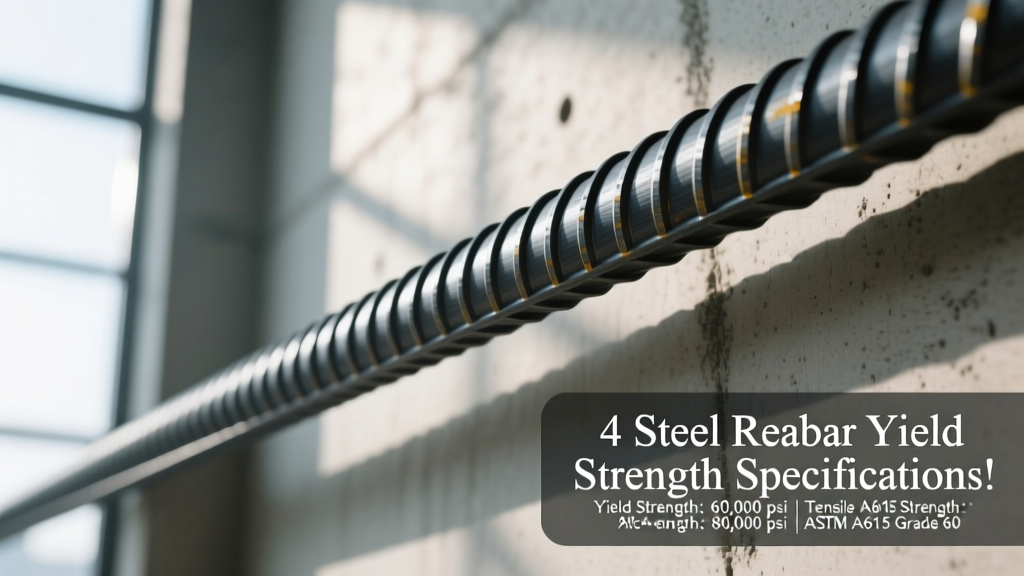
Core Dimensions and Physical Properties of #4 Rebar
In the United States, rebar sizing follows an imperial numbering system where the number represents the nominal diameter in eighths of an inch. Therefore, #4 steel rebar has a nominal diameter of 4/8 inch, or exactly 0.500 inches (12.7 mm). In the metric system, this corresponds to the #13M designation. Understanding the exact physical properties of #4 rebar is critical for structural engineers and contractors calculating dead loads, concrete displacement, and spacing requirements.
Quick Reference: #4 Rebar Physical Specs
- Nominal Diameter: 0.500 in. (12.7 mm)
- Cross-Sectional Area: 0.20 sq in. (129 mm²)
- Weight per Linear Foot: 0.668 lbs/ft (0.994 kg/m)
- Standard Lengths: 20 ft, 30 ft, 40 ft, 60 ft
- Deformation Pattern: Continuous longitudinal ribs with transverse lugs (ASTM standard)
The cross-sectional area of 0.20 square inches is the foundational metric used in all reinforced concrete design equations. When calculating the steel ratio (ρ) for a concrete beam or slab, the area of steel (As) is derived by multiplying 0.20 by the number of #4 bars in the tension zone. According to the Concrete Reinforcing Steel Institute (CRSI), the deformation height for #4 rebar must be a minimum of 0.035 inches to ensure adequate bond strength with the surrounding concrete matrix, preventing slippage under high tensile loads.
ASTM Material Standards: A615 vs. A706
Not all #4 rebar is manufactured to the same metallurgical standard. The two primary specifications governing carbon and low-alloy steel rebar in North America are ASTM A615 and ASTM A706. Selecting the correct standard dictates the material's weldability, ductility, and suitability for seismic applications.
ASTM A615: Standard Carbon Steel
ASTM A615 is the most common and cost-effective specification for general construction. It is produced primarily from recycled scrap metal via electric arc furnaces. While it meets strict tensile and yield requirements, A615 does not impose strict limits on the chemical composition—specifically the Carbon Equivalent (CE). Because the carbon content can vary widely between heats, A615 #4 rebar is generally considered non-weldable without extensive pre-heating and post-weld heat treatment, as sudden cooling can cause micro-cracking in the heat-affected zone.
ASTM A706: Low-Alloy Steel for Welding and Seismic Zones
When structural drawings specify welded rebar cages or moment-resisting frames in high seismic risk zones, ASTM A706 is mandatory. A706 restricts the Carbon Equivalent to a maximum of 0.55% for #4 rebar. This precise chemical control ensures the steel retains its ductility after welding. Furthermore, A706 mandates a tighter window between yield and tensile strength, ensuring that the steel yields predictably and absorbs seismic energy through plastic hinge formation before fracturing.
Performance Ratings: Yield and Tensile Strength Matrix
Rebar is categorized by its minimum yield strength, measured in thousands of pounds per square inch (ksi). The modulus of elasticity (E) for all standard steel rebar is universally accepted as 29,000,000 psi (29,000 ksi), meaning #4 rebar will elongate elastically at a rate of 0.00207 in/in when stressed to 60,000 psi.
| Grade | Min. Yield Strength (psi) | Min. Tensile Strength (psi) | Min. Elongation (in 8 in.) | Primary Application |
|---|---|---|---|---|
| Grade 60 | 60,000 | 90,000 | 9% | Standard slabs, foundations, walls |
| Grade 75 | 75,000 | 100,000 | 7% | High-rise columns, heavy retaining walls |
| Grade 80 | 80,000 | 105,000 | 6% | Specialized precast, mining infrastructure |
For standard residential and light commercial construction, Grade 60 is the default specification. However, engineers increasingly specify Grade 75 for #4 rebar in vertical retaining wall stems to reduce bar spacing and minimize concrete congestion, allowing for smaller aggregate mixes and better vibration consolidation.
Calculating Axial Load and Tensile Capacity
To determine the exact load rating of a single #4 rebar, structural designers use the nominal tensile capacity formula:
T = As × fy
Where:
T = Yield Tensile Capacity (lbs)
As = Cross-sectional area (0.20 sq in.)
fy = Yield strength (60,000 psi for Grade 60)
Applying this formula, a single #4 Grade 60 rebar will yield at exactly 12,000 lbs (12 kips) of pure axial tension. It will not reach ultimate rupture until the applied load reaches 18,000 lbs (0.20 sq in. × 90,000 psi tensile strength). In flexural design (beams and slabs), the American Concrete Institute (ACI) applies a strength reduction factor (φ) of 0.90 for tension-controlled sections, meaning the usable design strength of one #4 bar in bending is 10,800 lbs.
Bending Specifications and Hook Lengths
Cold bending #4 rebar on-site requires adherence to strict minimum bend diameters to prevent micro-fractures along the outer radius of the bend. According to ACI 318 code provisions, the minimum bend diameter for #4 rebar is dictated by the type of hook being formed:
- Standard 90-Degree Hooks: Minimum bend diameter is 4db (4 × 0.500" = 2.0 inches). This requires a bending machine pin with a minimum 2-inch diameter.
- Stirrups and Ties (135-degree hooks): Minimum bend diameter is 4db for standard stirrups, though some automated shear-line equipment can safely achieve tighter radii if the steel is certified for severe cold bending.
- Standard 180-Degree Hooks: Minimum bend diameter is 4db (2.0 inches).
Never re-bend #4 rebar that has already been bent in the field. The initial cold-working process alters the crystalline structure of the steel, increasing its yield point locally but severely reducing its ductility. Re-bending a #4 bar at the same deformation point will frequently cause a brittle snap failure, compromising the structural integrity of the concrete element.
2026 Procurement: Pricing, Coatings, and Lead Times
As of early 2026, domestic steel production has stabilized, but raw material surcharges continue to influence rebar pricing. Procurement strategies must account for both the base mill price and the value-added processing costs.
- Standard Black #4 Rebar (ASTM A615 Gr 60): $0.48 to $0.58 per linear foot (mill-direct, truckload quantities).
- Epoxy-Coated #4 Rebar (ASTM A775): $0.75 to $0.92 per linear foot. Mandatory for bridge decks, marine environments, and de-icing salt exposure zones.
- ASTM A706 Weldable Premium: Typically carries a $0.04 to $0.07 per foot premium over standard A615 due to tighter metallurgical controls.
- Cut-and-Bend Processing: Fabricators charge between $0.08 and $0.15 per pound for automated shear-line processing, which reduces on-site labor waste by up to 12%.
For projects in coastal or high-corrosion environments, engineers are increasingly specifying epoxy-coated or micro-composite rebar alternatives. When handling epoxy-coated #4 rebar, contractors must use padded clamps and patch any coating abrasions with two-part epoxy resin prior to the concrete pour to prevent localized galvanic corrosion cells from forming.
Frequently Asked Questions (FAQ)
What is the maximum allowable spacing for #4 rebar in a concrete slab?
For standard 4-inch to 5-inch residential slabs-on-grade, #4 rebar is typically spaced at 16 inches to 18 inches on center (O.C.) in a grid pattern. However, ACI 318 mandates that the maximum spacing of flexural reinforcement shall not exceed 3 times the slab thickness or 18 inches, whichever is smaller. For a 4-inch slab, the absolute maximum spacing is 12 inches O.C.
Can I weld #4 rebar found at a standard retail hardware store?
No. Retail hardware stores almost exclusively stock ASTM A615 rebar, which has no guaranteed Carbon Equivalent limit. Welding A615 rebar without a documented mill test report and proper pre-heat protocols will result in a brittle heat-affected zone that can fail under load. If welding is required, you must special-order ASTM A706 #4 rebar from a commercial steel service center.
How much concrete cover is required over #4 rebar?
Minimum concrete cover depends on the exposure condition and structural element. For #4 rebar in cast-in-place walls and slabs not exposed to weather or ground contact, the minimum cover is 3/4 inch. For footings and foundations cast directly against earth, the minimum cover is 3 inches. For structural elements exposed to de-icing salts or seawater, cover requirements increase to 2 to 2.5 inches, often accompanied by a reduction in the water-cement ratio of the concrete mix.