Steel Framing Price Breakdown: 2026 Cost Per Sq Ft & Linear Foot
Discover the 2026 steel framing price per square foot and linear foot. Compare metal stud costs, gauges, and hidden labor fees for your next build.

The Real Steel Framing Price Matrix: Material Costs by Gauge and Width
Calculating an accurate steel framing price requires moving beyond generic square-foot estimates. Cold-formed steel (CFS) pricing is heavily dictated by gauge thickness, web width, and galvanization coating. In 2026, raw material volatility has stabilized, but tariff adjustments and regional freight surcharges mean local pricing can fluctuate by up to 15% from national averages.
The table below outlines the baseline material-only cost per linear foot (LF) for standard galvanized steel studs (ASTM C645 compliant) in 2026. These figures assume standard 25 ksi yield strength for light-gauge and 33 ksi to 50 ksi for structural gauges.
| Gauge (Thickness) | Nominal Width | Min. Flange Size | Material Price (Per LF) | Primary Application |
|---|---|---|---|---|
| 25 ga (0.0179') | 2-1/2' | 1-1/4' | $0.85 - $1.15 | Non-load-bearing interior partitions, furring |
| 20 ga (0.0329') | 3-5/8' | 1-5/8' | $1.65 - $2.25 | Standard load-bearing walls, exterior sheathing |
| 16 ga (0.0538') | 6' | 2' | $3.80 - $4.60 | Multi-story load-bearing, shear walls |
| 14 ga (0.0677') | 8' | 2-1/2' | $6.10 - $7.50 | Heavy structural framing, high-wind/seismic zones |
| 12 ga (0.0966') | 10' | 3' | $11.20 - $13.80 | Column studs, heavy commercial trusses |
Deflection tracks and standard runner tracks typically cost 10% to 15% less per linear foot than their corresponding studs. However, specialized slip-joint tracks (used in multi-story construction to accommodate floor deflection) can cost 30% to 50% more than standard tracks due to the integrated slide mechanisms.
Installed Cost vs. Material-Only: The Labor Multiplier
When budgeting a project, the material cost is only half the equation. The installed steel framing price per square foot of wall area (not floor area) varies dramatically based on the gauge and the required connection methods.
Light-Gauge (25ga - 20ga) Installation
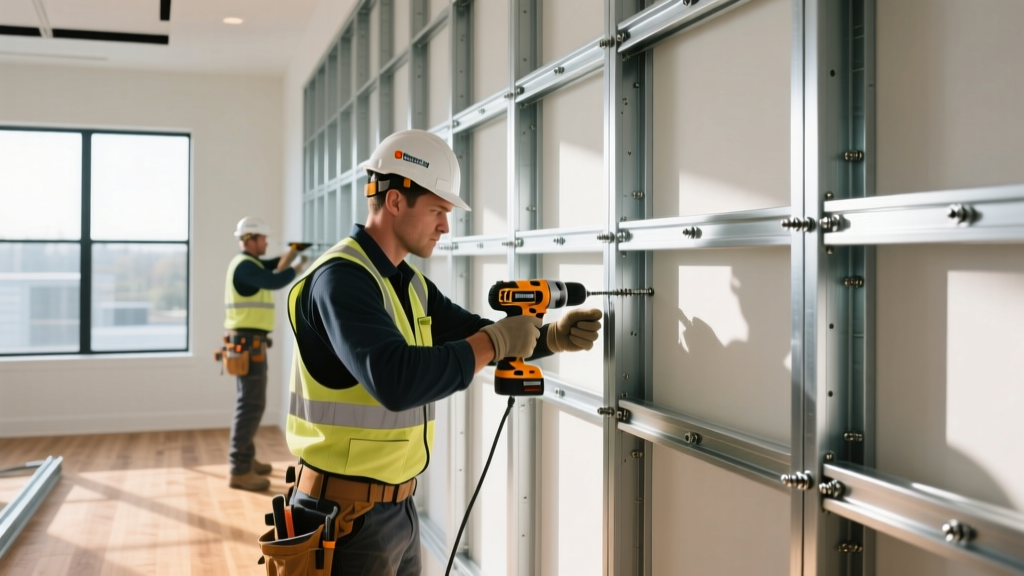
Light-gauge CFS is assembled using self-drilling wafer-head screws. A skilled framing crew in 2026 can erect approximately 400 to 600 square feet of wall per day. With commercial carpentry labor rates averaging $55 to $85 per hour, expect the installed price for light-gauge partitions to range between $8.50 and $12.00 per sq ft of wall area.
Heavy-Gauge (16ga - 12ga) Installation
Structural steel framing requires specialized labor. Connections are made using high-strength self-drilling structural screws (e.g., #12 or #14 hex washer heads) or, in some engineered shear walls, arc welding. Because heavy-gauge studs are thicker and harder to cut and align, labor productivity drops to 150–250 square feet per day. The installed price for heavy-gauge structural framing jumps to $16.00 to $24.00 per sq ft of wall area.
Hidden Cost Drivers That Spike Your Budget
Contractors and estimators frequently overlook ancillary components that are mandatory for code compliance and structural integrity. According to design guidelines published by the Steel Framing Industry Association (SFIA), failing to account for these elements can result in a 20% budget shortfall.
- Galvanization Upgrades (G60 vs. G90): Standard interior framing uses a G60 zinc coating. If the framing is exposed to weather during construction, or used in exterior cavity walls prone to condensation, building codes (and the American Iron and Steel Institute) often mandate a G90 coating. Upgrading to G90 adds 8% to 12% to your total material cost.
- Structural Bridging and Blocking: To prevent stud twisting under axial loads, flat-strap bridging or solid blocking is required every 4 to 6 feet vertically. Budget an additional $0.45 to $0.80 per linear foot of wall for blocking materials and the extra labor to install them.
- Fastener Volume: A standard 10-foot stud wall requires roughly 12-16 screws per stud (top and bottom track connections, plus bridging). A box of 1,000 premium #8 x 1-5/8' self-drilling screws (from brands like Grabber or Simpson Strong-Tie) costs about $45 to $60 in 2026. Fasteners alone can add $0.15 to $0.25 per square foot of wall.
- Fire-Rated Assemblies: Achieving a 1-hour or 2-hour fire rating (per ASTM E119) requires specific stud spacing (often 16' o.c. instead of 24' o.c.), multiple layers of Type X gypsum board, and mineral wool insulation in the cavities. The steel framing price itself doesn't change much, but the denser stud layout increases linear footage requirements by up to 33%.
Steel vs. Wood Framing: The True Lifecycle Cost Equation
When comparing the steel framing price to traditional dimensional lumber (2x4 and 2x6 SPF), wood still holds a slight edge in raw material costs for single-family residential builds. However, the gap has narrowed significantly due to lumber market volatility. More importantly, looking solely at the initial framing cost ignores critical lifecycle and risk-mitigation factors.
Where Steel Wins Financially
- Insurance Premiums: Commercial and multi-family builders frequently see a 15% to 30% reduction in builder's risk and property insurance premiums when utilizing non-combustible CFS framing.
- Waste and Scrap Value: Lumber yields 10% to 15% job-site waste (cutoffs, warped boards, crowns). Steel studs are pre-cut or easily snipped with near-zero waste. Furthermore, steel scrap retains a recycling value of roughly $60 to $100 per ton, allowing contractors to recoup a fraction of their material spend.
- Moisture and Call-Backs: Wood framing is susceptible to warping, twisting, and mold if exposed to moisture before the building is dried in. Steel eliminates drywall nail-pops and framing shrinkage, drastically reducing warranty call-backs in the first 24 months.
Where Wood Retains the Advantage
- Thermal Bridging: Steel is highly conductive. Without continuous exterior insulation (ci), steel studs create thermal bridges that degrade the wall's R-value, requiring additional spend on rigid foam or insulated sheathing to meet 2026 IECC energy codes.
- On-Site Modifiability: Modifying a wood-framed wall for an unexpected HVAC duct or plumbing chase requires a simple handsaw. Modifying heavy-gauge steel requires specialized snips, reciprocating saws with bi-metal blades, and potentially engineered reinforcement headers.
2026 Procurement Tactics for Contractors and Builders
Securing the best steel framing price in the current market requires strategic procurement. Major manufacturers like ClarkDietrich, MarinoWARE, and Super Stud Building Products operate through regional distribution networks. To optimize your spend:
- Lock in Mill-Direct Pricing for Large Volumes: If your project requires more than 50,000 linear feet of CFS, bypass the local lumber yard and request a mill-direct quote through a master distributor. This can shave 12% to 18% off the retail price.
- Standardize Your Gauges: Design your floor plans to utilize 20-gauge studs for both load-bearing and non-load-bearing interior walls where possible. Buying a single gauge in massive bulk yields better volume discounts than splitting orders between 25-gauge and 20-gauge.
- Factor in Freight and Unloading: Steel is dense. A truckload of 16-gauge 6-inch studs can easily exceed 40,000 lbs. Ensure your job site has a forklift or telehandler capable of offloading the material. If you require the delivery company to provide a crane or Moffett forklift for offloading, expect a $350 to $600 surcharge per delivery.
Estimator's Rule of Thumb: For quick conceptual budgeting in 2026, allocate $2.20 to $2.80 per square foot of floor area for light-gauge interior partition materials, and $4.50 to $6.00 per square foot of floor area for exterior load-bearing CFS materials. Always add a 10% contingency for complex geometries, high-seismic bracing, and acoustic treatments.
Written by
Priya KapoorPriya Kapoor is a real estate market analyst and construction economics researcher with expertise in housing affordability, development feasibility, and infrastructure investment. She holds a Master of Regional Planning from Cornell University and previously worked as a senior analyst at CBRE's Investment Properties group, where she modeled returns for $4B in mixed-use development pipelines. Priya now runs an independent research practice advising developers, municipalities, and REITs on construction cost forecasting and market timing. She publishes the quarterly "BuildMat Market Pulse" report tracking material price indices across 12 commodity categories. Based in Austin, TX, Priya serves on the board of Habitat for Humanity Austin and is a marathon runner.
More from Priya Kapoor
View all
Construction Cost
Cost to Build a 1600 Sq Ft Home in 2026: Full Breakdown
Accurate 2026 cost to build a 1600 sq ft home—material, labor, and regional pricing breakdowns included. Plan your budget with real-time estimates.
Aug 11, 2026

Wood & Lumber
Name the Types of Wood for Pressure Treatment and Preservation
Learn how to name the types of wood best suited for pressure treatment. Compare species treatability, chemical retention levels, and 2026 preservation costs.
Aug 4, 2026

Stone & Masonry
Stone Veneer Suppliers Lindenhurst: 2026 Cost Analysis
Analyze 2026 stone veneer costs in Lindenhurst, NY. Compare local supplier pricing, delivery fees, and Suffolk County installation labor rates.
Aug 4, 2026