Corrugated Metal Roof Cost Calculator & Estimation Guide 2026
Calculate exact 2026 costs for a corrugated metal roof. Learn panel quantity formulas, fastener counts, trim math, and hidden installation expenses.
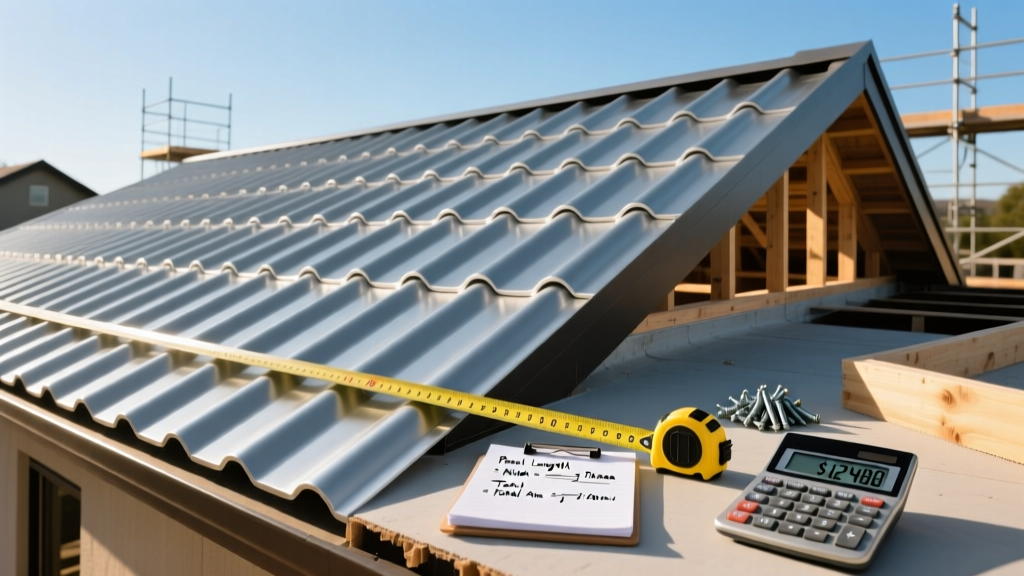
The True Cost of a Corrugated Metal Roof in 2026
Estimating the cost of a corrugated metal roof requires moving beyond basic square-foot averages. In 2026, material pricing fluctuates based on steel gauge, coating technology, and regional roll-forming availability. According to data from the Metal Roofing Alliance, exposed-fastener corrugated systems remain the most economical metal roofing option, but improper quantity calculations frequently lead to 15-20% budget overruns due to uncalculated trim, fasteners, and waste.
A standard corrugated metal roof installation ranges from $11.50 to $17.00 per square foot fully installed. Material-only costs sit between $4.50 and $7.50 per square foot, heavily dependent on whether you select bare Galvalume or a PVDF (Kynar 500) painted finish.
| Component | 29-Gauge Galvalume | 26-Gauge Galvalume | 26-Gauge PVDF Painted |
|---|---|---|---|
| Panels (Materials Only) | $3.50 - $4.20 | $4.50 - $5.50 | $6.00 - $7.50 |
| Trim, Flashing & Fasteners | $1.10 - $1.40 | $1.20 - $1.60 | $1.50 - $2.00 |
| Underlayment & Ice Guard | $0.35 - $0.60 | $0.35 - $0.60 | $0.45 - $0.85 |
| Labor & Installation | $6.50 - $8.50 | $7.00 - $9.50 | $8.50 - $11.00 |
| Total Installed Cost | $11.45 - $14.70 | $13.05 - $17.20 | $16.45 - $21.35 |
Step-by-Step Quantity Calculator Framework
To build an accurate bill of materials, you must calculate the roof area using pitch multipliers, then break that area down into panels, fasteners, and linear trim. Do not rely on simple footprint measurements.
Step 1: Calculating Roof Squares and Panel Count
A roofing "square" equals 100 square feet. To find your total squares, multiply the footprint of your building by the roof pitch multiplier. For example, a 6/12 pitch has a multiplier of 1.118. A 1,000 sq. ft. footprint at a 6/12 pitch yields 1,118 sq. ft. of actual roof area (11.18 squares).
Standard 7/8-inch corrugated panels are manufactured at 38 inches wide. However, they require a one-corrugation side lap (approximately 2 inches) for weatherproofing, leaving a 36-inch (3-foot) net coverage width. Panels are typically ordered in custom lengths up to 40 feet to avoid end-laps, which are primary leak points.
(Total Roof Square Footage ÷ 3 ft. coverage width) ÷ Panel Length = Total Panels Required.
Example: 1,118 sq. ft. ÷ 3 = 372.6 linear ft. If using 20 ft. panels: 372.6 ÷ 20 = 18.63. Round up to 19 panels per slope.
Step 2: Fastener, Closure Strip, and Trim Estimations
Corrugated panels are fastened through the valleys (pans) directly into the structural purlins or decking. The National Roofing Contractors Association (NRCA) recommends specific fastening patterns to resist wind uplift.
- Screws: Use #10 or #12 washer-head wood or metal screws (depending on substrate). Standard spacing is every 12 to 24 inches along the supports. Calculate 85 to 100 screws per square. For an 11.18-square roof, order 1,100 screws minimum.
- Closure Strips: Foam closure strips are mandatory at the eave and ridge to seal the 7/8-inch wave profile against wind-driven rain and pests. Measure the eave and ridge linear footage and add 5% for compression overlap.
- Trim and Flashing: Ridge caps, eave trim, and gable trims are sold in 10-foot and 12-foot lengths. Calculate the linear feet of all edges, divide by the trim length, and add 10% to account for the mandatory 4-inch end-laps on trim pieces.
Hidden Costs & Edge Cases in Corrugated Roofing
Quantity calculators often miss the ancillary materials required for a code-compliant installation. Factor these into your 2026 budget:
- Tear-Off and Disposal: Removing existing asphalt shingles costs $1.50 to $2.50 per square foot. Metal can sometimes be installed over one layer of existing shingles using battens, but this voids many manufacturer warranties and complicates fastener length calculations.
- Synthetic Underlayment: While 30lb asphalt felt is traditional, modern corrugated systems demand high-temp synthetic underlayment. Metal roofs can reach 160°F+ in direct summer sun, which melts standard felt and causes it to adhere to the metal underside. Budget $0.15 to $0.25 per sq. ft. for high-temp synthetic.
- Galvanic Corrosion Prevention: If you are installing corrugated steel panels over pressure-treated lumber (which contains copper-based preservatives), you must use a specialized slip sheet or ensure all fasteners and flashing are heavily galvanized or stainless steel to prevent rapid galvanic corrosion.
- Condensation Control: In unventilated agricultural or residential metal buildings, condensation drip is a major issue. Budget for a factory-applied anti-condensation fleece backing, which adds roughly $0.40 to $0.60 per square foot to the panel cost but eliminates the need for a separate vapor barrier.
Corrugated Metal vs. Standing Seam: Cost Matrix
While corrugated metal is the budget-friendly exposed-fastener option, it is frequently cross-shopped with concealed-fastener standing seam. Use this matrix to determine if the corrugated cost savings justify the long-term maintenance.
| Feature | 7/8" Corrugated (Exposed) | Mechanical Standing Seam (Concealed) |
|---|---|---|
| Material Cost (Per Sq. Ft.) | $4.50 - $7.50 | $9.00 - $14.00 |
| Installation Labor | Lower (faster overlap & screw) | Higher (requires seaming tools) |
| Fastener Maintenance | Requires inspection/tightening every 10 years | None (concealed clip system) |
| Thermal Movement | Restricted (can cause screw-hole elongation) | Accommodated (sliding clips) |
| Minimum Pitch Requirement | 3:12 (with sealant) or 4:12 | 1:4 (with specialized seals) |
Energy Efficiency and Long-Term ROI
The initial cost of a corrugated metal roof is offset by its lifespan and energy performance. Unpainted Galvalume reflects roughly 60% of solar radiation, while specialized "cool roof" PVDF pigments can reflect up to 70-80%. The U.S. Department of Energy notes that highly reflective metal roofs can reduce peak cooling demand by 10% to 15%, significantly lowering HVAC operational costs in southern climates.
Furthermore, while asphalt shingles require replacement every 15 to 20 years, a properly detailed 26-gauge corrugated Galvalume roof carries a 40-to-60-year functional lifespan. When running your long-term cost estimator, amortize the material cost over 50 years to see the true cents-per-square-foot annual value, which heavily favors steel over traditional composite materials.
Sourcing and Pro Tips for 2026
When sourcing materials, avoid big-box home improvement centers for primary roofing panels. Their stock is typically limited to 29-gauge, which is highly susceptible to oil-canning (visible waviness) and hail damage. Instead, locate a local commercial roll-former or metal building supplier. Local roll-formers can cut panels to the exact inch of your roof slope, eliminating end-laps, reducing waste, and lowering the overall fastener count. Always request the mill certificate for your steel to verify the G90 galvanization or AZ50 Galvalume coating thickness before taking delivery.