Steel Home Framing Corrosion Protection: Coatings & Best Practices
Learn how to protect steel home framing from corrosion. Compare G60, G90, and G185 galvanized coatings and moisture management tactics.

The Reality of Corrosion in Light Gauge Steel
Light gauge steel framing (LGSF) offers superior structural integrity, fire resistance, and dimensional stability compared to traditional wood. However, the primary vulnerability of steel home framing is oxidation. When bare steel is exposed to moisture and oxygen, it forms iron oxide (rust), which expands and compromises the structural cross-section. To prevent this, manufacturers apply metallic coatings, but the effectiveness of these coatings depends entirely on proper specification, handling, and environmental management during construction.
Galvanized steel home framing relies on zinc to protect the underlying steel substrate. Zinc is more anodic (less noble) than steel on the galvanic series. When moisture bridges a scratch or cut in the coating, the zinc sacrificially corrodes to protect the exposed steel. This electrochemical reaction continues until the local zinc reserve is depleted.
Decoding Galvanization Grades for Residential Framing
The standard for galvanized sheet steel used in framing is ASTM A653. The designation following the "G" indicates the total weight of the zinc coating on both sides of the sheet, measured in ounces per square foot (oz/ft²). Selecting the correct grade is a balance between project budget and environmental exposure.
| Coating Grade | Zinc Weight (oz/ft²) | Approx. Thickness (mils) | Recommended Application | Cost Premium |
|---|---|---|---|---|
| G60 | 0.60 | 0.50 | Interior, non-load-bearing partitions in dry climates. | Baseline |
| G90 | 0.90 | 0.75 | Exterior load-bearing walls, standard residential construction. | +5% to 8% |
| G185 | 1.85 | 1.50 | Coastal zones (within 1,500 ft of saltwater), high-humidity interiors. | +15% to 22% |
For the vast majority of steel home framing projects, G90 is the mandatory minimum for exterior envelopes. While G60 is frequently used by contractors to cut costs on interior demising walls, utilizing G60 on exterior sheathing lines invites premature failure if the weather-resistive barrier (WRB) is ever breached.
The Cut-Edge Vulnerability and Field Remediation
The most common point of failure in steel home framing is not the flat surface of the stud, but the cut edges created during field modifications. When framers use aviation snips or power shears to trim tracks and studs, they expose raw, uncoated steel.
The Limits of Sacrificial Protection
According to the American Galvanizers Association, the sacrificial protection of a zinc coating can only span a very short distance across bare steel—typically no more than 1/8 to 1/4 of an inch, depending on the coating thickness. If a framer cuts a large notch for plumbing or electrical runs, the zinc at the perimeter cannot protect the center of the exposed cut. This bare steel will flash-rust within days in humid conditions, eventually leading to structural pitting.
ASTM A780 Touch-Up Protocols
Any cut edge wider than 1/2 inch must be treated in the field according to ASTM A780 (Standard Practice for Repair of Damaged and Uncoated Areas of Hot-Dip Galvanized Coatings).
- Surface Prep: Remove all white rust, red rust, and cutting oils using a wire brush or abrasive pad.
- Material Selection: Apply a zinc-rich paint or zinc dust-based cold galvanizing compound. The dry film must contain a minimum of 94% zinc dust by weight to provide adequate cathodic protection.
- Approved Products: Use industry-recognized compounds such as ZRC Cold Galvanizing Compound or Galvafroid. Standard "galvanized look" spray paints from hardware stores contain aluminum flakes and zinc oxide, but lack the elemental zinc dust required for sacrificial protection.
- Application Thickness: The touch-up coating must be applied to a minimum dry film thickness (DFT) equal to the surrounding galvanized coating (typically 1.5 to 2.0 mils for G90 steel).
Galvanic Corrosion: The Fastener and Flashing Trap
Galvanic corrosion occurs when two dissimilar metals are in physical contact in the presence of an electrolyte (moisture). The less noble metal (the anode) corrodes rapidly to protect the more noble metal (the cathode). In steel home framing, this is a frequent, hidden source of structural degradation.
Never allow raw aluminum flashings, copper pipes, or untreated steel fasteners to rest directly against galvanized steel studs. Aluminum is highly anodic to zinc; if aluminum roof or window flashing touches a steel top track, the aluminum will corrode rapidly, and once depleted, the steel stud will begin to rust. Always separate dissimilar metals with a dielectric barrier (e.g., peel-and-stick flashing tape, rubberized asphalt, or heavy building felt).
Fastener Compatibility Matrix
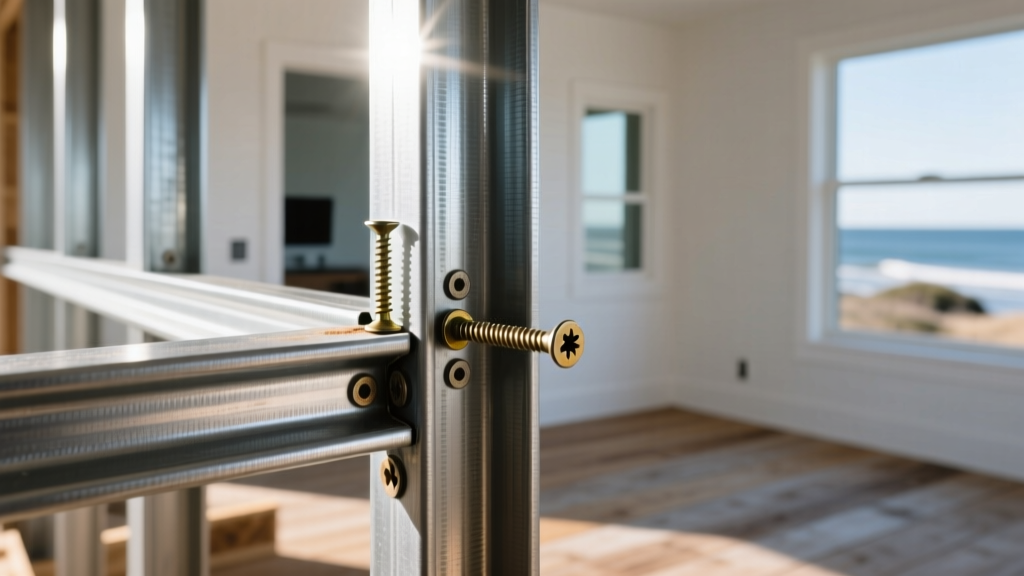
The Steel Framing Industry Association (SFIA) strictly mandates that fasteners used in LGSF must be compatible with the galvanized coating. Using the wrong screw will create a localized galvanic cell that rusts the stud from the inside out.
| Fastener Type | Compatibility with Galvanized Steel | Notes & Restrictions |
|---|---|---|
| Zinc-Plated Steel Screws | Compatible (Interior) | Standard for interior drywall and non-structural connections. Not rated for exterior moisture exposure. |
| Hot-Dip Galvanized (HDG) Screws | Highly Compatible | Required for exterior sheathing, roof trusses, and high-moisture areas. The thick zinc coating matches the stud. |
| Ceramic-Coated / Epoxy-Coated | Compatible (Exterior) | Excellent for exterior applications. Ensure the coating is rated for the specific alkaline environment of concrete contact if used at the sill plate. |
| Stainless Steel (300 Series) | Conditionally Compatible | Stainless is cathodic to zinc. Safe in dry environments, but in continuous wet conditions, the stainless screw will cause the surrounding zinc on the stud to corrode rapidly. |
| Plain / Black Oxide Steel | INCOMPATIBLE | Never use. Will rust immediately and stain finishes, compromising the structural joint. |
Environmental Exposure and Moisture Management
Corrosion requires three elements: an anode, a cathode, and an electrolyte. In steel home framing, you cannot change the anode (zinc) or the cathode (steel), but you can eliminate the electrolyte (liquid water and sustained high humidity) through rigorous moisture management.
Dew Point Control and Vapor Retarders
Condensation inside wall cavities is the silent killer of steel studs. When warm, moist interior air meets the cold surface of a steel stud in winter, condensation forms. Because steel is highly thermally conductive, the studs act as thermal bridges, making them the coldest surface in the wall cavity and the primary site for condensation.
To prevent this, framing designs must incorporate continuous exterior insulation (like rigid polyiso or mineral wool) to push the dew point outward, away from the steel. Furthermore, Class I or II vapor retarders must be installed on the warm-in-winter side of the wall to prevent interior moisture from reaching the cold steel. If a steel stud remains wet for more than 48 hours, even a G90 coating will begin to degrade.
Sill Plate Isolation
The bottom track of a steel frame resting on a concrete slab or foundation wall is highly susceptible to moisture wicking. Concrete is porous and highly alkaline. Direct contact between galvanized steel and cured concrete will strip the zinc coating through chemical degradation. Always install a minimum 10-mil polyethylene sill sealer or a specialized rubberized asphalt membrane between the concrete and the bottom steel track to provide both a capillary break and a chemical barrier.
Pre-Drywall Inspection Framework
Before closing up walls with gypsum board, superintendents and third-party inspectors must execute a targeted corrosion and protection audit. Use this specific checklist to catch vulnerabilities before they are hidden behind drywall:
- Verify Material Grades: Check the mill stamps on the web of the studs. Confirm exterior walls utilize G90 or G185, and interior load-bearing walls are minimum G60.
- Audit Cut Edges: Inspect all plumbing, HVAC, and electrical punch-outs. Any cut wider than 1/2 inch must be painted with an ASTM A780 compliant 94% zinc-rich cold galvanizing compound. Reject standard silver spray paint.
- Check Dissimilar Metals: Trace all copper plumbing lines and aluminum window flashings. Ensure a minimum 1/4-inch air gap or a dielectric slip-sheet separates them from the steel framing.
- Inspect Fasteners: Pull 5 random screws from exterior sheathing lines. Verify they are hot-dip galvanized or approved ceramic-coated exterior screws, not interior zinc-plated drywall screws.
- Evaluate Sill Isolation: Confirm a continuous sill sealer is present beneath all bottom tracks on concrete, with no gaps where concrete touches the steel.
- Assess Storage Damage: Look for "white rust" (zinc oxide) on stored materials. While light white rust is superficial and halts once the steel is dried in, heavy, flaking white rust indicates the zinc layer has been compromised and the stud should be rejected.
By treating corrosion protection as a systemic assembly requirement rather than just a material specification, builders can ensure that steel home framing achieves its full 100+ year structural lifespan without degradation.
Written by
Priya KapoorPriya Kapoor is a real estate market analyst and construction economics researcher with expertise in housing affordability, development feasibility, and infrastructure investment. She holds a Master of Regional Planning from Cornell University and previously worked as a senior analyst at CBRE's Investment Properties group, where she modeled returns for $4B in mixed-use development pipelines. Priya now runs an independent research practice advising developers, municipalities, and REITs on construction cost forecasting and market timing. She publishes the quarterly "BuildMat Market Pulse" report tracking material price indices across 12 commodity categories. Based in Austin, TX, Priya serves on the board of Habitat for Humanity Austin and is a marathon runner.
More from Priya Kapoor
View all
Construction Cost
Cost to Build a 1600 Sq Ft Home in 2026: Full Breakdown
Accurate 2026 cost to build a 1600 sq ft home—material, labor, and regional pricing breakdowns included. Plan your budget with real-time estimates.
Aug 11, 2026

Wood & Lumber
Name the Types of Wood for Pressure Treatment and Preservation
Learn how to name the types of wood best suited for pressure treatment. Compare species treatability, chemical retention levels, and 2026 preservation costs.
Aug 4, 2026

Stone & Masonry
Stone Veneer Suppliers Lindenhurst: 2026 Cost Analysis
Analyze 2026 stone veneer costs in Lindenhurst, NY. Compare local supplier pricing, delivery fees, and Suffolk County installation labor rates.
Aug 4, 2026