Steel Framing Square Selection: Layout Tools for Metal Studs
Select the right steel framing square for light gauge steel framing. Compare magnetic rafter squares, scribe notches, and metal stud layout tools.

The Galvanized Coating Challenge in LGSF Layout
Light gauge steel framing (LGSF) requires fundamentally different layout tools than traditional wood framing. When marking 20-gauge to 12-gauge galvanized C-studs, the primary objective is to achieve a precise 90-degree cut line without compromising the G60 or G90 zinc coating. According to the Steel Framing Industry Association (SFIA), gouging the galvanized layer during layout exposes the base steel to moisture, accelerating localized corrosion and violating structural warranties.
Standard aluminum or plastic speed squares fail in this environment for two reasons: they lack the mass to remain stable against the lateral pressure of a carbide scribe, and they lack magnetic adhesion to the steel flange. A dedicated steel framing square solves these issues through high-density neodymium magnets, precision-machined scribe notches calibrated for metal stud flange widths, and hardened steel blades that resist deformation when scoring heavy-gauge track.
While laser levels are standard for snapping chalk lines, cross-line lasers scatter heavily off the crystalline spangle of G90 galvanized coatings. For precise flange-to-flange squaring on individual studs, a physical steel framing square remains mandatory to ensure the 1/16-inch tolerances required for tight track fitment.
Core Selection Criteria for Metal Framing Squares
Selecting the optimal steel framing square requires evaluating three mechanical properties: magnetic holding force, scribe notch geometry, and blade rigidity.
1. Magnetic Adhesion: Neodymium vs. Ceramic
For high-production framing, the square must adhere to vertical studs without manual clamping. Look for squares equipped with N52-grade neodymium rare-earth magnets. Ceramic magnets, while cheaper, require a thicker steel substrate to achieve the same holding force and will slip on 25-gauge (0.0179-inch) non-structural studs when lateral scribing pressure is applied. A quality magnetic steel framing square should exert at least 15 lbs of pull force to resist displacement during scoring.
2. Scribe Notch Calibration for C-Stud Flanges
Wood framing squares feature scribe notches spaced at 1/2-inch or 1-inch intervals to accommodate dimensional lumber. Metal studs, however, feature standard flange widths of 1-1/4 inches or 1-5/8 inches. The ideal steel framing square includes continuous 1/8-inch scribe notches along the entire blade edge, allowing framers to offset marks precisely for track overlaps, punch-outs, and utility web penetrations without requiring a secondary tape measure.
3. Blade Thickness and Rigidity
Scoring 12-gauge structural steel requires significant downward pressure on a carbide-tipped scribe. Squares with a blade thickness of less than 1/8-inch will flex, resulting in skewed cut lines that cause binding when using electric shears or chop saws. Specify squares with a minimum 1/4-inch thick extruded aluminum body with a hardened steel edge, or solid 1/8-inch drop-forged steel for heavy structural applications.
Comparison Matrix: Top Steel Framing Squares
| Model / Brand | Blade Length | Magnet Type | Best Application | Avg. Price |
|---|---|---|---|---|
| Swanson Steel Speed Square | 7-inch | None (Manual) | Quick track cuts, 25ga interior partitions | $22 |
| Johnson Level Magnetic Rafter Square | 16-inch | Ceramic | Tall wall layouts, standard load-bearing studs | $45 |
| Malco Turbo Square | 12-inch | N52 Neodymium | High-production C-stud scribing, punch-out alignment | $38 |
| Pacific Rack Magnetic Square | 12-inch | N52 Neodymium | Heavy structural HSS, 12ga-16ga shear walls | $65 |
Application-Specific Selection Framework
Do not default to a single square for all steel framing tasks. Match the tool to the specific gauge and structural requirement of the project.
Scenario A: Interior Non-Load Bearing (20-25 Gauge)
For high-volume commercial tenant improvements utilizing 25-gauge studs, speed is the primary metric. A 7-inch or 12-inch magnetic speed square (like the Malco Turbo) allows framers to slap the tool onto the stud flange, scribe the 90-degree line through the 1/8-inch notches, and immediately cut with aviation snips. The neodymium magnets free up both hands, increasing layout speed by approximately 30% compared to manual clamping.
Scenario B: Exterior Load-Bearing Shear Walls (12-16 Gauge)
Load-bearing LGSF requires stricter tolerances. When marking 12-gauge C-studs for structural shear walls, use a 16-inch heavy-duty steel rafter square. The extended blade length bridges the wider flanges and provides a longer guide edge for heavy-duty carbide scribes. Ensure the square features a machined lip that hooks over the stud flange to guarantee a perfectly flush 90-degree registration before marking.
Scenario C: Structural HSS and W-Flange Layout
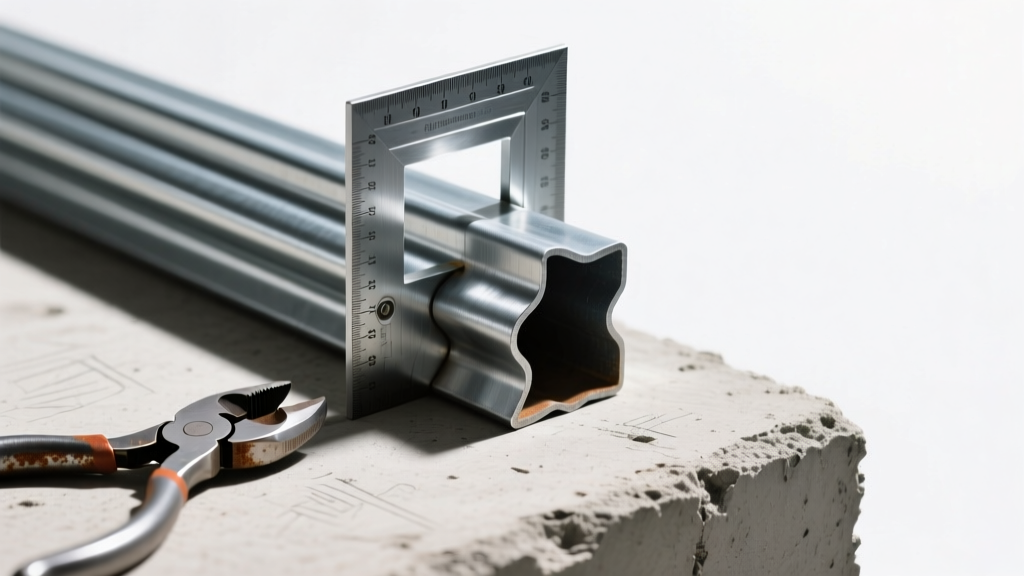
When transitioning from light gauge studs to structural Hollow Structural Sections (HSS) or wide-flange beams, speed squares are insufficient. The American Institute of Steel Construction (AISC) mandates strict tolerances for beam cope marks and weld preparation layouts. For these applications, utilize a traditional 24-inch L-shaped steel framing square (rafter square). The 2-inch wide blade provides a stable base for soapstone markers or silver pencils on rough mill-scale surfaces, while the 24-inch length allows for squaring across wide HSS tubes (e.g., 8x8 or 10x10 profiles).
Expert Insight: When marking structural HSS tubes for moment connections, never use the stamped graduation marks on the inside of a traditional L-square as a scribe guide. The stamping process creates a microscopic concave channel that will deflect a sharp scribe tip by up to 1/32-inch. Always scribe from the un-stamped outer edge of the blade to maintain AISC layout tolerances.
Calibration and Maintenance Protocol
Steel framing squares are subjected to extreme job site abuse. Dropping a solid steel square onto a concrete slab can alter the 90-degree angle by fractions of a degree, which compounds into significant errors over a 40-foot wall run.
- The Factory Edge Test: Once a month, test your square against a known factory-machined edge (such as the table of a cold-saw or a verified granite surface plate). Draw a line, flip the square 180 degrees, and draw a second line from the exact same origin point. If the lines diverge, the square is warped.
- Galvanic Corrosion Prevention: If using an aluminum-bodied square with a steel magnetic strip, wipe the tool down weekly. The dissimilar metals, combined with job site moisture, can cause galvanic corrosion that pits the registration lip, ruining the flush fit against the stud flange.
- Scribe Groove Cleaning: Metal shavings and zinc dust from galvanized studs will pack into the scribe notches. Use a wire brush to clear these notches daily; packed debris will offset your scribe mark by 1/16-inch, leading to misaligned track installations.
Final Procurement Specifications
When outfitting a commercial framing crew, standardizing on a single, high-quality magnetic steel framing square reduces layout errors and material waste. Specify squares with N52 neodymium magnets, a minimum 1/8-inch continuous scribe notch array, and a machined registration lip. Avoid multi-purpose plastic hybrids; the rigidity of hardened steel or thick extruded aluminum is non-negotiable for maintaining the tight tolerances demanded by modern light gauge steel framing systems.
Written by
Marcus ChenMarcus Chen is a licensed structural engineer (PE) and building materials analyst with over 12 years of experience across residential, commercial, and industrial construction. He holds a Master of Science in Civil Engineering from UC Berkeley and spent six years at Thornton Tomasetti before transitioning to independent consulting and technical writing. Marcus specializes in material selection for seismic-prone regions, concrete reinforcement strategies, and lifecycle cost analysis. His work has been cited by the American Concrete Institute (ACI) and the Structural Engineers Association of California (SEAOC). When he is not on a job site or at his desk, you will find him hiking the Sierra Nevada or restoring a 1920s craftsman bungalow in Oakland, CA.
More from Marcus Chen
View all
Construction Cost
How Much Did the Eiffel Tower Cost to Build?
How much did the Eiffel Tower cost to build in 1889? We adjust for inflation and compare its budget to modern skyscraper construction.
Aug 4, 2026

Fire Resistance
What Is a Fire Resistant Material? Testing & Certification Guide
Discover what is a fire resistant material through ASTM and UL testing. Learn how fire ratings, certifications, and assemblies work in construction.
Aug 4, 2026

Construction Cost
How Much Did the Burj Khalifa Cost to Build?
How much did the Burj Khalifa cost to build? We break down the $1.5B project and extract 5 money-saving strategies for your next build.
Jul 30, 2026